
What the day feels like
The beach is your highway here. At first light, the tide pulls back like a curtain and reveals a runway of hard-packed sand—Seventy-Five Mile Beach—running arrow-straight up the spine of K’gari (Fraser Island) in Great Sandy National Park. The Pacific exhales in steady sets that slap the shore with blue muscle. Gulls patrol the wind. A dingo slips out of the casuarinas, pauses to appraise you, then melts into the tea-tree shadows as if the island itself has waved it along. This is a place that moves, reworks, reshapes—sand sliding, freshwater spilling, forest advancing one root at a time. The island makes the rules; you adapt or turn back.
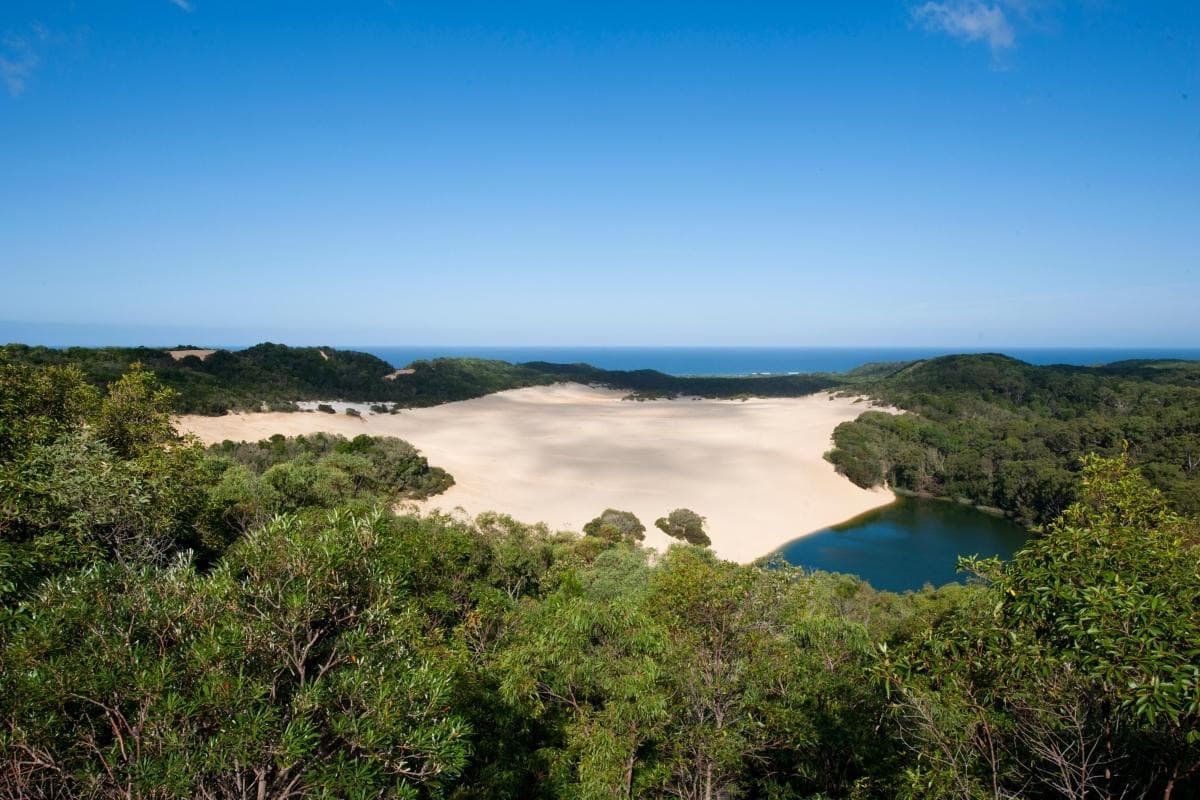
The practical magic of Great Sandy begins with water. More than 40 perched lakes—world-rare pools held aloft in layers of compressed organic matter—dot K’gari’s interior. Lake McKenzie is the showstopper, a bowl of azure over sugar-white silica that squeaks underfoot. Slide in and the lake greets you like a mirror: cool, clear, precise. The rainforest around Central Station pushes up through sand in defiance of botany, its satinay giants shouldering aside logic while the Wanggoolba Creek runs so transparent it feels like time has been turned down to a whisper. On the eastern edge, Eli Creek shoots toward the sea, daring you to float its current from the boardwalk to the beach while the tide hurries your exit.
The name K’gari—meaning “paradise”—comes from the Butchulla people, who have stewarded this island for millennia. Their three laws are still echoed on ranger signs: what’s good for the land comes first; if you have plenty, you must share; and don’t take what doesn’t belong to you. It’s a succinct checklist for modern visitors. The island’s UNESCO World Heritage status (1992) recognizes a rare fusion: an immense dynamic sandmass where rainforests cling to dunes, long beaches act as roads, and freshwater filters clean through the island’s core.
Geology writes the plot. Sand carried north by longshore drift gathers here in grand volume, sculpted by wind and weather into dune fields and plateaus. Perched lakes form where organic layers become watertight, catching rain like a cupped hand. Inland tracks thread between ridges in soft sand that swallows a lazy throttle. On the coast, shipwrecks stand as punctuation marks: the SS Maheno, flensed of its grandeur and rusted to a skeletal frame, lets the Pacific edit it wave by wave.
Most travelers launch from Hervey Bay or Rainbow Beach, catching a barge from River Heads or Inskip Point. The shift is instant: asphalt gives way to sand, schedules to tides. On K’gari, you time your day to low-water windows. The beach is its calmest when the ocean has pulled back, and that’s when you move—north to the Maheno, farther to Indian Head where the rock refuses erosion, and on to the Champagne Pools where waves fizz into basalt bowls safe from the open sea’s undertow and sharks. Inland, the road narrows to a single lane of ruts and roots. The forest breathes cool shadows. Pile Valley is a corridor of satinay and brush box, trees that feel like elders holding court.
K’gari doesn’t oversell itself. It doesn’t need to. The island rewards humility: deflate your tires, read the tides, respect the dingoes. When you follow those rules, the park opens generously. Humpback whales roll offshore from July through October, lifting barnacled heads and spraying plumes you can see from Indian Head’s lookout. At dusk, the dunes hold the day’s heat while the sky turns a watercolor—peach into orange into bruise-purple—and the beach road empties, leaving only the hush of surf and the wingbeat of unseen birds.
It’s easy to romanticize a place where rainforest grows in sand and lakes float above sea level, but K’gari is honest about what it asks of you. Bring water—more than you think. The sun is assertive, and shade can be a negotiation. Wear sturdy footwear for boardwalks, hot sand, and root-latticed tracks. If you’re driving, a high-clearance 4WD with recovery gear isn’t optional; it’s your vote of confidence when a patch of sugared sand tries to keep you. And remember: this isn’t a swimming beach. The Pacific here is muscular with rips and roving sharks. Save your dips for the lakes, Eli Creek’s quick glide, or the natural fizz of the Champagne Pools.
Stay overnight and the island shifts from tour-day rhythm to its own nocturne. Camp on the sand behind dingo-safe fences, or settle into established sites in the forest, where nightjars call and the Milky Way compromises the idea of sleep. Wake early for Lake McKenzie before the day’s footprints—its surface is most glass-like under a cool morning sky. Hike the short rainforest loops near Central Station to catch Wanggoolba Creek pushing forward in immaculate silence. Or if time is short, focus on the island’s greatest hits: Eli Creek’s float, Maheno’s iron bones at low tide, Indian Head’s cliff-top lookout when the sea is calm enough to reveal turtles, rays, and shadowy sharks tracing the reef line.
The best part? Great Sandy National Park offers adventure on your terms. Let a guided tour manage the tides and the logistics if you want to simply admire the island’s choreography. Or take the wheel, study the charts, and let the day unfold with the ocean’s clock. Either way, the island holds its ground, quietly at work, moving sand grain by grain—reminding you that here, you’re the one passing through.
Trail wisdom
Small choices, better day.
Time Your Drive to the Tides
Plan beach driving within two hours of low tide for firm sand and safer run-outs; avoid soft, cut-up sections near the high-tide line.
Deflate for Soft Sand
Drop tire pressure to around 18–22 psi before hitting beach or inland tracks; carry a compressor to reinflate before the barge or highway.
Swim Smart—Ocean Is Not a Pool
Skip ocean swims due to rips and sharks; choose Lake McKenzie, Eli Creek, or Champagne Pools for safe, refreshing dips.
Dingo-Safe Camping
Store food securely, keep children within arm’s reach, and never feed wildlife; use fenced camps or designated sites.
Local knowledge
Read the place, not just the route.
Watch for native species including Dingoes, Humpback whales (offshore in season).
Keep an eye out for wildlife during the transition between areas and habitats. Respect distance guidelines.
As a World Heritage site, K’gari’s perched lakes are highly sensitive—avoid soaps and minimize sunscreen in the water. Stay on marked tracks to protect fragile dune vegetation.
Follow the guide's instructions on size limits, ethical handling, and leave-no-trace practices.
Pile Valley’s satinay forest loop for a quiet rainforest walk. Sunrise at Lake McKenzie before tour groups arrive
Locally recommended viewpoints and quiet spots known best to local operators.
The Butchulla people are the island’s Traditional Owners; K’gari’s name means “paradise.” The SS Maheno ran aground here in 1935 and remains a photogenic shipwreck landmark.
Maritime roots and regional tradition shape the waterways and working coasts.
Seasonal guide
Four versions of the same landscape.
Spring
Best forWarm lake swims · Whale watching (early season)
ChallengesOccasional strong winds · Increasing crowds
Spring brings warming days and clear water, ideal for lakes and scenic drives along the beach.
Summer
Best forLong daylight hours · Lush rainforest shade
ChallengesHeat and humidity · Storms and possible cyclones · Biting insects
Expect hot, stormy conditions; start early, hydrate well, and plan indoor or shaded breaks at midday.
Fall
Best forQuieter trails · Stable weather
ChallengesShorter daylight for long drives
Autumn often means settled seas and fewer crowds—great for lake time and relaxed camp nights.
Winter
Best forMild temps for hiking and driving · Peak whale season
ChallengesCooler water · Crisp nights
Winter is comfortable for full-day touring and elevated lookouts; pack an extra layer for cool evenings.
Pack with intention
What to bring.
Good to know
Common questions.
Yes. A high-clearance 4WD is required for both beach and inland sand tracks unless you join a guided tour that provides vehicles.
Plan the edges
The details that make the day easier.
K’gari (Fraser Island) is the world’s largest sand island and contains more than 40 perched lakes—rain-fed bodies of water held above the water table by compacted organic layers.
Refuel on the Hervey Bay Esplanade with locally caught fish and a cold beer, or grab takeaway fish and chips at Urangan Boat Harbour and watch the sunset over the marina. If you’re returning via Rainbow Beach, a classic country pub meal and coastal lookout stroll cap the day.
- Closest airport
- Hervey Bay (HVB). Barges depart River Heads (near Hervey Bay) and Inskip Point (near Rainbow Beach). Driving: River Heads is ~20–30 minutes from Hervey Bay; once on K’gari, all travel is on sand. Cell service: Intermittent—expect black spots inland and along the beach. Permits: Vehicle access and camping permits are required; check Queensland Parks for current conditions and closures.
This World Heritage sand island relies on pristine freshwater systems—pack out all waste, avoid soaps in lakes and creeks, and keep a respectful distance from wildlife, especially dingoes.
Explore by topic
Follow the threads.
Keep exploring
Make the story part of the trip.
Set out from Bass Harbor for a private, customizable day on Blue Hill Bay — lighthouses, puffins, seals, and the chance to feel Acadia from the water. Small groups, local captains, unforgettable views.
In four hours you can move from shaded canyon ferns to wind-scoured coastal ridgelines, guided by someone who knows where the light—and the hidden views—live. This private half-day hike on the Monterey Peninsula or Big Sur is compact, curated, and perfect for travelers who want depth without a multiday commitment.
 Related story
Beneath a sky of shifting light, Skaftafell’s ice reads like a map of time. This three-hour guided glacier hike mixes technical instruction with geology and culture: compact, safe, and unforgettable.