
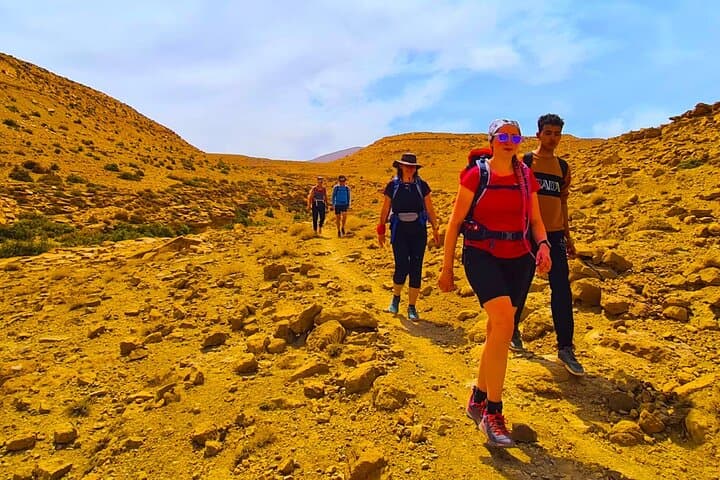
What the day feels like
By the time you slide your pack over your shoulders and step off the narrow lane that hugs the Todra, the canyon announces itself not with fanfare but with the sound of walls. Limestone cliffs rise like rust-red cathedral sails—faces scored by seasons, glistening where seepage has traced silver lines. The river dares you to come closer, a ribbon of green and stone threading the canyon floor. For the next three hours you walk in the shadow of those walls and in the living shadow of Berber life: orchards, nomadic tents, and low, mud-brick homes that open to mint tea and conversation.
This is not the crowded, paved slot of the main tourist viewpoint. Led by locals born in the High Atlas foothills, the Todra Gorge Hiking Adventure peels the place open: a short, purposeful trail that mixes riverbed walking, a little scrambling across boulders, and quiet detours into terraces and family compounds most visitors miss. The listed duration—195 minutes—feels right: long enough to move into the landscape’s rhythm, short enough to keep the day’s energy for whatever market, kasbah, or rooftop café awaits back in Tinerhir.
Geology is easy to read here. The Todra River has carved its way through folded limestone for millennia; narrow passages give way to courtyards of light, and the cliff faces are known locally and internationally to rock climbers for pitches that run hundreds of meters. Culturally it’s a hinge between nomadic traditions and settled oasis life: date palms and small fields irrigated by ancient khettaras (underground channels) contrast with the portable shelters of transhumant families. Your guide will point out these systems and, if you’re lucky, invite you into a home for tea—a gesture that explains why this hike feels less like a checklist and more like an actual exchange.
Why go? For the intimacy. The gorge’s main road gives you the postcard—this walk gives you the paragraph behind it. You’ll hear the cadence of Tamazight, taste mint tea brewed over a single glowing coil of charcoal, and see a sun-bleached goat tethered under a palm. At roughly 6–8 km (4–5 miles) of walking with about 200 m of cumulative elevation change, the terrain favors sturdy boots over fashion sneakers: river-worn rock, slippery sand where shade meets water, and a handful of short scrambles around collapsed blocks. It’s accessible for regular hikers but offers satisfying variety: quiet grove sections, narrow slot corridors, and exposed viewpoints where the canyon opens and the Atlas ridge watches from the distance.
Practicalities matter here. The tour is priced from about $36 USD, runs roughly 3 hours and 15 minutes, and is run by local guides—meaning your visit directly supports families who live in the gorge. The walk is best in spring or fall when temperatures are mild; summer brings intense heat in the open sections, and winter nights can be unexpectedly cold. Bring a guide if you want to visit homes: they bridge language and etiquette, and their introductions are part of what makes this experience authentic rather than intrusive.
Small details change a trip from pleasant to memorable. Pause often—there’s a quality of light trapped between the walls that will vanish if you march. Ask about irrigation routes and the seasonality of crops; the landscape and the rhythms of daily work are intimately connected here. Respect requests for no photos inside homes. And if a Berber family offers you bread and olives, accept: the exchange is the point.
For photographers, the canyon is a study in contrasts—deep shade, sudden shafts of light, and cliff faces that sing in warm tones at golden hour. Use a polarizer to deepen the sky and keep a mid-range zoom to capture both portrait moments in doorways and the vastness of the walls.
You’ll leave the gorge with more than a few images; you’ll carry a better sense of how a community persists in a landscape that is at once protective and demanding. It’s a short, precise adventure: enough to change the way you read Morocco’s mountains without requiring a week of technical climbing or a long acclimatization. It’s, in every sense, an earned view that begins and ends with human connections.
The practical: pack sun protection and a 1–2 liter water supply, wear ankle-supporting footwear, and plan the hike into a day that allows you to relax afterward in Tinerhir. If you go mid-week outside of high summer, the canyon has a quieter, more private feel—perfect for conversation you won’t get at the main overlook.
Bottom line: If you want a concentrated dose of geology, culture, and honest walking—served by local guides who know the families and the footpaths—this Todra Gorge hike is an efficient, richly rewarding way to experience southeastern Morocco’s High Atlas foothills.
Trail wisdom
Small choices, better day.
Walk the riverbed with care
River stones can be slick—wear grippy hiking shoes and take poles if you’re unsteady.
Carry at least 1 liter of water
There’s hot sun in exposed sections and sparse shade; hydrate before and during the hike.
Bring cash for tea and tips
Small bills in Moroccan dirham are appreciated for household visits and guide gratuities.
Respect private spaces
Ask before photographing inside homes; guides will facilitate introductions when appropriate.
Local knowledge
Read the place, not just the route.
Watch for native species including Barbary sheep, Various migrant birds such as wheatears.
Keep an eye out for wildlife during the transition between areas and habitats. Respect distance guidelines.
Support local guides and avoid single-use plastics; stick to existing paths and respect cultivated terraces to reduce erosion and disturbance.
Follow the guide's instructions on size limits, ethical handling, and leave-no-trace practices.
Small palm-grove terraces off the main road where locals grow figs and pomegranates. A quiet alcove near the gorge’s upstream rim with a view of the Atlas ridgeline
Locally recommended viewpoints and quiet spots known best to local operators.
Todra Gorge sits at the eastern end of the High Atlas—its limestone walls were carved over millennia by the Todra River and have long been home to Berber communities.
Maritime roots and regional tradition shape the waterways and working coasts.
Seasonal guide
Four versions of the same landscape.
Spring
Best forWildflower displays · Moderate temperatures · Comfortable river flow
ChallengesOccasional muddy patches after rain · Cool mornings
Spring is ideal—flowers and moderate temps make walking pleasant and the river lively without the heat of summer.
Summer
Best forLong daylight hours · Post-harvest date markets · Climbing opportunities for pros
ChallengesIntense midday heat in exposed sections · Sparse shade
Summer can be hot in the canyon’s open stretches; start early and avoid mid-afternoon heat.
Fall
Best forClear skies · Crisper air for photography · Local harvests and fresh produce
ChallengesCooler nights · Potential for sudden wind in the gorge
Fall mirrors spring’s comfortable conditions with warm afternoons and cooler mornings—good for late-season travelers.
Winter
Best forQuiet trails · Dramatic low-angle light · Low crowds
ChallengesCold temperatures at dawn and dusk · Possible rain making river crossings trickier
Winter visits are quiet and dramatic but require warm layers and care after rain when surfaces are slippery.
Operator details
What the booking data adds.
Included
- ✓Bottled water
- ✓Only tea that can be served in a nomadic camp
- ✓Local Gift from Todgha Gorge
Not included
- —Private transportation
Good to know
- ✓Suitable for all physical fitness levels
Pack with intention
What to bring.
Good to know
Common questions.
The guided experience runs about 195 minutes (roughly 3–3.5 hours) over 6–8 km with moderate undulation—suitable for hikers with stable ankles and basic fitness.
Plan the edges
The details that make the day easier.
Todra Gorge’s vertical cliffs reach up to about 300 meters (nearly 1,000 feet) in places and have made the area a renowned destination for rock climbers.
After the hike, head to Tinerhir for a slow tagine and freshly squeezed orange juice; try local dates and visit a rooftop café to watch the light fade over the palm groves—ask your guide for a recommended family-run restaurant.
- Closest airport
- Errachidia (ERH) or drive from Marrakech; Nearest town: Tinerhir (15–20 min drive to trailhead); Cell service: intermittent in the gorge; Permits: none required for day visits; Operator notes: private tours and free cancellation are offered on the listed booking page.
This hike is community-run—support local families by accepting hosted tea respectfully, avoiding single-use plastics, and staying on established routes to protect fragile terraces and riparian habitat.
Explore by topic
Follow the threads.
Keep exploring
Make the story part of the trip.
Set out from Bass Harbor for a private, customizable day on Blue Hill Bay — lighthouses, puffins, seals, and the chance to feel Acadia from the water. Small groups, local captains, unforgettable views.
In four hours you can move from shaded canyon ferns to wind-scoured coastal ridgelines, guided by someone who knows where the light—and the hidden views—live. This private half-day hike on the Monterey Peninsula or Big Sur is compact, curated, and perfect for travelers who want depth without a multiday commitment.
 Related story
Beneath a sky of shifting light, Skaftafell’s ice reads like a map of time. This three-hour guided glacier hike mixes technical instruction with geology and culture: compact, safe, and unforgettable.