
What the day feels like
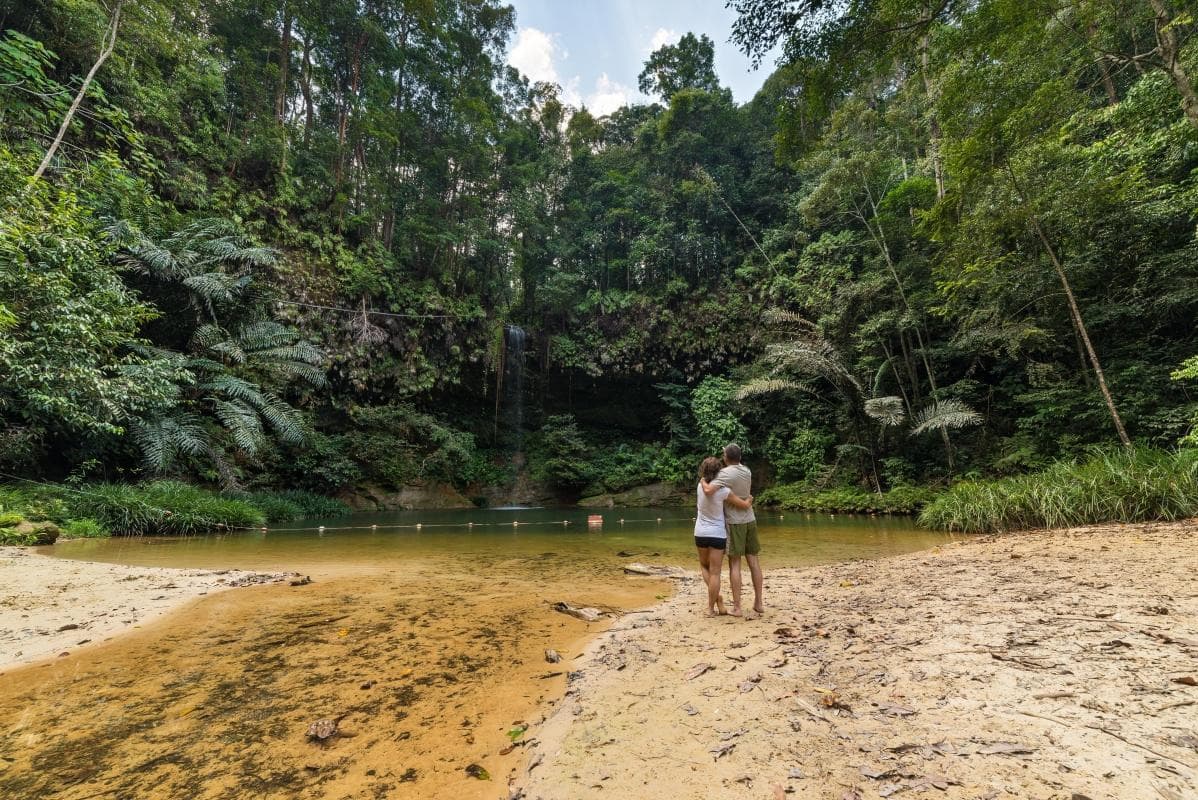
You step off the battered minivan and the air changes—becomes cooler, thicker, full of damp green. The road from Miri has been a ribbon of palm and oil-palm flats, but here the trees pull together like the walls of a cathedral. Light filters through a thousand different leaf shapes; water runs somewhere underneath, conspiring with gravity to bring you toward a waterfall. This is Lambir Hills National Park, a compact, sweating pocket of Borneo rainforest that manages, in a few hours, to feel endless.
Lambir sits about 36 km south-west of Miri on the Miri–Bintulu road and covers roughly 6,950 hectares (about 17,180 acres). Within that space, it’s been repeatedly measured as one of the richest plant communities on Earth—an archive of species stacked vertically and laterally across ridges, gullies, and stream corridors. The park’s forest breathes in humid exhalations; vines stitch the understory to massive dipterocarps, and gibbons broadcast their high, clarion calls from the canopy. Streams dare you closer with the promise of plunge pools cold enough to make your skin tingle.
History and geology here are plain in the rock and root. The underlying substrate—ancient sandstone—has been scored by time into ridges and gullies that channel the rain into waterfalls and pools. Local communities and early conservationists recognized the area’s value decades ago; Lambir became a protected area in the later 20th century and has since been a focus for botanists and birders who come to measure, catalog, and marvel at its biodiversity.
The human story that threads the park is quieter: small Malay and indigenous communities in the greater Miri region have long used the forest for seasonal harvesting, and today local guides bring a practical intimacy to visits—pointing out strangler figs, medicinal leaves, and the telltale spoor of a barking deer. For travelers, that local knowledge turns a hike into an education: the plants become characters, the birds have backstories.
There are two ways most visitors experience Lambir. One is the gentle, immersive local tour—the Half-Day Lambir Hills National Park Tour from Miri—that packages a guided walk, a birdwatching sweep, and a rope through the steady current of a waterfall swim. The other is a longer Nature Excursion & Trekking itinerary that leans into exploration: longer trails, a picnic by a stream, and a better chance of stumbling upon monkeys, flying squirrels, or stately hornbills.
Trails vary. You can choose short loops that lead quickly to a series of shady pools and a dripping cascade, or you can commit to a few hours of climbing that push you into the ridgelines where viewpoints open and the forest feels thinner, more exposed to wind and sky. Expect roots and rocks, slippery stones after rain, and the occasional steep step. The reward is always the same: the sound of water, the sudden flush of color from a bird, the cool slap of a jungle pool.
Practical edges matter here. Timing makes the difference between a crisp, bug-conscious morning crawl and a swampy slog. Most operators and park staff advise starting early—before midmorning heat and the day’s rain cells build. Guides are recommended (and included in many half-day tours); they read the forest in ways you won’t, pointing out rare plants, listening for canopy activity, and keeping a careful eye on stream levels. Bring water—at least 1–2 liters per person—wear grippy shoes, and keep valuables dry: a plastic bag or lightweight dry sack is simple and effective. If you plan to swim, a quick-dry towel and a change of clothes make the afternoon more comfortable.
The wildlife here is not shy if you move quietly. Gibbons scream from the canopy, hornbills wing through high corridors, and the small, nocturnal flying squirrels manifest like brief, moonlit ghosts at dusk. For birders, the park’s species list is satisfying; for botanists or serious plant lovers, the density of species and the presence of unusual understory orchids and ferns is the real draw.
Safety and conservation overlap. Trails can become treacherous after heavy rain—water surges and slick rocks are the usual hazards—so the rule is simple: respect the weather and the guide’s judgement. Stick to trails and boardwalks where they exist, take your litter back to Miri if necessary, and leave the forest as you found it. The park is small but ecologically precious; the best way to experience Lambir is to leave it little changed.
If you’re planning a visit from Miri, you can book a half-day run that includes transport, or take a longer nature excursion for a deeper day in the forest. Either way, be ready to walk, to slow down, and to listen. Lambir’s pleasures are mostly unflashy—an unexpected splash of color in the canopy, the hollow sound of a gong-like bird call across the valley, the cool, clean slap of water as you climb back out of a pool. It isn’t about summiting a peak or ticking a famous viewpoint off a list; it’s about letting the forest rearrange your sense of time.
Practical tip: aim for the dry window between June and August for the most stable trail conditions, but carry rain protection year-round. Hire a local guide through your tour operator or the park office; they’ll translate the place into something you can read and remember. Come with curiosity and leave with the memory of a green cathedral—quiet, urgent, and very much alive.
Trail wisdom
Small choices, better day.
Start before dawn
Morning light is best for wildlife, trails are cooler, and streams are safer before afternoon rains build.
Wear grippy footwear
Trails are rooty and rocks become slippery when wet—trail shoes with good tread are a must.
Bring a local guide
Guides read the forest, point out rare species, and know safe routes and stream conditions.
Keep valuables dry
A small dry sack or zip-top bag protects camera gear and electronics from humidity and waterfall spray.
Local knowledge
Read the place, not just the route.
Watch for native species including gibbons, hornbills.
Keep an eye out for wildlife during the transition between areas and habitats. Respect distance guidelines.
The park supports long-term ecological research; visitors are encouraged to stick to trails, carry out waste, and follow guides' instructions to limit impact.
Follow the guide's instructions on size limits, ethical handling, and leave-no-trace practices.
Small plunge pools below the main cascades—often quieter in mid-afternoon. Less-used side loops that climb to ridge viewpoints for forest panoramas
Locally recommended viewpoints and quiet spots known best to local operators.
Lambir was designated a protected area in the later 20th century and has been important for botanical research and biodiversity inventories.
Maritime roots and regional tradition shape the waterways and working coasts.
Seasonal guide
Four versions of the same landscape.
Spring
Best forbirdwatching · wildflower spotting · short hikes
Challengesintermittent showers · higher humidity
Spring (Mar–May) brings active birdlife and fresh growth; be prepared for sudden, heavy showers and sticky air.
Summer
Best fordrier trails · waterfall swims · longer treks
Challengesheat and midday humidity · increased insect activity
Summer (Jun–Aug) is often the most reliable for stable trails and comfortable swims, but mornings are still the smartest hiking window.
Fall
Best forfruiting trees and wildlife activity · photography of dramatic skies
Challengesoccasional storms as monsoon approaches · muddy sections after rain
Fall (Sep–Nov) sees fruiting in forest trees and active mammals; watch for sudden storms and slick trail patches.
Winter
Best forlush rainforest scenes · short guided walks
Challengesheaviest rains and swollen streams · some trails may be closed
Winter (Dec–Feb) coincides with the wettest months—expect heavy rain, strong currents in streams, and potentially impassable sections.
Pack with intention
What to bring.
Good to know
Common questions.
Guides are not strictly required for a casual short walk, but they are highly recommended—especially for longer treks, wildlife spotting, and safety around streams.
Plan the edges
The details that make the day easier.
Lambir Hills National Park’s roughly 6,950 hectares have been cited in scientific surveys as containing some of the world’s highest local plant biodiversity—making it a research hotspot for botanists.
Pair a Lambir day trip with a night in Miri—sample Sarawak laksa, fresh seafood, and the vibrant Tamu (market) where locals sell fruit and snacks; local guides often share knowledge of edible plants and traditional uses.
- Distance from Miri
- ~36 km; Time required: half-day to full-day; Transport: tour transfer or private car; Facilities: park office, basic toilets; Book: half-day or longer guided tours available from Miri.
Support local guides, stay on trails, avoid single-use plastics, and don’t remove plants or wildlife—Lambir’s global ecological value relies on low-impact visitation.
Explore by topic
Follow the threads.
Keep exploring
Make the story part of the trip.
Set out from Bass Harbor for a private, customizable day on Blue Hill Bay — lighthouses, puffins, seals, and the chance to feel Acadia from the water. Small groups, local captains, unforgettable views.
In four hours you can move from shaded canyon ferns to wind-scoured coastal ridgelines, guided by someone who knows where the light—and the hidden views—live. This private half-day hike on the Monterey Peninsula or Big Sur is compact, curated, and perfect for travelers who want depth without a multiday commitment.
 Related story
Beneath a sky of shifting light, Skaftafell’s ice reads like a map of time. This three-hour guided glacier hike mixes technical instruction with geology and culture: compact, safe, and unforgettable.