
What the day feels like
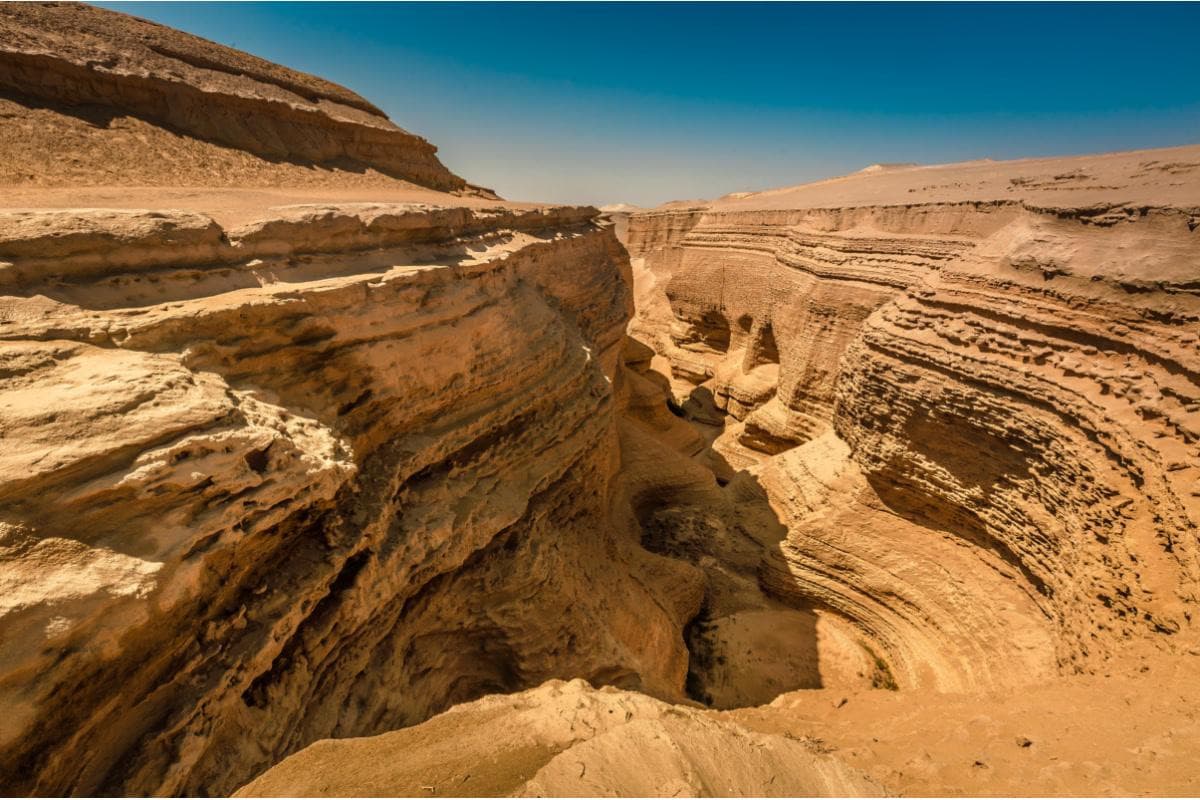
You can feel it before you see it: the desert hush that shrinks the world down to the steady sound of your breath and the click of boots against packed sand. Then the earth opens. From a windswept viewpoint the Cañón de los Perdidos — a jagged fissure some 150 meters deep and roughly three kilometers long — slices the horizon like a wound in the coastal plain. Sunlight pulls the canyon walls into bands of ochre and pink, and the wind sculpts thin finials that look as if a giant hand carved them yesterday.
Most visitors arrive from Huacachina or the city of Ica on a half- or full-day tour; others come as part of a longer coastal road trip that threads pisco vineyards, desert lagoons and the Nazca lines into a single, off‑beat itinerary. Guides point out the layers of sediment that tell a surprising story: these dry hills were once seabed, and the canyon walls keep the fossils to prove it. Look closely and you’ll find the white outlines of shells and the shadows of long-extinct marine life, each fossil a quiet, tangible line to another era.
The Canyon of the Lost was only put on the travel map in the 1980s, discovered locally and opened by guides eager to show the layers of Ica’s hidden natural history. Standing on the rim, it’s easy to understand why the canyon has been associated with misdirection and mystery — its narrow tracks and labyrinth of side fissures make it a place where you can easily believe people and time get lost.
Geologically it’s a study in contrasts. The canyon is a sedimentary scar, carved by ancient water and wind rather than steep alpine uplift. Vegetation is sparse — cacti, saltbush and a few tenacious shrubs — but the canyon’s ecology is lively: red-headed vultures wheel above thermal currents, seeking thermals that ripple off the sunlit ridges; small reptiles dart over sunbaked stone; and, in hidden hollows, desert-adapted birds find shade.
Culturally the canyon sits in Ica, a region famous for its wine, pisco and the unmistakable oasis town of Huacachina. Many of the local tours combine a canyon walk with a visit to an artisanal winery — a welcome mix of exertion and reward. Guides here are storytellers as much as pathfinders: they interpret the fossils, read the canyon’s layers, and explain how this coastal desert went from seabed to sand in a sweep of geologic time.
Practical details matter here more than romanticism. Most guided routes are straightforward day hikes: expect 2–5 hours on site depending on your group and itinerary, with short sections of scrambling and a couple hundred meters of cumulative elevation change as you move from rim to floor and back. Trails are loose, sandy and occasionally rocky; the canyon’s interior throws down simple technical challenges — narrow gullies, steep scree slopes and a few crumbly ledges. Guides will typically lead groups from scenic viewpoints down a sedimentary road into the main gorge, taking time to point out marine fossils and to visit the small desert lagoons known locally as Ojos de Agua.
If you go: aim for early morning or late afternoon. The desert’s thermal rhythm makes midday hot and relentless; early light brings cooler temps and cleaner air, while late afternoon paints the canyon walls amber. Hydration is non-negotiable — bring at least 2 liters for a half-day, more if you plan to roam — and sun protection is essential: the reflected heat off sandstone is punishing.
Footwear should be sturdy and grippy; the best shoes have predictable traction for sandy descents and rocky scrambles. A light daypack, wind layer and hat are the basics. Most organized tours include pickup from Huacachina or Ica, a bilingual guide, and sometimes extras like wine or pisco tastings on return, making this a high-value day that pairs natural history with local flavor.
For photographers the canyon is generous: morning side-light reveals textures, mid-day clears the distant lines of the desert, and golden hour saturates the reds and browns. Bring a wide-angle for the rim panoramas and a short telephoto to compress the canyon’s layers and pick out fossil seams. Drone use is subject to local restrictions — check with your operator to avoid disturbing wildlife.
Conservation here is a practical matter. Fossils embedded in canyon walls are non-renewable; resist the urge to chip fragments free as souvenirs. Local guides work with communities to manage visitor flow and protect sensitive spots, and many tours support small wineries and family-owned farms that keep the local economy tied to responsible tourism.
In a place that feels designed to unroot you — a deep, narrow crack in one of Peru’s most emblematic deserts — the Cañón de los Perdidos offers something rarer than vistas: a compact lesson in time. Walk slowly enough and you’ll see how wind and water have read the strata like pages; pause and you’ll find traces of the sea and of lives that adapted to a merciless landscape. When the sun dips low and the canyon cools, the desert seems to breathe again, as if the lost were only resting, waiting for the next group of travelers to find their way in.
Trail wisdom
Small choices, better day.
Start at first light
Morning hikes avoid the desert’s fiercest heat and bring softer side-light that reveals the canyon’s textures.
Pack extra water
Bring at least 2 liters per person for a half-day; there is no reliable water source in the canyon.
Wear grippy shoes
Choose trail shoes with good traction for sandy descents and loose scree sections.
Respect fossils
Do not remove or chip fossils from the canyon walls; take photos and leave the geology intact.
Local knowledge
Read the place, not just the route.
Watch for native species including red-headed vulture (Andean and coastal scavengers), desert lizards and small passerine birds.
Keep an eye out for wildlife during the transition between areas and habitats. Respect distance guidelines.
Local operators emphasize leave-no-trace practices and avoid removing fossils; supporting guided visits helps preserve fragile sites and benefits nearby communities.
Follow the guide's instructions on size limits, ethical handling, and leave-no-trace practices.
Ojos de Agua — small desert lagoons tucked near the canyon floor. Local artisanal wineries on return routes offering pisco and wine tastings
Locally recommended viewpoints and quiet spots known best to local operators.
The canyon was put on the tourist map in the 1980s; its walls contain marine fossils that reveal the coastal plain’s ancient life as seabed.
Maritime roots and regional tradition shape the waterways and working coasts.
Seasonal guide
Four versions of the same landscape.
Spring
Best formild temperatures · fewer crowds
Challengesvariable winds · strong sun in midday
Spring brings mild mornings and cooling evenings; expect gusty afternoons and excellent conditions for daytime exploration.
Summer
Best forlong daylight · clear skies
Challengeshot afternoons · intense UV
Peru’s coastal summer (Dec–Mar) is warmer and can be quite hot midday — early starts are crucial to avoid heat stress.
Fall
Best forgolden light · stable weather
Challengescooler mornings · less consistent water access
Fall offers stable weather and excellent afternoon color; pack a light layer for cooler early mornings.
Winter
Best fordry clarity · pisco and winery visits
Challengescold mornings · strong daytime sun
Peru’s dry winter (May–Sept) is widely regarded as the best time: crisp air, minimal humidity and superb visibility.
Pack with intention
What to bring.
Good to know
Common questions.
Most routes cover the main gorge of about 3 km in length; allow 2–5 hours depending on stops, photos and side hikes.
Plan the edges
The details that make the day easier.
The canyon walls contain marine fossils showing that the Ica desert was once part of the Pacific seabed millions of years ago — fossil evidence that helped scientists reconstruct ancient coastal changes.
Pair your walk with Ica’s culinary staples: artisanal pisco tastings, local wine from family bodegas and the sandboard-and-buggy culture of Huacachina; many tour operators include a winery stop for a well-earned tasting.
- Nearest base
- Huacachina or Ica (3–50 min transfer to canyon depending on route). Typical tours: half-day to full-day with hotel pickup. Bring sun protection, cash for tastings and allow 2–5 hours on-site.
Respect fossil sites by not collecting specimens, stay on established trails to avoid erosion, and choose local guides to ensure tourism dollars support conservation and community livelihoods.
Explore by topic
Follow the threads.
Keep exploring
Make the story part of the trip.
Set out from Bass Harbor for a private, customizable day on Blue Hill Bay — lighthouses, puffins, seals, and the chance to feel Acadia from the water. Small groups, local captains, unforgettable views.
In four hours you can move from shaded canyon ferns to wind-scoured coastal ridgelines, guided by someone who knows where the light—and the hidden views—live. This private half-day hike on the Monterey Peninsula or Big Sur is compact, curated, and perfect for travelers who want depth without a multiday commitment.
 Related story
Beneath a sky of shifting light, Skaftafell’s ice reads like a map of time. This three-hour guided glacier hike mixes technical instruction with geology and culture: compact, safe, and unforgettable.