
What the day feels like
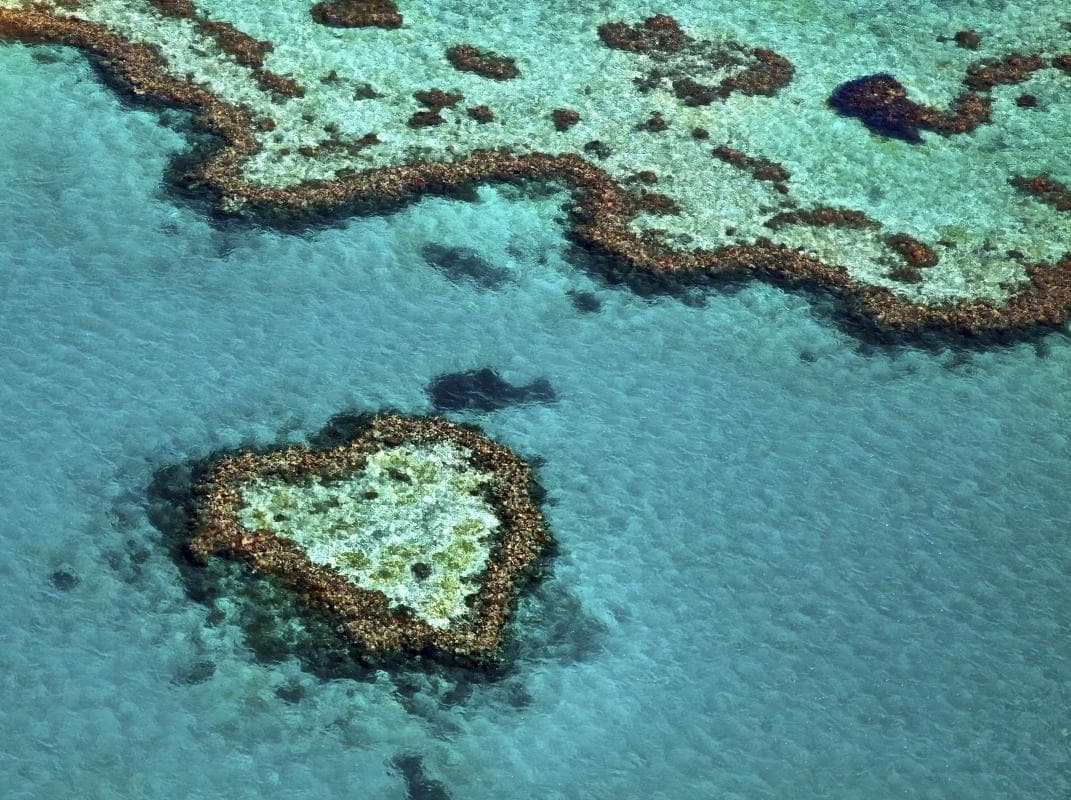
The helicopter rises and the world rearranges itself beneath you: sugar-white beaches unspooling like ribbon, the slow blue of open ocean, and then, impossibly framed in the shallows, a perfect heart stitched from coral. Heart Reef doesn’t reveal itself like a mountain summit or a canyon rim where you can hike and claim the view; it demands an aerial oath. Up here the reef is a small, heartbreakingly precise punctuation mark in a massive seascape—one of those natural curiosities that feels engineered to be photographed, then quietly says, don’t try to keep it.
From the deck at Airlie Beach the Whitsunday islands look like a scattered handful of emeralds. But the real poetry of this place is how its geology and oceanography write themselves across the surface: tides carving silica sand into the ghostly swirls of Hill Inlet; currents nourishing coral gardens that hum with life; and a reef architecture shaped by millions of years of coral growth and sea-level change. Heart Reef sits on Hardy Reef, part of the fringing reef systems that fringe the Great Barrier Reef. Seen close-up, its living coral is delicate and complex; seen from above, it becomes a graphic symbol that has come to represent the entire Whitsunday experience.
There is history here too. The Whitsundays are on the traditional sea-country of the Ngaro people—mariners and island custodians whose knowledge of tides, fish, and stars sustained them for millennia. European exploration brought charting and commerce, and later tourism. The modern story is complicated: these reefs support a fragile ecosystem and a tourism economy that must balance access with protection. What you experience as a traveler—whether in a small fixed-wing scenic flight, a helicopter loop, or a boat-based snorkeling excursion—is the outcome of that ongoing negotiation.
How you see Heart Reef shapes the trip. The simplest and most dramatic is a 60-minute scenic flight over the Whitsundays: fixed-wing aircraft with large windows, live pilot commentary and a steady, cinematic sweep past Whitehaven Beach and Hill Inlet before the pilot banks over Hardy Reef and you get your first view of the heart. Helicopter tours are more intimate—there are one-hour flights that circle the reef, and longer 2.5-hour helicopter itineraries that combine a Whitehaven Beach landing with cold drinks and a closer look at the islands before you fly past Heart Reef. If you prefer to feel the ocean beneath your boots, fly-raft packages and ocean-rafting combos let you pair an early aerial look with a boat-based snorkel on the reef and a walk across Whitehaven’s silica sands.
Each format highlights different strengths of the Whitsundays. The plane is wide-open, stable and economical; the chopper is cinematic and immediate; the raft or crewed vessel gives you time in the water and on the beaches—where you’ll notice the finer textures of the place: the coral architecture close-up, the scrubby coastal forests that harbor the occasional rock wallaby, or the way the silica sand squeaks when you pick it up.
Practicalities make the trip better. Flights depart daily from Whitsunday Airport, near Airlie Beach; helicopters leave from nearby pads with strict weight limits (usually around 130 kg/seat and combined caps). Morning light is often best—calmer seas and cleaner air make for superior visibility and photographs. Book early for midwinter months (June–August) when clear skies and cooler, dry weather are typical. If you choose a reef encounter by boat, bring reef-safe sunscreen and a light stinger suit in summer months (box jellyfish protocols still apply in northern Queensland).
For those planning the logistics: a combined scenic flight and raft day makes for the most efficient Whitsunday day—fly over Heart Reef first to get the sweeping view, then land on a beach or join a snorkel site to see what's under the water. If you’ve only got one hour—choose the helicopter for sheer drama. If you want slow immersion—choose the Reefworld or full-day reef options that include snorkeling from an anchored platform and access to underwater viewing facilities.
Conservation is never far from the itinerary. The Great Barrier Reef Marine Park Authority manages access and activity in the area; operators are licensed and most follow best-practice reef stewardship to limit anchor damage, control waste, and brief guests on not touching coral. That stewardship matters: the reef is resilient but stressed by warming waters and storms. Your choices—using reef-safe sunscreen, keeping a respectful distance from marine life, and opting for operators who demonstrate sustainable practices—make a measurable difference.
Travel here is equal parts spectacle and responsibility. Floating above Heart Reef you understand why people fall in love with this corner of the world—and why it’s worth protecting. The view is ephemeral: tide, light and cloud conspire to change it. But a well-timed flight, a mindful snorkel, and a quiet walk on Whitehaven will give you the full narrative: an ocean that dares you to look closer, reefs that push back with fragile complexity, and islands that keep their secrets until you approach them from the air.
If you go, do so with a camera, patience, and a curiosity for the science behind the sight. Then leave something of your own: a lighter footprint and a willingness to learn how to be a better temporary custodian of this very public, very delicate heart of the sea.
Trail wisdom
Small choices, better day.
Book morning flights
Visibility is usually clearest early; aim for the first or second departure to avoid haze and midday heat.
Respect helicopter weight limits
Tours often cap individual and combined passenger weight—declare accurate weights when you book to avoid last-minute changes.
Use reef-safe sunscreen
Choose mineral-based sunscreen and apply before boarding to protect coral from harmful chemicals.
Bring binoculars and a polarizing filter
Binoculars enhance island views; a polarizer reduces surface glare for better aerial and snorkeling photos.
Local knowledge
Read the place, not just the route.
Watch for native species including green sea turtle, humpback whale (seasonal, Jun–Sep for migration).
Keep an eye out for wildlife during the transition between areas and habitats. Respect distance guidelines.
Activities are regulated by the Great Barrier Reef Marine Park Authority; choose operators that use moorings, provide education, and follow reef protection protocols.
Follow the guide's instructions on size limits, ethical handling, and leave-no-trace practices.
Hill Inlet lookout on Whitsunday Island for wind-sculpted sand patterns. Reefworld underwater observatory at Hardy Reef for dry viewing of coral life
Locally recommended viewpoints and quiet spots known best to local operators.
The Whitsundays are on the traditional sea-country of the Ngaro people, who navigated these islands long before European mapping and modern tourism.
Maritime roots and regional tradition shape the waterways and working coasts.
Seasonal guide
Four versions of the same landscape.
Spring
Best forcalmer seas · wildlife sightings · clear aerial views
Challengesoccasional showers · variable winds
Spring (Sep–Nov) brings warmer water and longer days—good for snorkeling and aerial photography, but watch for changing weather fronts.
Summer
Best forlively coral display · warm water snorkeling · long daylight hours
Challengesstinger season (box jellyfish) · higher humidity and storms
Summer (Dec–Feb) is hot and humid with stinger season in full swing—wear a stinger suit and heed operator guidance.
Fall
Best forstill waters · fewer crowds than peak winter · good visibility
Challengesresidual summer heat · occasional tropical systems
Autumn (Mar–May) offers warm seas and good snorkeling; keep an eye on cyclone-season advisories early in the season.
Winter
Best forclear skies · mild temperatures · excellent flight conditions
Challengescooler mornings · busy tourist season
Winter (Jun–Aug) is the dry season—crisp air and calm seas make for ideal scenic flights and photography, but book early.
Pack with intention
What to bring.
Good to know
Common questions.
No—Heart Reef is a living coral formation and protected; viewing is strictly from the air. Landings are made on beaches like Whitehaven, not on coral.
Plan the edges
The details that make the day easier.
Heart Reef is part of Hardy Reef and is naturally formed coral that has been shaped by tidal and wave action into a heart-like pattern—its shape is visible only from the air.
Airlie Beach is a relaxed gateway town with seafood-focused cafés, reef-knowledgeable guides, and a friendly cruising culture—try local reef fish dishes and chat with guides about reef conservation.
- Departure hub
- Whitsunday Airport
- Airlie Beach. Best access
- scenic flights and helicopter transfers. Time needed: 1–6 hours depending on tour. Bookings recommended in peak season (Jun–Aug). Weight limits: apply for helicopters.
Pick operators who use moorings, brief guests on reef etiquette, and participate in reef-monitoring—small choices reduce anchor damage and stress to coral communities.
Explore by topic
Follow the threads.
Keep exploring
Make the story part of the trip.
Set out from Bass Harbor for a private, customizable day on Blue Hill Bay — lighthouses, puffins, seals, and the chance to feel Acadia from the water. Small groups, local captains, unforgettable views.
In four hours you can move from shaded canyon ferns to wind-scoured coastal ridgelines, guided by someone who knows where the light—and the hidden views—live. This private half-day hike on the Monterey Peninsula or Big Sur is compact, curated, and perfect for travelers who want depth without a multiday commitment.
 Related story
Beneath a sky of shifting light, Skaftafell’s ice reads like a map of time. This three-hour guided glacier hike mixes technical instruction with geology and culture: compact, safe, and unforgettable.