
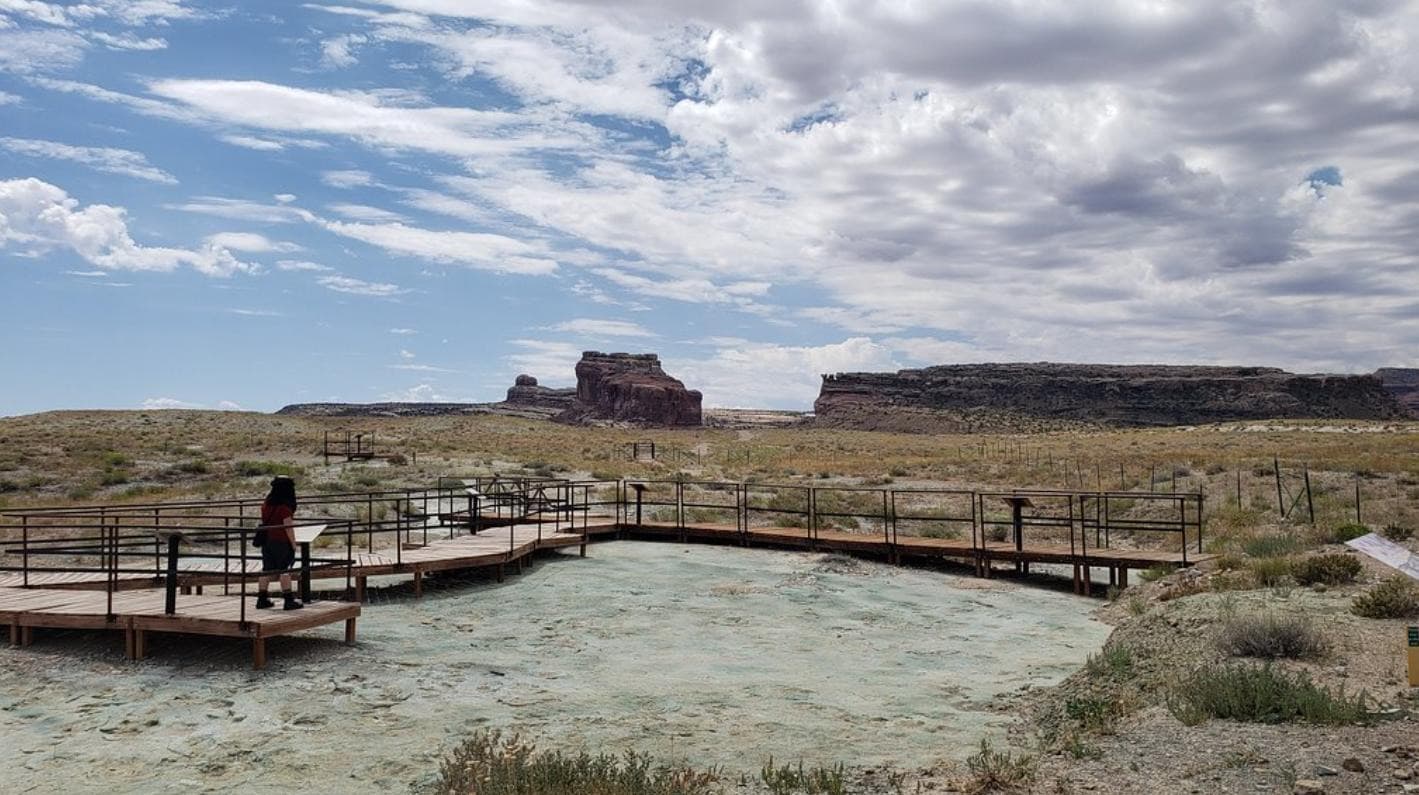
What the day feels like
By the time the first light slides over the La Sal Mountains, the sandstone in Mill Canyon is already warming. You can feel it under your boots — a slow, ancient heat that comes from stones baked by millennia and preserved in layers of red and cream. Walk a few paces and the ground changes from loose sand to a natural showroom: shallow depressions, elongated ellipses, and clawed impressions that read like a long-forgotten script. These are not weathered potholes but real dinosaur trackways, frozen in the Jurassic and waiting for the careful observer.
Mill Canyon Dinosaur Trail is a compact, unmistakable piece of paleontological theater tucked a short drive from Moab, Utah. It’s not a sweeping canyon carved over eons or a cliffside gallery of petroglyphs; it’s a set of small outcrops where fossilized footprints are visible at eye level. That intimacy is its charm. You can kneel beside a theropod print and study the three-toed symmetry, or trace a sauropod’s weighty pad across a slab of sandstone and imagine the slow, heavy gait that made it. The trail is the kind of place that makes the geological timescale feel less abstract — these impressions are tangible interruptions in the present.
Geology and history are braided here. The track-bearing slabs date to the Jurassic period, the same era that produced giants across what is now the American West. Over millions of years, rivers deposited sand and silt that later lithified into sandstone; periodic wetting and drying preserved footprints, which minerals then cemented into durable casts. In the 20th century, amateur paleontologists and local guides began documenting these surfaces, bringing attention to their scientific value while also building a modest trail for visitors. Unlike large fossil quarries, Mill Canyon has stayed low-key: a high-value, low-footfall site where context and care are crucial.
This is not a white-glove museum; it’s a desert hiking experience with a museum-grade surprise. The trail is short — roughly 1.5–2 miles round-trip — with minimal elevation gain (a few hundred feet at most). The path alternates between packed dirt, slickrock slabs, and short sections of loose rock. It’s an easy outing in terms of exertion, but it rewards slow walking and close attention rather than speed. You’ll want to move deliberately: crouch, shift perspective, photograph prints from low angles to preserve scale. Ultimately, the gift here is time — time to stand in a pocket of ancient life and to read the marks left by creatures that once dominated this landscape.
Local culture in Moab leans hard into outdoor stewardship: climbers, mountain bikers, and desert lovers all share a civic understanding that tracks, nests, and rock art must be respected. That ethic matters here because a careless fingernail or boot can scrub away delicate surfaces that took millions of years to form. Park signage and local interpreters will ask you not to step on the prints and to stay on designated paths. It’s sensible advice — and a small obligation for an experience that feels, in its humility, like a privilege.
Practicalities are straightforward but worth planning. Early morning or late afternoon provides the best light for photography and the softest temperatures; mid-summer can be brutally hot. Carry at least 1–2 liters of water per person for a short visit, wear sturdy shoes with decent traction for slickrock transitions, and pack sun protection: the high desert sun is direct and the shade is sparse.
If you’re visiting from Moab, the trail is an easy half-hour drive and makes for a perfect half-day excursion combined with other nearby sites. Families can do it; it’s a great way to introduce kids to paleontology without museum barriers. For more seasoned adventurers, pair the visit with a longer hike or a scenic drive along Mill Canyon Road. Guides and tour operators in Moab can add context and might point out lesser-known trackways or interpretive specimens nearby, but you’ll get a lot from simply being present and observant.
Conservation and etiquette underpin the visit. The prints are irreplaceable; even touching them alters the surface oils and can accelerate weathering. Photography is encouraged — just don’t use chalk, climbing aids, or any adhesive for scale. Leave the rock as you found it. If you want to learn more, plan a stop at local museums in Moab that feature curated fossil finds and more in-depth interpretation.
Why go? Mill Canyon is one of those rare sites where science, landscape, and storytelling converge in an accessible way. It’s an efficient, low-impact outing that offers a high-return payoff: the chance to read an ancient moment beneath your feet. You come for the prints, but you often leave with a clearer sense of deep time, of how this red rock has recorded life and change. It’s the kind of trail that insists you slow down — and that’s exactly the point.
Plan for sunrise light, bring good shoes, and allow an hour or two to explore and photograph. Keep to the path, savor the details, and treat the slabs like a library of the long-gone past. Mill Canyon doesn’t shout. It invites a quiet, thoughtful curiosity, and that invitation is well worth accepting.
Trail wisdom
Small choices, better day.
Respect the prints
Stay on the marked trail and avoid stepping on or touching fossilized footprints — oils and abrasion accelerate deterioration.
Bring ample water
Even for a short visit, carry at least 1–2 liters per person; shade is limited and summer temperatures climb quickly.
Wear grippy shoes
Traction on slickrock and uneven slabs matters more than ankle support — opt for sturdy hiking shoes with sticky soles.
Time for light
Visit at sunrise or late afternoon for the best shadows to reveal footprint contours and to avoid midday heat.
Local knowledge
Read the place, not just the route.
Watch for native species including Mule deer, Common desert lizards and ravens.
Keep an eye out for wildlife during the transition between areas and habitats. Respect distance guidelines.
Visitors are asked to practice Leave No Trace: stay on established paths, don’t touch or remove fossils, and pack out all trash to protect the fragile desert ecosystem.
Follow the guide's instructions on size limits, ethical handling, and leave-no-trace practices.
Small outcrops and undisrupted slabs just off the main path often show finer, lesser-known tracks — look but don’t touch. Combine the trail with a short stop at a nearby roadside overlook for wide desert panoramas and birdwatching
Locally recommended viewpoints and quiet spots known best to local operators.
The trackways in Mill Canyon are preserved in Jurassic-age sandstone and were first documented by local researchers and rockhounds in the 20th century; their discovery helped draw attention to the region’s paleontological record.
Maritime roots and regional tradition shape the waterways and working coasts.
Seasonal guide
Four versions of the same landscape.
Spring
Best forWildflower displays · Comfortable daytime temps · Photography at golden hour
ChallengesOccasional wind · Cool mornings and evenings
Spring offers mild temperatures and blooming desert plants; plan for brisk starts and stronger winds in exposed areas.
Summer
Best forLong daylight hours · Pairing with early-morning outings · Low chance of rain
ChallengesHigh heat · Strong sun exposure · Limited shade
Summer brings intense heat — aim for pre-dawn visits and bring extra water and sun protection to avoid heat stress.
Fall
Best forStable weather · Pleasant hiking temps · Clear skies for photos
ChallengesShortening daylight · Cooler nights
Fall is ideal for comfortable hiking and crisp light; mornings can be cool so layer up for early starts.
Winter
Best forQuiet trails · Crisp clear air · Photography with low-angle sun
ChallengesCold snaps · Occasional icy patches on slickrock
Winter visits are quiet and striking, but be prepared for cold mornings and the potential for slickrock frost or ice.
Pack with intention
What to bring.
Good to know
Common questions.
The trail is short — roughly 1.5–2 miles round-trip depending on route choices — and typically takes 1–2 hours including stops for observation.
Plan the edges
The details that make the day easier.
Mill Canyon preserves visible dinosaur trackways in Jurassic sandstone — these fossilized footprints are direct evidence of dinosaur activity preserved in the sedimentary record.
Moab’s local scene blends outdoor grit with casual hospitality: grab breakfast tacos and strong coffee before a morning visit, and celebrate the sunset later with local craft beer and trail stories—locals prize conservation-minded visitors who leave no trace.
- Distance
- ~1.5–2 miles round-trip; Difficulty: easy; Time: 1–2 hours; Best time: sunrise or late afternoon; Facilities: limited—bring water and sun protection.
Protect the fossil surfaces by staying on marked paths and avoiding contact with track-bearing slabs; support local conservation groups that fund interpretive signage and trail maintenance.
Explore by topic
Follow the threads.
Keep exploring
Make the story part of the trip.
Set out from Bass Harbor for a private, customizable day on Blue Hill Bay — lighthouses, puffins, seals, and the chance to feel Acadia from the water. Small groups, local captains, unforgettable views.
In four hours you can move from shaded canyon ferns to wind-scoured coastal ridgelines, guided by someone who knows where the light—and the hidden views—live. This private half-day hike on the Monterey Peninsula or Big Sur is compact, curated, and perfect for travelers who want depth without a multiday commitment.
 Related story
Beneath a sky of shifting light, Skaftafell’s ice reads like a map of time. This three-hour guided glacier hike mixes technical instruction with geology and culture: compact, safe, and unforgettable.