
What the day feels like
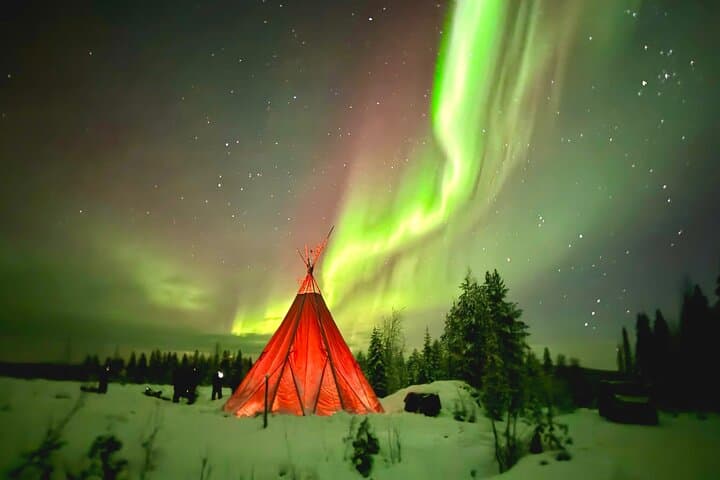
The night arrives like a rehearsal. Pale daylight slips away and the pines exhale cold against your cheeks. You are driven away from Rovaniemi's sodium-lit streets into a black-sky theater where stars and silence hold court. A small clearing appears, a simple campfire sputtering at its center, and for the next three hours the landscape simplifies to warmth, companionship, and the possibility of color overhead. When the aurora wakes, it does not hurry. It unfurls—green ribbons, then curtains, sometimes a sudden surge of violet—moving as if the sky itself is breathing. You cup a steaming mug, roast a sausage over the blaze, and feel the rare luxury of being the only small audience under an immense Arctic sky.
This private Northern Lights tour at the campfire is a compact, deliberately intimate way to experience one of nature's most theatrical phenomena. It is not about ticking a box or wrestling for a photo spot. It is about lowering your pace until the horizon and the heavens come into a conversation you can listen to. The tour runs roughly three hours, typically beginning in the evening when darkness is full and the odds of aurora activity are highest. It is designed for people who want a private, low-effort way to chase the aurora without the logistics, and it tends to attract couples, families, and small groups celebrating something special.
There is history underfoot as well as above. Northern Lapland, with its boreal forests and frozen floodplains, bears the fingerprints of the last Ice Age. Glacial action left a soft, rounded terrain called a drumlin field and abundant wetlands that freeze glass-smooth in winter. Local culture is layered too: Rovaniemi sits at the crossroads of modern Finland and the indigenous Sámi world. Sámi people have read the lights for generations, attaching meanings to their colors and dances, and while this tour takes place in a contemporary setting the surrounding landscape is part of a living cultural tapestry. Guides will often share small local stories—about reindeer migration routes, midnight sun myths, or the role of the Arctic Circle in regional identity—so the aurora arrives as a guest of a place with deep roots.
The geology that allows for such clarity is simple and severe. Far from coastal humidity and lowland haze, Lapland offers long stretches of clear sky in winter. The region is dominated by taiga, a spruce-and-pine realm that holds snow like a memory; the white blanket enhances contrast, making aurora colors pop. Light pollution is the enemy, which is why the experience is staged away from town and why timing matters: moon phase, cloud cover, and solar activity all conspire to determine the show.
Practical advantages here are real. The tour is private and short: no multi-night commitment, no freezing stakeouts. For travelers pressed for time or who want guaranteed comfort, the campfire setup is a pragmatic choice. That said, the Arctic is uncompromising. Dress for extreme cold, bring a charged camera battery and tripod, and plan for intermittent cell service when you leave the urban grid. Expect a guide who knows how to read the forecast and who can pivot plans when clouds roll in. The experience is as much about preparation as it is about luck.
For photographers, the evening is a lesson in restraint and readiness. A fast lens, high ISO, and a tripod are the baseline; a patient eye for when the aurora shifts from a slow glow to a textured curtain will reward you with the best frames. For everyone else, the activity is an exercise in allowing nature to surprise you. There will be bursts of exhilaration—a sudden flare that makes people cheer—and long pauses where the campfire and conversation are the night's centerpieces.
The cost reflects the private nature of the tour and the guided expertise, but it buys something intangible: privacy, warmth, and the slow luxury of being the only group in that clearing. For first-timers it removes the anxiety of self-navigation in Arctic conditions; for repeat aurora chasers it offers an uncomplicated, comfortable evening with a high potential payoff.
This experience is as responsible as it is evocative. Guides follow local rules about lighting fires, using sustainably sourced firewood, and minimizing impacts to habitat. Travelers can do their part by sticking to designated meeting points, packing out waste, and keeping noise to a respectful level so wildlife is not disturbed.
If you want an aurora night that feels like an event—simple, private, and staged to let the sky take the lead—this is a smart, efficient way to do it. You will leave with photos and perhaps a few soot-smudged marshmallows, but more importantly with the memory of a sky that moved like a living thing and a quiet sense of having been small, in the best possible way, under something enormous and beautiful.
Trail wisdom
Small choices, better day.
Dress in layers
Temperatures can plummet; base layers, insulating mid-layers, and a windproof outer shell keep you warm during long periods of stillness.
Bring a tripod and spare batteries
Cold drains batteries fast and hand-holding shots will blur; a small tripod and extra batteries are essential for aurora photography.
Mind your headlamp
Use a red-filtered headlamp to preserve night vision and avoid disturbing others when moving around the campfire.
Stay flexible on timing
Guides will choose the best clearing based on cloud cover and aurora forecasts; be ready to shift location for better visibility.
Local knowledge
Read the place, not just the route.
Watch for native species including Reindeer, Snowshoe hare.
Keep an eye out for wildlife during the transition between areas and habitats. Respect distance guidelines.
Guides prioritize low-impact practices such as using existing fire rings, sourcing local firewood responsibly, and minimizing light and noise to protect nocturnal wildlife.
Follow the guide's instructions on size limits, ethical handling, and leave-no-trace practices.
Drive a short way to a frozen riverbank for unobstructed northern horizons. Visit a local smoke sauna in Rovaniemi to warm up after the tour
Locally recommended viewpoints and quiet spots known best to local operators.
Rovaniemi became the administrative capital of Finnish Lapland after the town was rebuilt following World War II, and it has since marketed itself as the Arctic gateway and hometown of Santa Claus.
Maritime roots and regional tradition shape the waterways and working coasts.
Seasonal guide
Four versions of the same landscape.
Spring
Best forIncreasing daylight · Late-season aurora windows · Milder nights
ChallengesUnstable temperatures · Slushy access roads
Early spring keeps long aurora nights but edges toward milder weather; still cold at night and sometimes wet underfoot.
Summer
Best forMidnight sun experiences · Hiking and daylight activities
ChallengesNo aurora · 24-hour daylight
Summer in Rovaniemi is not suitable for aurora viewing because the midnight sun washes out night skies.
Fall
Best forClear, crisp nights · Fewer tourists · Good aurora chances after September
ChallengesUnpredictable storms · Shortening daylight
Autumn brings long nights and increasing auroral activity, but weather becomes more variable as the season progresses.
Winter
Best forPeak aurora season · Snow-covered landscapes · Classic Arctic atmosphere
ChallengesExtreme cold · Short days affecting other activities
Winter provides the longest, darkest nights perfect for aurora viewing, with typical temperatures well below freezing.
Operator details
What the booking data adds.
Included
- ✓Information about the Northern Lights
- ✓Pick-ups and drop-offs are included in the price in 10 km radius from Rovaniemi city center
- ✓A Tour Guide in English (other languages available on request: French, Spanish, Finnish)
- ✓Photos taken with your own device
- ✓Local Snacks & Drinks
- ✓Winter clothing (Adult & Child size), overalls, boots & gloves
- ✓Private tour only for your group
Not included
- —Please be ready and wait in your hotel lobby 10 minutes prior to your scheduled pickup time
- —Product may be cancelled or rescheduled in case of extreme weather conditions
Good to know
- ✓Specialized infant seats are available
- ✓Not recommended for travelers with poor cardiovascular health
- ✓Suitable for all physical fitness levels
Pack with intention
What to bring.
Good to know
Common questions.
While no operator can guarantee an aurora sighting, the tour is timed for peak dark hours and run with guides who track solar activity and local cloud cover to maximize your chances.
Plan the edges
The details that make the day easier.
Rovaniemi markets itself as the official hometown of Santa Claus and the Arctic Circle runs through the nearby Santa Claus Village, making the area a year-round tourist draw.
After the tour, head back to Rovaniemi for hearty Lappish cuisine—try reindeer stew and cloudberry jam at a local tavern, or warm up with craft beers at a neighborhood pub. For a cultural touch, visit the Arktikum museum to learn about regional history and Sámi culture.
- Closest airport
- Rovaniemi Airport (RVN). Typical drive to meeting point: 15–30 minutes from city center. Cell service: reliable near town, limited in remote clearings. Permits: none required for private guided tours but follow local access rules.
This area values dark-sky preservation; minimize artificial light, pack out all waste, and follow guide directions to protect fragile Arctic habitats.
Explore by topic
Follow the threads.
Keep exploring
Make the story part of the trip.
Set out from Bass Harbor for a private, customizable day on Blue Hill Bay — lighthouses, puffins, seals, and the chance to feel Acadia from the water. Small groups, local captains, unforgettable views.
In four hours you can move from shaded canyon ferns to wind-scoured coastal ridgelines, guided by someone who knows where the light—and the hidden views—live. This private half-day hike on the Monterey Peninsula or Big Sur is compact, curated, and perfect for travelers who want depth without a multiday commitment.
 Related story
Beneath a sky of shifting light, Skaftafell’s ice reads like a map of time. This three-hour guided glacier hike mixes technical instruction with geology and culture: compact, safe, and unforgettable.