
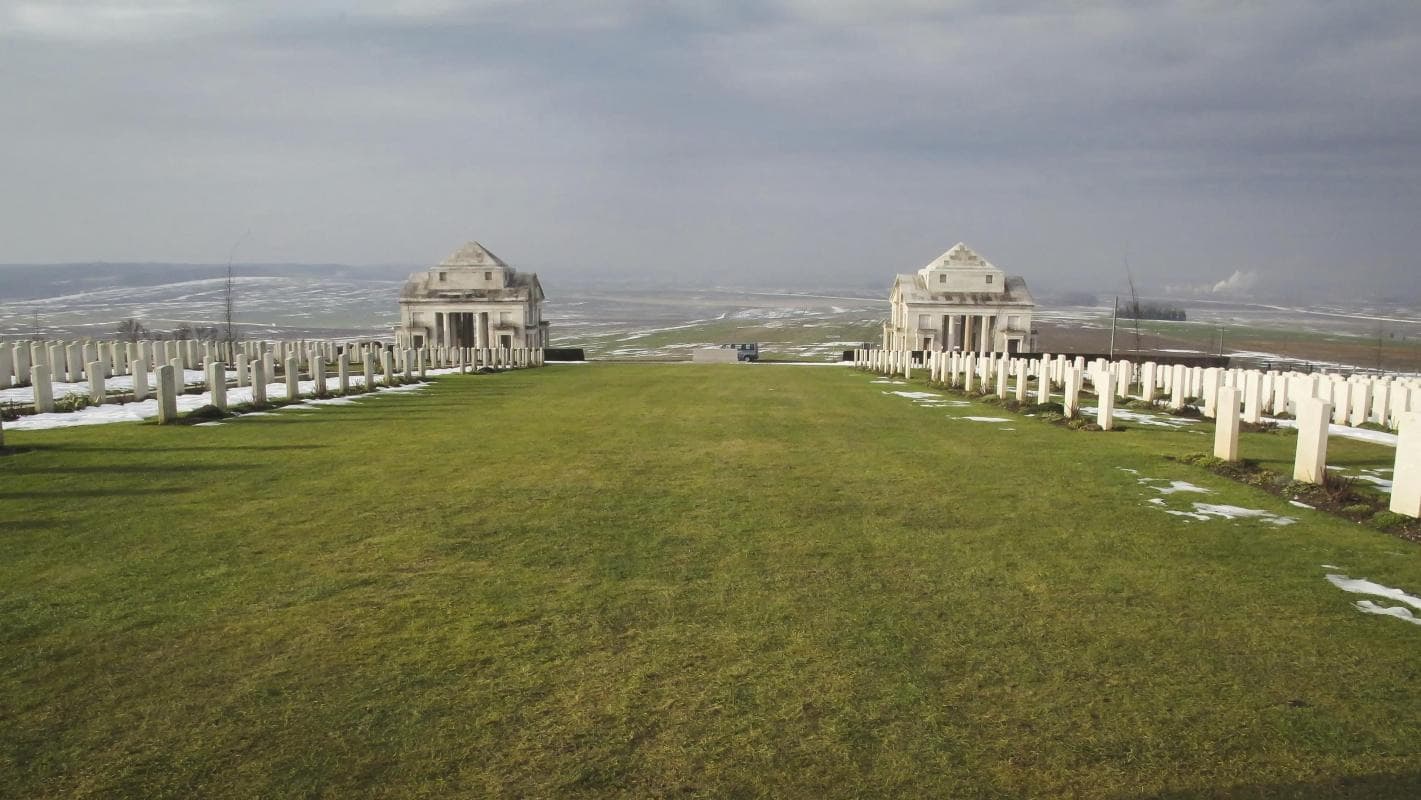
What the day feels like
You arrive before the buses, when the fields around Villers-Bretonneux are still stitched with morning mist and the bells of the town clock have only just begun to toll. The white of the headstones in the Australian National Memorial cemetery cuts a clean line across the green; dew beads on the carved names, and somewhere a skylark lifts its thin song. At the Sir John Monash Centre the glass façade reflects this quiet—an architecture of memory designed to hold stories as much as artifacts. This is not a dramatic alpine pass or crashing coastline; it’s a gentle landscape whose flatness makes the violence of 1918 feel all the more stark. You walk slowly because the ground asks it of you.
Villers-Bretonneux sits on the eastern fringe of Amiens in France’s Somme department. Its place in the Australian story of World War I is enormous: in April 1918 Australian troops helped halt the German Spring Offensive and later liberated the town. The Australian National Memorial here, with its imposing stone tower and wall of names, is a focal point. The Sir John Monash Centre, opened in 2018, provides a modern, emotionally intelligent interpretation—oral histories, maps, and multimedia that let you follow individual soldiers as well as entire units. Outside, the battle-scarred landscape softens into the pastoral—the very terrain that shaped tactics and allowed commanders to read lines and move machines.
Geologically there’s little drama: Somme’s low-lying chalk and clay fields, bisected by straight farm roads, made trench construction and movement of artillery predictable but brutally effective. Culturally, the area has long memories. Picardy villages like Villers-Bretonneux wear commemorations as a living part of daily life—ANZAC Day services in late April, carefully tended graves, and the quiet rituals practiced by descendants who visit. The town’s ties to Australia run deep; the memorial and the museum are not foreign impositions but woven into town identity.
What travelers experience here is as much interior as exterior. Guided tours—whether a day-trip from Paris or a private, personalized three-day itinerary—tend to follow a rhythm: museum interpretation, a walk among cemeteries and memorials, then a vantage point where you can look across fields to the distant line of trees and imagine the slow, mechanical advance of 1918. Key nearby sites include Le Hamel where Sir John Monash used coordinated infantry, tanks and artillery in a compact, effective operation; the Lochnagar Crater near La Boisselle, a yawning reminder of underground mining warfare; and Thiepval and Pozières, where the scale of the Somme campaign is made brutal and intimate at once.
Practically, a visit to Villers-Bretonneux is low-impact physically but high in emotional intensity. Distances on-site are short—expect several walks of 10–20 minutes between museum displays and cemeteries—but surfaces vary from tarmac paths to grassy slopes and muddy tracks after rain. Allow half a day for a focused visit to the Sir John Monash Centre and the memorial grounds; full-day or multi-day tours add other Somme sites and give space for reflection.
Timing is everything. Spring and early summer bring comfortable weather and flowering hedgerows; autumn offers clear light and longer shadows that make the fields feel cinematic. Winter’s cold and wind can be starkly beautiful, but road conditions and museum hours may be constrained. If you want to attend the Anzac Day dawn service (April 25), book well in advance—the town fills with Australians and families who come to commemorate.
On the ground, respect is the first rule: quiet voices, phones on silent, and observe signage. Museums in the area, including the Sir John Monash Centre and the Historial de la Grande Guerre in Péronne, do an excellent job of contextualizing artifacts—let them guide you rather than turning the sites into mere photo ops. Local guides who specialize in Australian battlefields offer invaluable nuance: they can put a father’s unit into a map of movement, locate a grave, or tailor an itinerary around a family story.
Transport is straightforward. Villers-Bretonneux is reachable by car from Amiens in about 20 minutes and from Paris in roughly two to two-and-a-half hours by car or organized tour. Trains to Amiens are regular from Paris Gare du Nord with local transfers or private pickups as common add-ons from tour operators. Several day-trip products run from Paris, Lille, Arras, and Amiens and vary from shared coach tours to private, bespoke drivers who can trace family histories.
Why come? Because Villers-Bretonneux is a place that asks you to look closely—at landscape, at loss, at the human scale of war. It’s accessible for most travelers, layered with narrative, and anchored by excellent interpretation. For anyone drawn to military history, family research, or quiet cultural pilgrimage, it’s one of the most thoughtful, humane sites on the Western Front.
To prepare: bring sturdy shoes for wet grass, a waterproof layer, and a respectful frame of mind. Plan for a half to full day, and if you’re connecting to other Somme sites, leave buffer time for reflective pauses. Whether you come as a historian, a descendant, or a curious traveler, Villers-Bretonneux will slow your pace and sharpen your attention—an experience that is at once sobering and necessary.
Trail wisdom
Small choices, better day.
Arrive early
Start before the mid-morning crowd to enjoy quieter, more contemplative visits to the Sir John Monash Centre and memorial grounds.
Dress for mud
Wear waterproof shoes—paths through cemeteries and fields get muddy after rain even when roads are fine.
Respectful photography
Photo rules vary by site—avoid close-ups of individual headstones unless family consent is visible; use wide framing for landscapes.
Book guided tours for family research
Choose private guides if you’re tracing a unit or ancestor—many operators will research records ahead of time.
Local knowledge
Read the place, not just the route.
Watch for native species including skylark, hare.
Keep an eye out for wildlife during the transition between areas and habitats. Respect distance guidelines.
Local sites balance memorial upkeep with agricultural use; visitors are asked to stay on paths and support local museums and guides who fund conservation efforts.
Follow the guide's instructions on size limits, ethical handling, and leave-no-trace practices.
The small war memorial gardens behind Villers-Bretonneux town hall for intimate reflection. Nearby Le Hamel village green—where tactical innovation is interpreted at a human scale
Locally recommended viewpoints and quiet spots known best to local operators.
Villers-Bretonneux was the site of fierce fighting in April 1918; Australian units helped recapture the town and the Australian National Memorial now honors those missing on the Western Front.
Maritime roots and regional tradition shape the waterways and working coasts.
Seasonal guide
Four versions of the same landscape.
Spring
Best formild weather · flowering hedgerows · ANZAC Day commemorations
Challengesunpredictable rain · Anzac Day crowds
Spring offers comfortable temperatures and vivid fields; book special events like Anzac Day well in advance.
Summer
Best forlong daylight · combined Somme itineraries · outdoor memorial visits
Challengeshigher tourist numbers · occasional heat waves
Summer is ideal for linking multiple sites but expect more visitors and plan for sun protection.
Fall
Best forclear light for photography · fewer crowds · crisp walking conditions
Challengesshorter days · cooler mornings
Autumn’s slant light and quieter roads make for thoughtful site visits and strong photos.
Winter
Best forsolemn atmosphere · off-season rates · museum interiors
Challengescold winds · reduced museum hours
Winter’s austerity suits reflective visits but check opening times and pack warm layers.
Pack with intention
What to bring.
Good to know
Common questions.
Allocate at least 3 hours for the Sir John Monash Centre and the memorial grounds; join a full-day tour to add nearby Somme sites.
Plan the edges
The details that make the day easier.
The Sir John Monash Centre at Villers-Bretonneux opened in 2018 and uses first-person accounts and digital displays to interpret Australian involvement on the Western Front.
Picardy hospitality pairs simple regional dishes—potage, pâté, and apple tarts—with cafés in nearby Amiens; visiting local bakeries and markets after a morning of memorials is a quiet way to process the visit.
- Nearest major hub
- Amiens (20 minutes by car). From Paris, expect ~2–2.5 hours by car or join an organized tour. Allow 3–6 hours on-site for museum and memorials. Free entry to Sir John Monash Centre.
Stick to marked paths, avoid picking flowers on graves, support local museums and guides, and consider slow travel—combine the Somme itinerary to reduce extra driving.
Explore by topic
Follow the threads.
Keep exploring
Make the story part of the trip.
Set out from Bass Harbor for a private, customizable day on Blue Hill Bay — lighthouses, puffins, seals, and the chance to feel Acadia from the water. Small groups, local captains, unforgettable views.
In four hours you can move from shaded canyon ferns to wind-scoured coastal ridgelines, guided by someone who knows where the light—and the hidden views—live. This private half-day hike on the Monterey Peninsula or Big Sur is compact, curated, and perfect for travelers who want depth without a multiday commitment.
 Related story
Beneath a sky of shifting light, Skaftafell’s ice reads like a map of time. This three-hour guided glacier hike mixes technical instruction with geology and culture: compact, safe, and unforgettable.