
What the day feels like
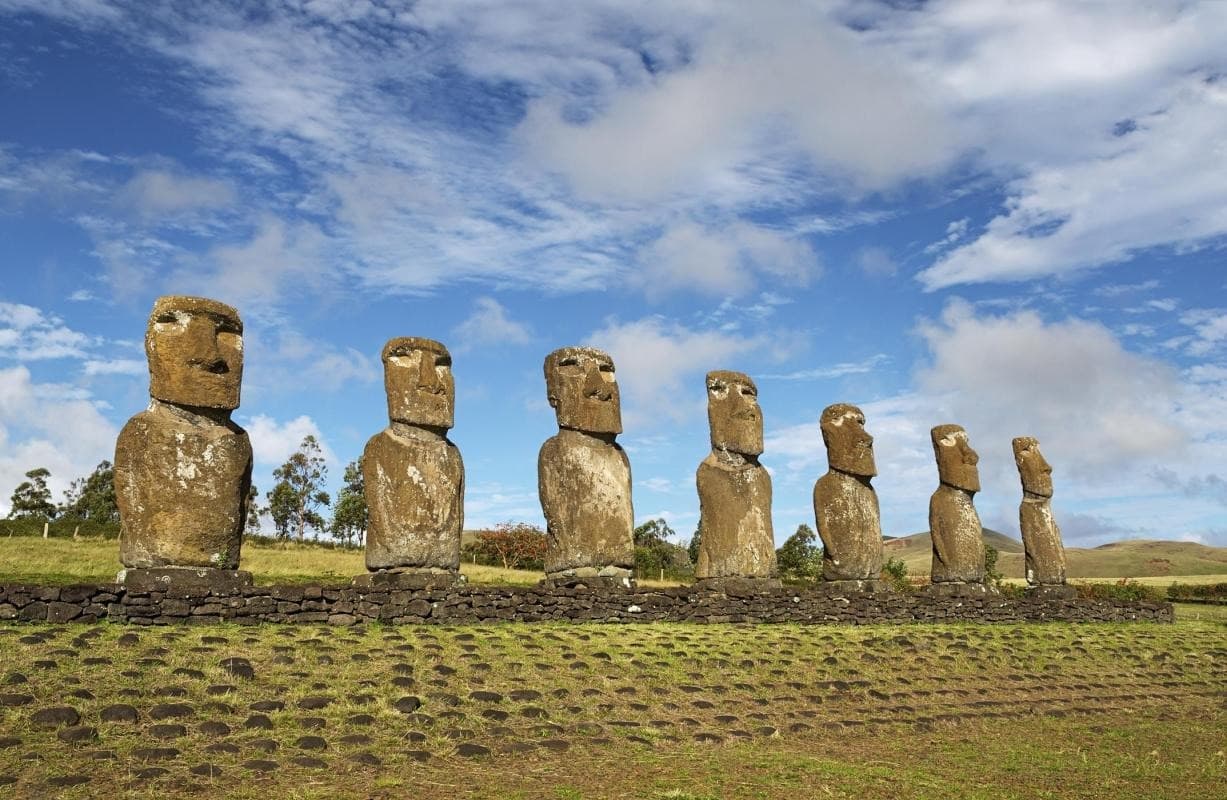
When light spills across the short grass plains west of Hanga Roa, seven silhouettes stand like punctuation against the thin horizon — stoic, weathered, and oddly personable. They are the moai of Ahu Akivi, hewn from volcanic tuff centuries ago, replanted here in the 20th century, and today one of the most approachable archaeological classrooms on Easter Island. Step close and the monumental stone heads feel less like relics and more like companions; they stare out toward the sea with an agency that makes the surf and wind around them feel like conspirators in an ancient story.
Ahu Akivi is atypical for Rapa Nui. Most moai look inland, guarding clan lands. These seven face the open ocean, sitting on a restored ahu (ceremonial stone platform) a little inland from the cliffs that ring the island. Oral histories say they represent the seven scouts sent by the founding chief Hotu Matu'a; archaeologists add layers of complexity — astronomical alignments, shifting political centers, and the island’s volcanic geology that supplied both the raw stone and the pigments for its early sculptors.
The setting is intimate. A short walk around the platform reveals working details: eye sockets that once held white coral and obsidian pupils; chisel marks on bodies hidden beneath the grass; and the way the statues are positioned with precision that suggests both cosmology and community. Pause and you’ll notice smaller things too — the black basalt fragments of old walls, the hint of petroglyphs at Puna Pau’s quarry nearby, and the distant silhouette of Rano Kau’s rim. It’s a place to think visually: how landscape, labor, and ritual were braided into a culture that turned rock into memory.
Geologically, Ahu Akivi and its neighbors are products of volcanic violence. Rapa Nui rises from the sea as a trio of eroded volcanoes; the island’s tuff and basalt provided the moai carvers with workable stone. Over centuries, the island’s society engineered remarkable feats — quarrying, transporting, and erecting statues weighing many tons across distances that still fuel lively debate. By the 17th and 18th centuries, internal conflict and environmental pressures changed the island’s social blueprint, and many ahu fell. The Ahu Akivi restoration in the 20th century was itself a cultural reclamation: a reconstruction that raises as many questions as it answers, but undeniably makes the moai legible to modern visitors.
Culturally, visiting Ahu Akivi is more than a photo stop; it’s a conversation with Rapa Nui’s present-day people. Guides — often local Rapa Nui — tell legends about Tangata Manu (the Birdman cult), the island’s shifting rituals, and the living language and customs that persist despite centuries of change. Many tours that include Ahu Akivi, from short half-day combinations (Ahu Tahai + Ahu Akivi) to multi-day archaeological circuits, prioritize time for story as much as scenery. That matters: the moai are symbols, but the stories and stewardship of the island are what keep them meaningful.
Practicalities make Ahu Akivi a perfect first stop for any Rapa Nui itinerary. The site is flat and accessible, rarely requiring more than a short stroll from the vehicle. Half-day tours commonly run 2–3 hours and often pair Ahu Akivi with Puna Pau (the red scoria quarry) and Tahai (handsome for sunset). Full-day and multi-day private options expand outward to Rano Raraku, Orongo, and Anakena beach, letting you see the moai’s production site, the Birdman ceremonial village, and the island’s best coastal light.
If you time it right you can have the place to yourself. Early morning catches the statues in cool, angled light and the wind softer; late afternoon yields gold for portraiture and longer shadows for dramatic compositions. Expect light to change fast; the island’s weather is oceanic and can shift from bright sun to overcast in minutes. Bring layers and plan for wind — the moai don’t mind, but you will.
What to expect on-site: relatively level walking around a restored ahu, interpretive markers, and local guides who will explain the archaeological debates and oral histories. Tours vary in depth. A 3-hour half-day tour is ideal if you have limited time; two-day archaeological circuits let you absorb the island’s full sequence: moai carving at Rano Raraku, the ceremony-scape of Orongo, and the restored platforms at Tahai and Ahu Akivi.
For photographers and curious travelers alike, Ahu Akivi rewards patience. Shoot wide to capture the moai and the ocean; move close to frame carved hands and weathered chisel marks; and don’t forget to include the ground-level details — coral eye sockets, volcanic cobbles, and the stitching of modern stonework used in restoration. Bring a polarizer for saturated skies and a windproof jacket for long exposures; the sea wind will test your tripod’s resolve.
Finally, approach Ahu Akivi with a light footprint. The island’s ecosystems are fragile, and Rapa Nui residents are protective of their landscapes. Stay on designated paths, respect the moai — don’t climb or touch — and choose locally run tours when possible. The best visits are those that leave the island as it was: a little more admired, not a bit more worn.
Ahu Akivi is accessible, enigmatic, and human-sized. It’s where Rapa Nui’s past feels immediate — carved faces that seem to watch the same ocean voyagers once did, a place that teaches you about endurance, skill, and the long arc of cultural memory. Plan a morning here as part of a longer archaeological circuit, or linger at sunset. Either way, the Seven Watchers will be there, patient and exacting, ready to make you part of the island’s next chapter.
Trail wisdom
Small choices, better day.
Aim for golden hour
Visit at sunrise or late afternoon for softer light and fewer crowds; the wind diminishes in the early morning.
Respect the ahu
Stay on paths and don’t climb or touch the moai — both archaeological conservation and local custom demand distance.
Pack wind protection
A light, windproof jacket makes waiting for the perfect shot or story comfortable.
Hire a local guide
Local guides add context on Rapa Nui legends, restoration history, and archaeological interpretation.
Local knowledge
Read the place, not just the route.
Watch for native species including Nazca booby (offshore), tropical seabirds and endemic landbirds.
Keep an eye out for wildlife during the transition between areas and habitats. Respect distance guidelines.
Rapa Nui’s sites are vulnerable to erosion and visitor impact; local organizations emphasize guided tours, designated paths, and limiting physical contact with moai.
Follow the guide's instructions on size limits, ethical handling, and leave-no-trace practices.
Puna Pau quarry — the source of the red pukao (topknots). Tahai at sunset — an intimate restored ceremonial complex
Locally recommended viewpoints and quiet spots known best to local operators.
Ahu Akivi is tied to oral traditions about the island’s founding; the seven moai are often linked to scouts sent by the legendary chief Hotu Matu'a.
Maritime roots and regional tradition shape the waterways and working coasts.
Seasonal guide
Four versions of the same landscape.
Spring
Best formilder temperatures · fewer crowds · wildflowers
Challengesvariable wind · occasional showers
Southern-hemisphere spring (Sep–Nov) brings mild weather and fewer visitors — a comfortable time to explore the sites.
Summer
Best forlong daylight · stable sea conditions · beach time
Challengesmore tourists · strong UV exposure
Summer (Dec–Feb) is busiest; combine site visits with Anakena beach but prepare for sun and crowds.
Fall
Best forgolden light · photography · cooler temps
Challengesshortening days · windy afternoons
Fall (Mar–May) offers great light for photography and comfortable touring conditions.
Winter
Best forquiet sites · dramatic skies
Challengeschillier weather · more rain
Winter (Jun–Aug) sees fewer visitors and dramatic weather — dress warm and expect quick changes.
Pack with intention
What to bring.
Good to know
Common questions.
A focused visit takes 30–60 minutes; combine it with nearby Puna Pau and Tahai on a 2–3 hour half-day tour.
Plan the edges
The details that make the day easier.
Ahu Akivi is unique among major moai sites because its seven statues face the ocean; oral tradition links them to the seven scouts sent by Rapa Nui’s founding chief Hotu Matu'a.
Rapa Nui culture blends Polynesian heritage with islander hospitality — try local dishes like ceviche and poisson cru, listen for stories in the Rapa Nui language at cultural shows, and purchase crafts directly from island artisans to support the community.
- Nearest town
- Hanga Roa (10–15 min drive). Typical visit: 30–60 minutes. Half-day tours: 2–3 hours. Bring cash for small fees; follow local guides for best context.
Choose local operators, stay on marked trails, and avoid touching the moai — small choices help protect fragile archaeological sites and support Rapa Nui’s stewardship efforts.
Explore by topic
Follow the threads.
Keep exploring
Make the story part of the trip.
Set out from Bass Harbor for a private, customizable day on Blue Hill Bay — lighthouses, puffins, seals, and the chance to feel Acadia from the water. Small groups, local captains, unforgettable views.
In four hours you can move from shaded canyon ferns to wind-scoured coastal ridgelines, guided by someone who knows where the light—and the hidden views—live. This private half-day hike on the Monterey Peninsula or Big Sur is compact, curated, and perfect for travelers who want depth without a multiday commitment.
 Related story
Beneath a sky of shifting light, Skaftafell’s ice reads like a map of time. This three-hour guided glacier hike mixes technical instruction with geology and culture: compact, safe, and unforgettable.