
What the day feels like
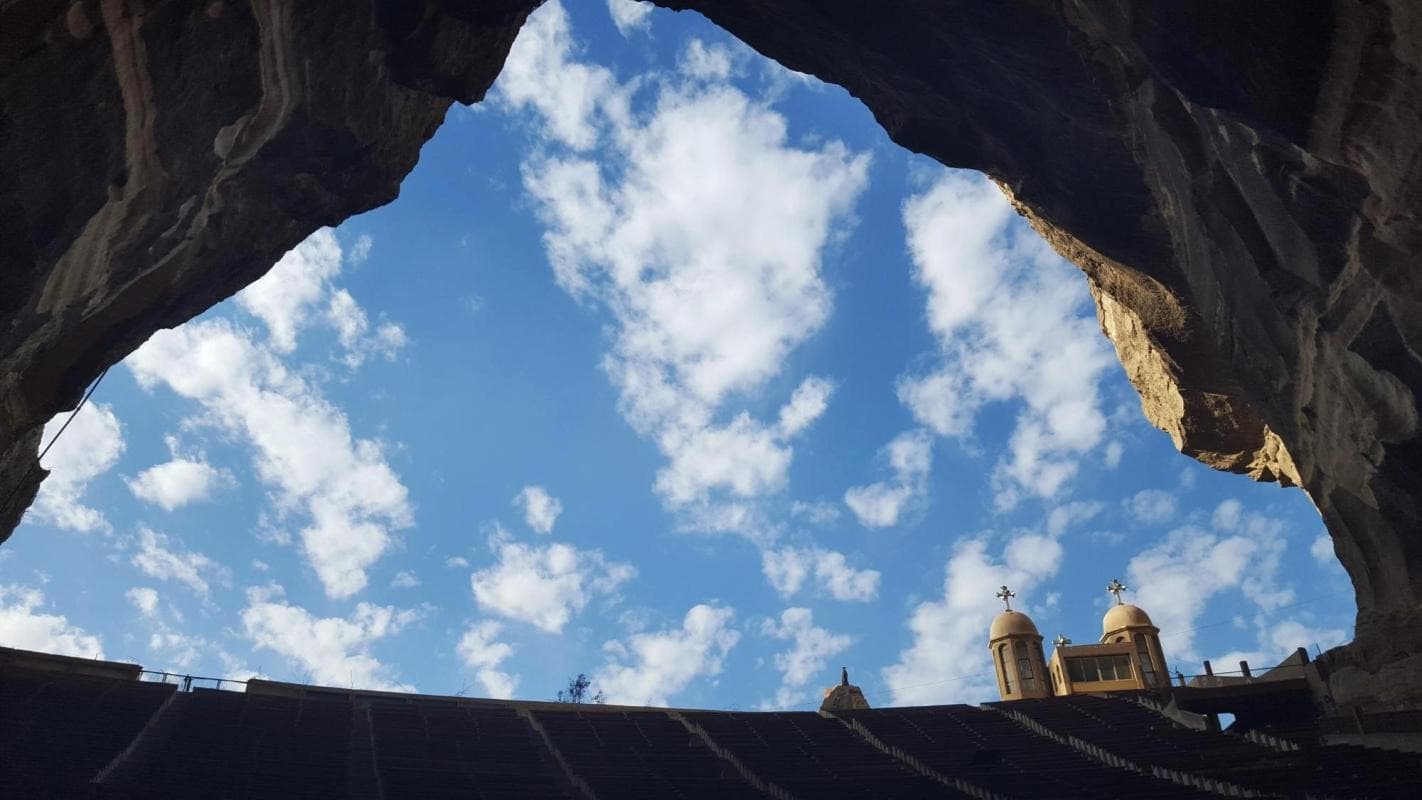
You arrive in Garbage City — Zabbaleen — through a patchwork of corrugated roofs, chickens and the slow, efficient rhythm of a community that has made a business from what others discard. The road climbs toward the pale flank of Mokattam Mountain, and then, tucked into a cleft of limestone, the entrance appears almost shy: a low doorway carved into a quarry face. Inside, the rock opens up into a cathedral of stone. Light from skylights slices across enormous hand-carved biblical scenes; echoing voices fold into concrete benches that seat thousands; a simple plastic fan hums above an altar framed by raw, red stone. This is the Cave Church — the Monastery of St. Simon the Tanner — a place where faith, local life and geology meet, and where the city’s dust gives way to the hush of a pilgrimage cave.
The story that draws most visitors here is as dramatic as the space itself. St. Simon the Tanner is a Coptic saint credited with the miracle of “moving the Mokattam Mountain” — an episode retold by generations of Coptic Christians in which a mountain was raised after a period of prayer during the Fatimid era. The cave church became a formal place of worship much later: discovered and cleared in the 1970s, it was adapted into the soaring halls you see today — rooms with a 17-meter ceiling in places and murals engraved into the stone itself. The space is both modern and ancient: electric lights and plastic chairs meet hand-chiseled biblical tableaux.
Geologically, the Mokattam hills are Cairo’s limestone backbone. Quarrying for stone made the caves possible and the same human shaping that hollowed the mountain also created the architecture that now frames devotion. Culturally, the Cave Church sits at the edge of two worlds. Zabbaleen communities have lived and worked here for decades, recycling the city’s refuse into livelihoods and forming a unique urban ecosystem; the church is the most visible public expression of their faith and community pride. For travelers, a visit is less about quiet contemplation than about bearing witness — to resilience, to intricate religious history, and to a neighborhood seldom on the tourist map.
How to experience it: there are several ways in. Private half-day tours that combine Coptic Cairo’s jewels — the Hanging Church, Abu Serga, Ben Ezra Synagogue — routinely include the Cave Church and the 20–30 minute walk/climb into Mokattam. Private guides can navigate the neighborhood’s narrow lanes, explain the miracle stories and the cave’s iconography, and introduce you to local families or the informal recycling workshops that give Garbage City its name. For travelers keen on deeper context, some guided tours focus explicitly on the churches of Coptic Cairo and the Mokattam narrative — these stretch the visit into a full morning of storytelling, liturgy and neighborhood walks.
Practical edge: the site isn’t remote but it isn’t exactly tourist infrastructure either. Expect short uphill stretches and some stepped pathways — comfortable shoes are a must. Modest dress is required for entering worship spaces; women should carry a scarf. Services and community gatherings can happen at varying times; if you want to photograph the carvings or a service, ask first. The cave’s scale means it can be surprisingly cool in the shade and warm near the sunlit entrance; pack a light layer.
What you’ll remember — beyond the basilica scale and the murals — is the way the place is lived in. Children dart along cave walls, a volunteer explains the iconography while dust motes swim in cathedral light, and outside, the Zabbaleen’s trucks and sorting yards hum. Combine the Cave Church visit with Old Cairo highlights: the Hanging Church for Byzantine timberwork, the Ben Ezra Synagogue for Jewish-Coptic history, and Khan el-Khalili if you want bustling markets afterward. Many travelers add the Grand Egyptian Museum or a Pyramids outing to balance the spiritual with the archeological.
Timing matters. Early mornings ease the heat and bring quieter moments before the large tour groups arrive. If you’d prefer immersive interaction with the local community, choose a smaller private guide who can introduce you to Zabbaleen social projects or recycling workshops. Respectful behavior—asking permission before photographing people, buying a snack from a local stall, or tipping a guide—goes a long way here.
For planning: allow 3–4 hours if you’re pairing the Cave Church with other Coptic sites; expect the ascent into Mokattam to be a brisk 10–20 minutes from the nearest drop-off, depending on mobility. Guides and drivers can usually manage drop-offs at the road near the monastery, but expect brief uphill walking on uneven surfaces. Bring cash for local purchases and small tips.
The Cave Church is not merely a photo stop; it’s a lived civic and spiritual center. It rewards travelers who slow down, who listen to the layered histories of Coptic and Egyptian life, and who come prepared—practically and with curiosity. In a city of pyramids and palaces, this is a different kind of monument: human-scale, carved from the city’s own bones, and pulsing with ongoing life.
Trail wisdom
Small choices, better day.
Wear supportive shoes
Paths into Mokattam include short uphill stretches and uneven steps—choose footwear with grip for comfort and safety.
Modest attire & headscarf
Covering shoulders and knees (and women carrying a scarf) is customary inside Coptic churches and helps show respect.
Bring water and small bills
There are limited services nearby; bring a bottle of water and small cash for guides or local vendors.
Ask before photographing
Always request permission to photograph worshippers or community members, especially during services.
Local knowledge
Read the place, not just the route.
Watch for native species including city pigeons, feral cats.
Keep an eye out for wildlife during the transition between areas and habitats. Respect distance guidelines.
Visits support local livelihoods—book with guides who work with community projects, avoid littering, and don’t remove or deface rock carvings.
Follow the guide's instructions on size limits, ethical handling, and leave-no-trace practices.
Local recycling workshops in Zabbaleen where you can see traditional sorting techniques. A short viewpoint above the cave where Cairo’s eastern neighborhoods and the Nile plain open up
Locally recommended viewpoints and quiet spots known best to local operators.
The Cave Church was cleared and converted into a functioning church in the 1970s and contains engraved biblical scenes and a large assembly hall; it celebrates St. Simon the Tanner, tied to the legend of the moving Mokattam Mountain.
Maritime roots and regional tradition shape the waterways and working coasts.
Seasonal guide
Four versions of the same landscape.
Spring
Best forcooler walking conditions · spring light for photography · quieter mid-week visits
Challengesoccasional dust storms · busy holiday weekends
Spring offers mild temperatures and forgiving light for interior and exterior photos, but watch for occasional windborne dust.
Summer
Best forearly-morning visits · combining indoor museum stops · longer daylight for sightseeing
Challengeshigh temperatures · crowded tourist sites
Summer is hot—visit early and plan air-conditioned transfer between sites; interior cave spaces provide brief respite from the heat.
Fall
Best forcomfortable weather · photography-friendly skies · pairing with outdoor walks
Challengesholiday crowds around religious festivals · variable temperatures
Autumn brings ideal temperatures and stable skies—great for combining the cave church with Old Cairo walks.
Winter
Best foroff-season quiet · clear air quality · less dust
Challengescool nights · shorter daylight hours
Winters are mild and often quieter, though mornings can be chilly; dress in layers for comfort.
Pack with intention
What to bring.
Good to know
Common questions.
Most visitors go by private car or tour vehicle; the drive is a short taxi or 20–40 minute drive depending on traffic, with a brief uphill walk from the drop-off point.
Plan the edges
The details that make the day easier.
The cave that houses the Monastery of St. Simon was cleared for worship in the 1970s and includes carved biblical scenes and a hall reported to seat around 2,000 people.
The Cave Church visit brings you into the daily life of Cairo’s Zabbaleen — a community famed for recycling and resourcefulness. Try a local koshari or ful medames at neighborhood stalls, and consider buying small crafts or donating to community projects tied to the area.
- Location
- Mokattam Mountain, Cairo. Access: taxi or private tour; short uphill walk. Best time: morning. Dress: modest. Duration: 2–4 hours when paired with other Coptic sites.
Support community-run tours and local vendors, avoid single-use plastics, and respect sacred spaces—your responsible visit helps sustain both the church and neighborhood livelihoods.
Explore by topic
Follow the threads.
Keep exploring
Make the story part of the trip.
Set out from Bass Harbor for a private, customizable day on Blue Hill Bay — lighthouses, puffins, seals, and the chance to feel Acadia from the water. Small groups, local captains, unforgettable views.
In four hours you can move from shaded canyon ferns to wind-scoured coastal ridgelines, guided by someone who knows where the light—and the hidden views—live. This private half-day hike on the Monterey Peninsula or Big Sur is compact, curated, and perfect for travelers who want depth without a multiday commitment.
 Related story
Beneath a sky of shifting light, Skaftafell’s ice reads like a map of time. This three-hour guided glacier hike mixes technical instruction with geology and culture: compact, safe, and unforgettable.