
What the day feels like
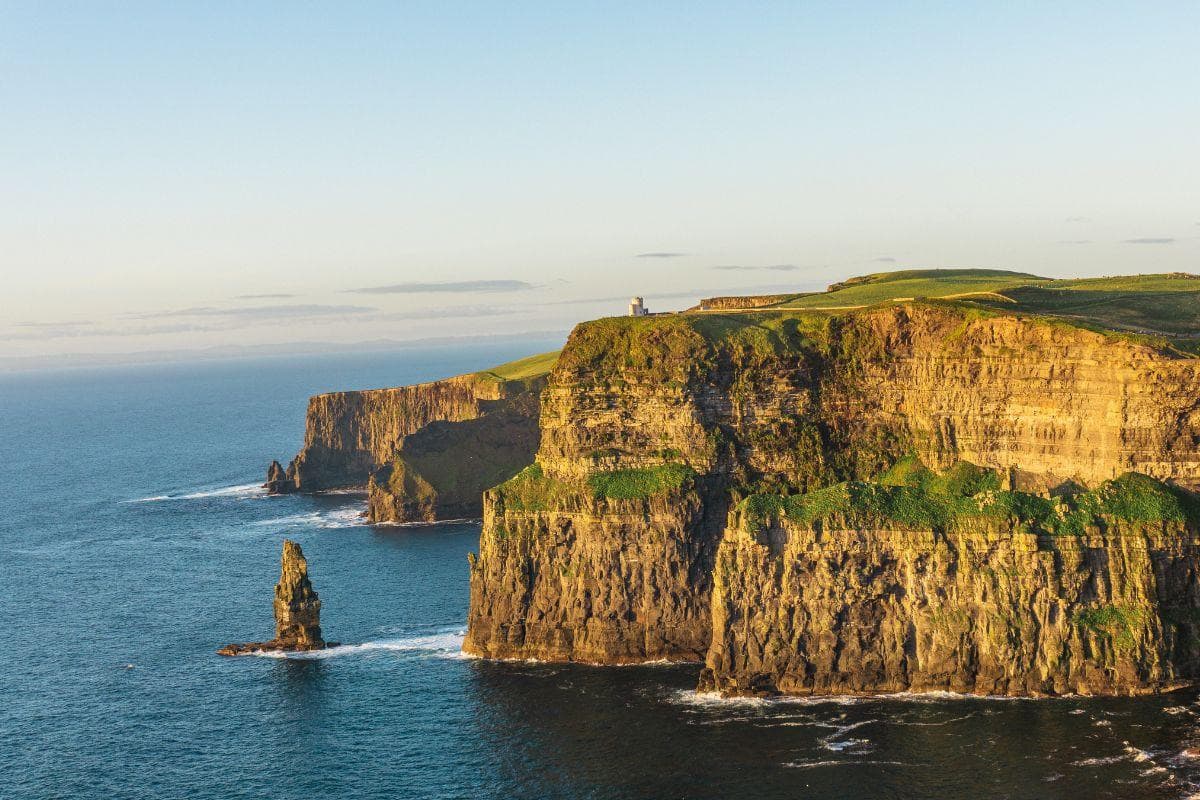
The wind arrives well before you do. It strips the warmth from your cheeks, presses your hair into your collar, and then opens your vision—the Atlantic unfolding like a bruise, dark and immediate, with white teeth where the waves clatter into rock. You reach the cliff edge and the land beneath your boots ends with a vertical drop: 214 meters at the highest point, sheer and raw, a living wall of layered stone. Gulls wheel, the currents below seem to argue with the shore, and the cliff-top path leads you westward along a coastline that has kept its own counsel for millennia.
That stretch of coastal drama—known the world over as the Cliffs of Moher—runs roughly 8 kilometers along County Clare's coastline, where the limestone and sandstone stacks tilt toward the ocean. Start at the visitor center, built low and stitched into the hillside to minimize visual impact, and you’ll find old stone, modern interpretation galleries, and O’Brien’s Tower: a small 19th-century folly that acts as both perch and historical punctuation. From there the walking options are immediate and honest—short circuits for casual strollers, longer, raw cliff-top treks for those who want to follow the rim until the land softly surrenders to suburban farmland.
Geology gives these cliffs their voice. Sediment laid down during the Carboniferous and Namurian periods—ancient muds and sands compressed into shale and sandstone—rises in layered ribs that the Atlantic scours. The rock is both record and resistance: fossil traces of tropical seas trapped in stone that now face the endless Irish Atlantic. The cliffs have a weather too—spring and summer can be placid and bird-heavy; autumn and winter bring squalls that fling spray and sharpen the angles of everything.
Culture threads through the landscape. Cornelius O’Brien, a local landlord in the 1830s, built his tower as a viewing platform for Victorian visitors; farmers, fishermen, and Clare musicians have since added their own human rhythms. Nearby villages—Liscannor, Doolin, and Lahinch—are tidy bases where pubs still hold sessions, where fresh seafood is a weekday ritual, and where the Burren’s lunar limestone speaks to a different kind of wildness inland.
For travelers, the Cliffs are both spectacle and activity hub. Local tour operators run everything from single-day returns from Dublin to multi-day west-coast circuits that stitch the cliffs into the larger story of the Wild Atlantic Way. If you prefer private logistics, chauffeur tours from Galway give you a flexible eight-hour window to set your pace; luxury options can add restorative seaweed baths and sheepdog demonstrations afterward—little rewards for damp socks and wind-rubbed cheeks.
Plan the visit like you mean to enjoy it. Most visitors spend 1.5–3 hours exploring viewpoints and short sections of the coastal path; photographers and hikers can easily stretch this into a half-day by following the cliff path west to Hag’s Head or east toward the quieter headlands. Trails are mostly stone and packed earth, with exposed sections near the edge—stout footwear and a head for exposure are good ideas. Because the exposed ridge sits open to Atlantic storms, layers and a windproof jacket are non-negotiable.
If birds are your reason, go in spring and early summer: razorbills, guillemots, and puffins arrive to nest in ledges and crevices, their colonies a living, noisy affirmation of the cliffs’ biological importance. The visitor center and local guides will point out best viewing windows and explain the seasonal rhythms so you can leave the birds to their work and still see them in numbers.
Logistics are practical: Galway lies about 1.5 hours north by car and is the most convenient city for an overnight. Dublin is roughly a three-hour drive, which is why many visitors pick guided day trips that include the Burren and small towns along the way. Entry to the visitor centre and some tower access is included on many organized tours, but if you’re independent, arrive early (or late afternoon) to avoid coach crowds. Respect signage: fenced paths and marked viewpoints are there for your safety and for the protection of ground-nesting birds and fragile vegetation.
If you have a full day, weave the Burren’s otherworldly limestone pavements and the road to Dunguaire Castle into your route, or finish with a seaweed bath or local pub session. Seaweed baths—an old coastal remedy—are a pleasant way to warm back up and sink into coastal calm after a windy walk.
This is not a place to rush. Let the cadence slow: watch the tide’s negotiations with the cliff base, listen to the wind reconfigure the gulls, and keep your eyes open for seal heads popping in offshore kelp. The Cliffs of Moher give you spectacle, but they also offer scale: they remind you of the time the earth takes to shape itself and the small, bright urgency of a single walk along its edge.
Trail wisdom
Small choices, better day.
Stay on the marked paths
Cliff edges can be unstable and the coastal turf erodes; fencing and signs protect both you and nesting birds.
Layer for sudden weather
Windproof shell plus a warm mid-layer will handle sun, spray, and squalls better than a single heavy jacket.
Time for tide and light
Sunrise and late afternoon give the best light for photography and fewer crowds; midday brings coaches.
Bring binoculars for birdwatching
Seabird colonies are often distant; binoculars reveal nesting razorbills, guillemots and puffins without disturbance.
Local knowledge
Read the place, not just the route.
Watch for native species including Atlantic puffin, razorbill (Alca torda).
Keep an eye out for wildlife during the transition between areas and habitats. Respect distance guidelines.
The cliffs are part of a designated Special Protection Area for seabirds; staying on paths and avoiding nesting ledges helps protect vulnerable colonies.
Follow the guide's instructions on size limits, ethical handling, and leave-no-trace practices.
Hag’s Head viewpoint to the south—fewer crowds and dramatic rock stacks. Poulnabrone Dolmen in the Burren—an ancient portal tomb about 30 minutes inland
Locally recommended viewpoints and quiet spots known best to local operators.
O’Brien’s Tower (built 1835) is a Victorian-era viewing folly that reflects early tourism on the cliffs; the area has been an informal lookout for centuries.
Maritime roots and regional tradition shape the waterways and working coasts.
Seasonal guide
Four versions of the same landscape.
Spring
Best forbirdwatching · wildflowers · cool, clear days
Challengesunpredictable wind · muddy paths after rain
Spring brings nesting seabirds and early blooms across the Burren; expect cool temperatures and variable weather.
Summer
Best forlong daylight · lighter clothing · sea views
Challengespeak crowds · sun exposure
Summer offers the most stable weather and puffin sightings but also the highest visitor numbers—arrive early.
Fall
Best fordramatic weather · fewer crowds · photography
Challengesshorter daylight · stronger storms
Autumn delivers moody skies and quieter trails; bring robust windproof layers for Atlantic gales.
Winter
Best forstorm-watching · low-season solitude
Challengespath closures · severe winds · cold temperatures
Winter is the rawest season—spectacular for storm watchers but unsuitable for exposed walking in dangerous conditions.
Pack with intention
What to bring.
Good to know
Common questions.
Most visitors spend 1.5–3 hours exploring the main viewpoints; hikers and photographers may extend this to a half-day or more to follow the cliff path.
Plan the edges
The details that make the day easier.
The Cliffs of Moher reach a maximum height of 214 meters (702 feet) and are composed of Namurian-age sandstones and shales laid down roughly 300 million years ago.
After the walk, head to a Doolin pub for fresh Clare seafood, a pot of mussels or smoked salmon, and local trad music—many tours finish with a pub stop to sample community life.
- Nearest city
- Galway (1.5h). Visitor centre access and parking available. Typical visit: 1.5–3 hours. Bring layers and allow extra time for weather delays.
Stick to designated paths, take litter home, and choose certified local guides who contribute to conservation and local economies.
Explore by topic
Follow the threads.
Keep exploring
Make the story part of the trip.
Set out from Bass Harbor for a private, customizable day on Blue Hill Bay — lighthouses, puffins, seals, and the chance to feel Acadia from the water. Small groups, local captains, unforgettable views.
In four hours you can move from shaded canyon ferns to wind-scoured coastal ridgelines, guided by someone who knows where the light—and the hidden views—live. This private half-day hike on the Monterey Peninsula or Big Sur is compact, curated, and perfect for travelers who want depth without a multiday commitment.
 Related story
Beneath a sky of shifting light, Skaftafell’s ice reads like a map of time. This three-hour guided glacier hike mixes technical instruction with geology and culture: compact, safe, and unforgettable.