
What the day feels like
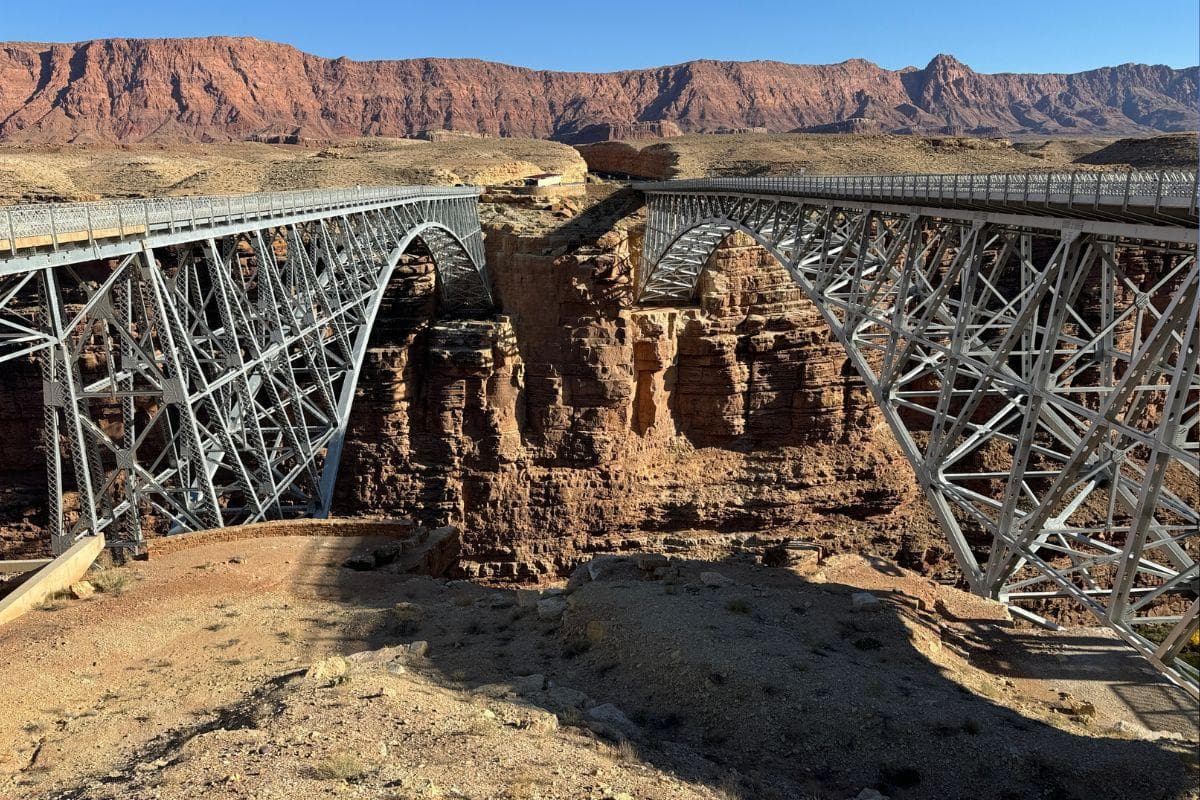
The morning wind along Marble Canyon has the blunt honesty of desert air—cool, sharp, and carrying a scent of sun-warmed stone. You step out of the car onto a short paved approach, and the bridge appears: two steel arches pacing the sky, one carrying traffic, the older one given over to a narrow pedestrian walkway. Below, the Colorado River threads the canyon like a dark ribbon, a patient line that has carved rock for millennia. Standing on Navajo Bridge you feel the canyon’s scale in the way sound changes: voices become small, the river’s murmur is distant, and the cliff faces loom with geological patience.
Navajo Bridge is less an isolated postcard than a junction of landscapes and stories. It marks a narrow point in Marble Canyon where the Colorado has knifed through uplifted sandstone. The original steel-arch bridge—completed in 1929—was a marvel of its era, finally connecting isolated northern Arizona communities with the rest of the state. A second, modern bridge opened in 1995 to carry highway traffic, leaving the older span as a pedestrian vantage. From the walkway you can watch rafters at Lees Ferry prepare for multi-day runs, and spot the small white wash of river where pilots guide craft through calm stretches before the big drops of Glen Canyon downstream.
The setting is geological theater: cross-bedded Navajo Sandstone, layers of Kaibab and Toroweap, and the deep blues of the Colorado working against warm rock. Human history sits quietly beside it—this is land long traversed by the Hopi, Zuni and Navajo peoples and later by river pilots and pioneering road crews. A few miles away Cameron Trading Post still sells Navajo and Hopi jewelry and woven rugs, a reminder that these roads never really disconnected culture from landscape.
For travelers who make the short detour to Navajo Bridge, the reward is twofold: immediate, cinematic views of the river and canyon, and access to activities that let you linger. The “Colorado River Smooth Water Float Trip and Horseshoe Bend from Sedona” is one such offering that threads together scenic driving, indigenous culture, and the slow pace of the river. From Sedona you wind through Oak Creek Canyon (one of the country’s most scenic drives), past the San Francisco Peaks, across the Painted Desert, and eventually to the bridge that frames the Colorado. Float trips through Glen Canyon offer a gentle counterpoint to the canyon’s grand scale—slow water, high walls, and time to look up.
Why visit? Navajo Bridge is an ideal waypoint for travelers who like to combine short, high-reward stops with a larger route. It’s compact—no long hikes required—yet it opens onto a suite of regional experiences: photographic study of canyon light, a quiet walk on a historic bridge, and river trips that allow a slow, human-paced perspective on landscapes usually seen from highway overlooks. For families and less-experienced travelers, it’s accessible; for photographers and geology enthusiasts, it offers layers to explore.
Practical notes: the pedestrian walkway is short and paved, making the viewpoint accessible to most visitors. Parking is limited at peak times—early morning or late afternoon keeps both light and crowds favorable. If you’re doing the float from Sedona to Page, expect a long day of driving bracketed by quiet time on the water; the route is intentionally scenic, with stops that include Oak Creek Canyon and the Cameron Trading Post. Bring sun protection and water: the rim is exposed and sun can be relentless even when temperatures feel mild.
Timing the visit makes a difference. Dawn and dusk compress colors in the canyon until they look almost painted; mid-day can be harsh but will reveal the deep blues of river water and the fine textures of the stone. For photographers, a polarizing filter and a long lens will pay off; for hikers and families, sturdy shoes and layered clothing make short walks comfortable. If you’re interested in deeper exploration, Lees Ferry—just downstream—is the legal put-in for many Grand Canyon river trips and an important cultural crossing historically.
Respect the place. This is river country with fragile desert ecology and culturally significant lands. Pack out what you bring in, stay on designated paths, and consider purchases at places like Cameron Trading Post—your dollars support local artists and trading-post economies. For river float participants, follow guide and permit rules carefully: the Colorado is calm in stretches but remains a living river with its own weather and seasonal flows.
Navajo Bridge is not a destination that demands an epic commitment of time. It asks for a thoughtful one: stop, look, and let the river’s long work on stone recalibrate your sense of immediacy. Pair that short stop with a smooth-water float and you get the region’s best paradox—power at geological scale, experienced at human pace.
Trail wisdom
Small choices, better day.
Go early or late
Sunrise or sunset softens canyon light and reduces crowds—parking is easier and temperatures are milder.
Bring shade and water
The bridge is exposed; carry a hat and at least 1–2 liters of water per person for short visits.
Pair with a float trip
If you’re taking the Sedona–Page smooth-water float, plan the long drive segments and expect stops like Cameron Trading Post.
Respect fragile edges
Stay on designated walkways—rock edges and local flora are easily damaged by foot traffic.
Local knowledge
Read the place, not just the route.
Watch for native species including bighorn sheep, raptor species such as peregrine falcons.
Keep an eye out for wildlife during the transition between areas and habitats. Respect distance guidelines.
The area is managed to balance visitor access with protection of fragile desert ecosystems—stay on paths, avoid disturbing wildlife, and support local conservation initiatives.
Follow the guide's instructions on size limits, ethical handling, and leave-no-trace practices.
Lees Ferry put-in for river trips and its historic boat ramp. Cameron Trading Post for authentic Navajo and Hopi crafts and a classic roadside meal
Locally recommended viewpoints and quiet spots known best to local operators.
The original Navajo Bridge (completed 1929) drastically improved travel in northern Arizona; its preservation as a pedestrian span keeps that history visible.
Maritime roots and regional tradition shape the waterways and working coasts.
Seasonal guide
Four versions of the same landscape.
Spring
Best forwildflower pockets · comfortable river floats · cool morning photography
Challengesunpredictable weather · busy spring-break weekends
Spring offers mild temperatures ideal for short walks and smooth-water floats, though weekends can be busy and storms still possible.
Summer
Best forlong daylight hours · river activity · late-night stargazing
Challengeshigh heat, strong sun, limited shade
Summer brings hot, dry conditions—plan early visits, pack extra water, and expect the bridge to be sunny and exposed.
Fall
Best forcrisp light for photos · fewer crowds · pleasant hiking weather
Challengesshorter daylight and cooler nights
Autumn is ideal: comfortable days, great light, and reduced visitation make the bridge especially enjoyable.
Winter
Best forclear air and solitude · dramatic low-angle light
Challengescold temps, potential ice on pavements, limited services
Winters are quiet and crisp—dress warmly and use caution on icy surfaces; services like nearby trading posts may have reduced hours.
Pack with intention
What to bring.
Good to know
Common questions.
Yes—there is a short paved pedestrian walkway on the historic bridge that is accessible to most people; keep an eye on edges and supervise small children.
Plan the edges
The details that make the day easier.
The original Navajo Bridge was completed in 1929 and reopened as a pedestrian walkway after a second vehicular bridge was built in 1995—both spans now provide distinct perspectives on Marble Canyon.
The road to Navajo Bridge threads through lands where Navajo and Hopi cultures remain vital—stop at trading posts to meet artisans, sample Navajo fry bread, and learn about regional craft traditions.
Stay on designated paths, avoid collecting cultural artifacts, and support local businesses and artists to ensure economic benefits remain with indigenous communities.
Explore by topic
Follow the threads.
Keep exploring
Make the story part of the trip.
Set out from Bass Harbor for a private, customizable day on Blue Hill Bay — lighthouses, puffins, seals, and the chance to feel Acadia from the water. Small groups, local captains, unforgettable views.
In four hours you can move from shaded canyon ferns to wind-scoured coastal ridgelines, guided by someone who knows where the light—and the hidden views—live. This private half-day hike on the Monterey Peninsula or Big Sur is compact, curated, and perfect for travelers who want depth without a multiday commitment.
 Related story
Beneath a sky of shifting light, Skaftafell’s ice reads like a map of time. This three-hour guided glacier hike mixes technical instruction with geology and culture: compact, safe, and unforgettable.