
What the day feels like
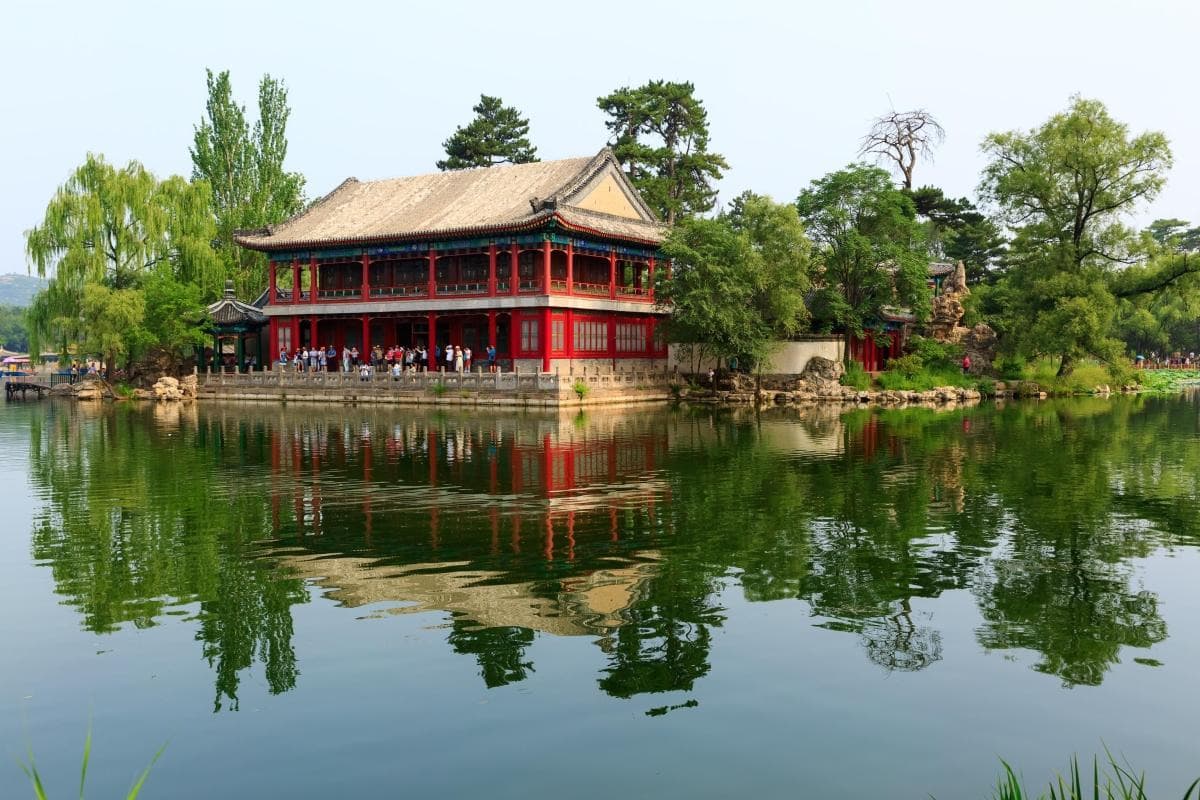
The first breath hits like a small refund on a Beijing summer: cooler, cleaner, the air moving through pines as if it knows it has a job to do. You step off a morning bullet train or out of a private transfer and into a landscape that feels arranged to soothe a dynasty. Paths curve through lakes that hold temple reflections like ink in paper; marble bridges punctuate willow-shaded canals; distant ridgelines rise with a polite, steady patience. Welcome to the Mountain Resort in Chengde — the Qing emperors’ summer escape, a designed landscape where politics, religion and mountain air met for strategy and rest.
The Mountain Resort (Bishu Shanzhuang) spreads out across more than 5.6 square kilometers of palace, gardens and engineered wilderness. Built in the 18th century under Kangxi, Yongzheng and Qianlong, the site was both summer residence and ceremonial stage: emperors relocated here to avoid the Beijing heat and to perform diplomatic rituals with Mongol and Tibetan leaders. The result is a hybrid of imperial garden, scaled landscape, and a political theatre of architecture. Walk a causeway and the water seems to press against your calves with intent; climb a pavilion and the trees lean in to tell you the best direction to study the details.
Geologically, Chengde sits at the north edge of the Taihang Range’s foothills, where rolling, forested hills meet cultivated valleys. The park’s designers exploited that transition — lakes fed by small streams, terraced viewpoints, and winding alleys that turn every ten minutes to give you a new frame. In summer the mean temperature is a comfortable 24.5°C (76°F), a major reason Qing court members decamped here, while the annual mean hovers near 9.1°C — testimony to how this place keeps its cool.
Culture here is layered. The Mountain Resort is paired with the Eight Outer Temples, a ring of Tibetan-, Mongol- and Han-style monasteries commissioned in the Qianlong era to affirm imperial authority and to host visiting lamas. The Putuo Zongcheng Temple, often called the “Small Potala Palace,” is a standout: from some angles it reproduces Lhasa’s silhouette, and inside gilded halls still carry the hush of ritual. Puning Temple, with its towering wooden Buddha, and quieter meditation courtyards beyond, are less theatrical but no less powerful.
For travelers, Chengde suits two appetites: deliberate history and active wandering. Most visitors arrive on day trips from Beijing — many packaged as private tours, bullet-train experiences (complete with first-class options), or combined itineraries that fold in a hike at Jinshanling Great Wall on the way. If you want to balance a cultural deep-dive with a dose of mountain walking, a two-day option that pares the pace is ideal. And whether you’re following a guide or doing a self-guided loop, expect a lot of soft gradients, well-kept paths and moments where the place invites you to slow down.
Practical planning matters. Tours commonly include entrance fees, private transfers and lunch; the operator typically books bullet train tickets and arranges station transfers, making a single-day run from Beijing straightforward (roughly 180 km northeast). If you’re traveling independently, arrive early: the palace’s wide lawns are best in morning light, and the temples feel more intimate before midday crowds. Wear stable walking shoes — many surfaces are flagstone — and bring a light rain shell; mountain weather can turn quickly.
Respect is part of the itinerary. Temples are active religious sites: remove hats, keep voices low, and follow any photography restrictions. The region’s cultural blend—Manchu court tastes meeting Tibetan Buddhist practice—means you’ll see ritual objects and living ceremonies; be curious but unobtrusive.
Skill and conditioning requirements are mild. Most touring within the Mountain Resort is low-impact walking, but pairing Chengde with Jinshanling transforms the day into a more strenuous outing. If you plan to hike a Great Wall sector, train for sustained uphill sections and bring more water. For anyone on a one-day bullet-train excursion, expect 6–10 hours of movement between rail transfers, temple visits and walking loops.
Where to tilt your lens: the Small Potala at mid-morning, when shadow lines accentuate its tiers; the lakes at golden hour, when wind drops and the palaces double perfectly; and one of the hilltop pavilions for a panorama that makes spatial history feel tactile. If you want to escape the main routes, skirt the east edge of the park for quieter paths that thread between pines and small farms — you’ll find fewer crowds and better birdwatching.
Logistics at a glance: book train and entrance tickets in advance during July and early autumn; consider private transfers for same-day returns to Beijing; carry a compact guidebook or download a map, since English signage is limited outside the main complexes. For a low-effort, high-context experience, a private Chengde day tour or a bullet-train day with a local guide gives you both the historical framing and the timing to make the most of the mountain air.
Chengde is a place of temperate contrasts: imperial ambition softened into garden geometry, political symbolism embedded in prayer halls, and a climate that deliberately conspires to do what emperors paid for — to cool, to calm and to give perspective. Walk here and you’ll feel the choreography: nature showing you a route, temples offering a pause, and history nodding as you pass. It’s an easy place to love — and an even easier one to learn from.
Recommended ways to experience it: choose a private day tour if you want curated context and convenience; take the bullet train if you prefer the thrill of transit and the efficiency of modern China; book a two-day itinerary that adds Jinshanling Great Wall if you want to mix cultural exploration with classic northern-mountain hiking. Whatever you pick, leave room in your day for a slow bench and a cup of hot tea: Chengde rewards attention.
Trail wisdom
Small choices, better day.
Start early to beat heat and crowds
Arrive at opening to catch morning light on the lakes and quieter temple visits; many tours schedule early bullet-train departures for this reason.
Layer for variable mountain weather
Temperatures can shift, so pack a light shell and an insulating mid-layer even in summer.
Respect temple etiquette
Remove hats, keep voices low in prayer halls, and follow posted photography rules—especially at active monasteries.
Combine with Jinshanling for a fuller day
If you want hiking as well as history, pick a 2-day or combined tour that includes the Great Wall nearby.
Local knowledge
Read the place, not just the route.
Watch for native species including migratory waterfowl on park lakes, roe deer and native songbirds in surrounding woodlands.
Keep an eye out for wildlife during the transition between areas and habitats. Respect distance guidelines.
As a UNESCO World Heritage Site, the resort is subject to conservation plans; visitors are encouraged to stay on paths, avoid touching delicate surfaces, and support local guides.
Follow the guide's instructions on size limits, ethical handling, and leave-no-trace practices.
Putuo Zongcheng Temple (Small Potala Palace) for intricate replication of Tibetan design. East-side walking paths outside the main circuit for quieter birdwatching and local village views
Locally recommended viewpoints and quiet spots known best to local operators.
Constructed in the 18th century under Kangxi, Yongzheng and Qianlong, the Mountain Resort served as the Qing emperors’ summer residence and diplomatic stage.
Maritime roots and regional tradition shape the waterways and working coasts.
Seasonal guide
Four versions of the same landscape.
Spring
Best forWildflowers and mellow hiking · Fewer tourists · Temple architecture in clear air
ChallengesUnpredictable rain · Cool mornings
Spring brings new greens and fewer crowds; bring a rain shell and expect morning chill.
Summer
Best forCooler retreat from Beijing heat · Full gardens and lake reflections · Cultural festivals
ChallengesHigher visitor numbers · Occasional afternoon thunderstorms
Summer is peak for its temperate climate and lush landscaping—book trains and tours in advance.
Fall
Best forCrisp air and early color · Photogenic golden light · Comfortable hiking temperatures
ChallengesShorter daylight · Colder nights
Autumn offers clear skies and color, ideal for photography and longer walking loops.
Winter
Best forQuiet temples and frosted architecture · Contemplative visits · Low crowds
ChallengesCold temperatures and possible snow · Reduced services
Winter is quiet and starkly beautiful but cold; dress warmly and check opening hours.
Pack with intention
What to bring.
Good to know
Common questions.
Chengde is about 180 km northeast of Beijing; bullet-train plus transfers typically takes 2–3 hours each way depending on connections.
Plan the edges
The details that make the day easier.
The Imperial Mountain Resort and its Outlying Temples in Chengde were inscribed as a UNESCO World Heritage Site in 1994.
Chengde blends Manchu court culture with Tibetan Buddhist traditions; try local mutton dishes and simple northerner teas at small eateries near the park after a morning of sightseeing.
- Distance from Beijing
- ~180 km; Typical day-trip duration: 10–12 hours round trip; Access: bullet train with private transfers or private coach; Tickets: tours often include entrance fees and lunch; Currency: RMB.
Stick to marked trails, avoid single-use plastics, and hire local guides to support community stewardship; donations to temple preservation funds help maintain fragile interiors.
Explore by topic
Follow the threads.
Keep exploring
Make the story part of the trip.
Set out from Bass Harbor for a private, customizable day on Blue Hill Bay — lighthouses, puffins, seals, and the chance to feel Acadia from the water. Small groups, local captains, unforgettable views.
In four hours you can move from shaded canyon ferns to wind-scoured coastal ridgelines, guided by someone who knows where the light—and the hidden views—live. This private half-day hike on the Monterey Peninsula or Big Sur is compact, curated, and perfect for travelers who want depth without a multiday commitment.
 Related story
Beneath a sky of shifting light, Skaftafell’s ice reads like a map of time. This three-hour guided glacier hike mixes technical instruction with geology and culture: compact, safe, and unforgettable.