
What the day feels like
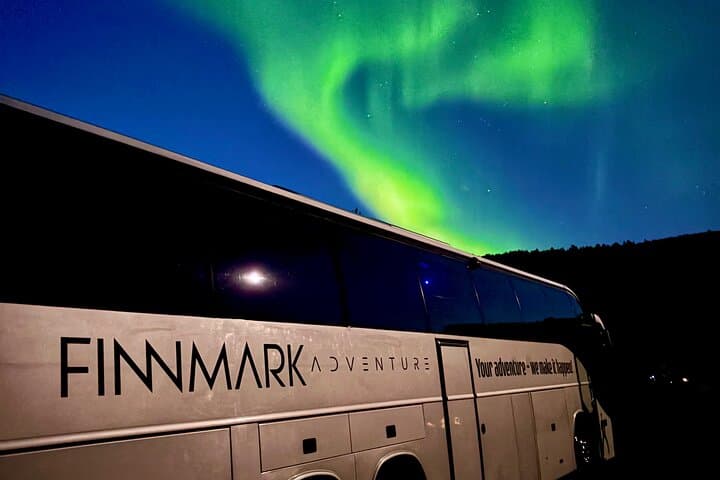
You step off the curb into a blue-black Arctic evening and feel the cold like a second wind—clean, sharp, honest. The bus waits with its heater humming, a small moth of warmth in the big northern dark. Windows fog from breath and anticipation as the driver, part meteorologist, part storyteller, consults a live map of cloud and geomagnetic forecasts. There is no guarantee inside that heater; there is only the patient, improvisational art of chasing the sky. For three hours you follow the promise of clear sky along plateau and fjord, swapping stories with strangers who quickly become conspirators in a nocturnal hunt.
Alta sits at the edge of Finnmark, where the Arctic opens up both horizontally and vertically: long horizons, low light pollution, and an honest line to the magnetic north that makes auroras particularly reliable. The Northern Lights bus tour is not a studio production; it’s a modest, practical chase—small-group vehicles that run where the sky looks best, drivers who read winds and clouds like sailors read currents, and passengers who trade camera tips and folklore as the landscape slides by. Along the way you’ll hear Sámi legends about dancing souls and fiery spirits, threads of cultural history that have always tried to answer why the lights appear.
Geologically and physically, the aurora is a conversation between the sun and Earth. Solar particles stream out during coronal mass ejections, strike the magnetosphere, and collide with oxygen and nitrogen high in the atmosphere; the result is color and motion, greens and purples that the eye perceives as a living curtain. In Alta’s latitude, the curtain dips regularly into view during dark months. Still, the aurora has a mind of its own. Some nights she is coy; other nights she stages a full-on ballet.
The bus tour makes that uncertainty manageable. Rather than anchoring you to a single viewpoint with bad sky, the driver moves. Routes are flexible—out toward the Finnmarksvidda plateau, along coastal arms that keep horizon lines low, or inland where cloud breaks are more frequent. The tour is short—about three hours—so it’s deliberately compact: a focused chase, not an overnight camp-out. That brevity is also practical: you can do it after dinner, or as your first night in town, which matters in a place where weather and schedules rule your options.
Why go? Because the chase itself is part of the experience. You’ll stand on a frozen shoreline, breath visible in the beam of a headlamp; you’ll hear the faint hiss of tires on packed snow and the quiet hush of people watching. If the sky opens, there is instant, collective elation. If it doesn’t, you’ve still absorbed a slice of Arctic night, learned about local culture, and left with sharper expectations for chasing lights elsewhere.
Practicalities are straightforward. Tours typically last three hours and run from Alta; vehicles are small-group—often no more than six passengers—so dress for the tundra even if you’ll be moving between heated stops. Bring a tripod and a camera that allows manual exposure for the best photos. Expect cold, clear air that makes long exposures crisp but also drains batteries; carry spares. The tour is budget-conscious, with fares that undercut pricier private hunts, and they offer instant booking and free cancellation within operator policy window.
For photographers: wide-angle lenses and apertures of f/2.8 or wider are ideal. Start at ISO 800–3200 depending on your camera, and experiment with shutter speeds between 5 and 12 seconds. Use a remote or timed release to avoid shake. If the lights intensify, shorten exposures to keep motion from blurring the bands.
A few local truths: Alta is more than an aurora backdrop. The area hosts prehistoric rock carvings now recognized by UNESCO—reminders that people have watched and recorded northern skies for millennia. The Sámi community remains culturally present, and local guides often weave those perspectives into the narrative of a chase. Respectful curiosity goes further than loud cameras. Also, the northern night is fragile in its own way—light pollution and careless driving can dull an otherwise brilliant show.
What to expect on a typical night: pickup in Alta, a flexible route determined by cloud cover, two to three stops for sky watching and photography, short walks to dark-sky vantage points, and a return to town within three hours. There’s no guarantee the aurora will appear, but you do gain mobility and expertise: this is a hunt informed by local intuition and real-time weather data.
If you’re planning this trip, prioritize warmth and camera prep. Dress in layers with an insulating mid-layer and a windproof, insulated outer shell. Insulated boots, a warm hat, and mittens matter more than a name-brand jacket. Bring an extra battery and a thermos of something hot. Mentally, prepare for patience: the best nights often begin with long stretches of quiet, and then the sky decides.
On the other side of waiting, the payoff can be quietly enormous: curtains of green that whisper and then roar; reflections on black water; the soft, surprised laughter of strangers watching the same thing. Whether you see a whisper of aurora or a full-tilt display, the chase through Arctic night—guided by people who know how to read it—is an efficient, humane, and memorable way to meet the lights.
Trail wisdom
Small choices, better day.
Dress for the Arctic
Layer: a warm base layer, insulated mid-layer, windproof shell, warm hat and mittens—temperatures plummet once you stop moving.
Bring a tripod and spare batteries
Long exposures and cold drains batteries quickly; keep spares warm inside your jacket.
Trust the driver’s route choices
Flexible routing increases your odds—drivers read clouds and wind and will move you to clearer sky when possible.
Manage expectations
Auroras are natural and unpredictable; come for the hunt as much as the display and you’ll enjoy the night regardless.
Local knowledge
Read the place, not just the route.
Watch for native species including Reindeer, Arctic fox.
Keep an eye out for wildlife during the transition between areas and habitats. Respect distance guidelines.
Minimize light pollution by using red headlamps and avoid stopping in sensitive wildlife zones; stick to roads and established parking areas.
Follow the guide's instructions on size limits, ethical handling, and leave-no-trace practices.
Drive to low-lying coastal arms for horizon-reflected auroras. Small fjord beaches near Alta offer dark-sky reflections
Locally recommended viewpoints and quiet spots known best to local operators.
Alta’s landscape holds millennia of human presence, including UNESCO-listed rock carvings that speak to ancient life under northern skies.
Maritime roots and regional tradition shape the waterways and working coasts.
Seasonal guide
Four versions of the same landscape.
Spring
Best forLate-season aurora viewing · Fewer tourists · Milder nights
ChallengesUnstable weather · Shortening nights compared with mid-winter
Late winter into early spring can still produce strong aurora nights with slightly warmer temperatures and longer daylight hours.
Summer
Best forMidnight sun experiences · Extended daylight activities
ChallengesNo dark nights for aurora · Warm temperatures not suited for aurora hunts
Summertime is not suitable for aurora viewing due to continuous daylight; focus on other Arctic activities instead.
Fall
Best forEarly aurora season · Changing landscapes · Fewer crowds
ChallengesVariable cloud cover · Rapidly cooling nights
Autumn brings earlier nights and solid aurora chances; watch forecasts and expect quick temperature swings.
Winter
Best forPeak aurora season · Clear, dark nights · Snow-covered vistas
ChallengesExtreme cold · Short daylight hours affect daytime activities
Winter is the optimal season for aurora chases—long, dark nights and cold, stable air favor clear skies.
Operator details
What the booking data adds.
Included
- ✓Snacks
- ✓Air-conditioned vehicle
- ✓Tour Guide
- ✓Coffee and/or Tea
Good to know
- ✓Infants and small children can ride in a pram or stroller
- ✓Suitable for all physical fitness levels
Pack with intention
What to bring.
Good to know
Common questions.
The tour runs approximately three hours and departs from Alta; exact pickup locations vary by operator.
Plan the edges
The details that make the day easier.
Alta is home to prehistoric rock carvings that are a UNESCO World Heritage Site, showing human connections to northern skies dating back thousands of years.
After a chase, warm up in Alta with local Arctic fare—look for dishes featuring reindeer or Arctic char and seek cafés that pour strong coffee and local cloudberry desserts. For cultural context, visit the Alta Museum to see the rock carvings and learn Sámi history.
- Closest airport
- Alta Airport (ALF)
- Typical departure
- central Alta (short drive)
- Driving distance
- 10–60 minutes to viewing spots
- Cell service
- generally available near roads, patchy in remote areas
- Permits
- none required for this organized tour
Minimize light pollution and disturbance to wildlife; stay on roads and designated parking, pack out all trash, and follow guide instructions to protect fragile Arctic environments.
Explore by topic
Follow the threads.
Keep exploring
Make the story part of the trip.
Set out from Bass Harbor for a private, customizable day on Blue Hill Bay — lighthouses, puffins, seals, and the chance to feel Acadia from the water. Small groups, local captains, unforgettable views.
In four hours you can move from shaded canyon ferns to wind-scoured coastal ridgelines, guided by someone who knows where the light—and the hidden views—live. This private half-day hike on the Monterey Peninsula or Big Sur is compact, curated, and perfect for travelers who want depth without a multiday commitment.
 Related story
Beneath a sky of shifting light, Skaftafell’s ice reads like a map of time. This three-hour guided glacier hike mixes technical instruction with geology and culture: compact, safe, and unforgettable.