
What the day feels like
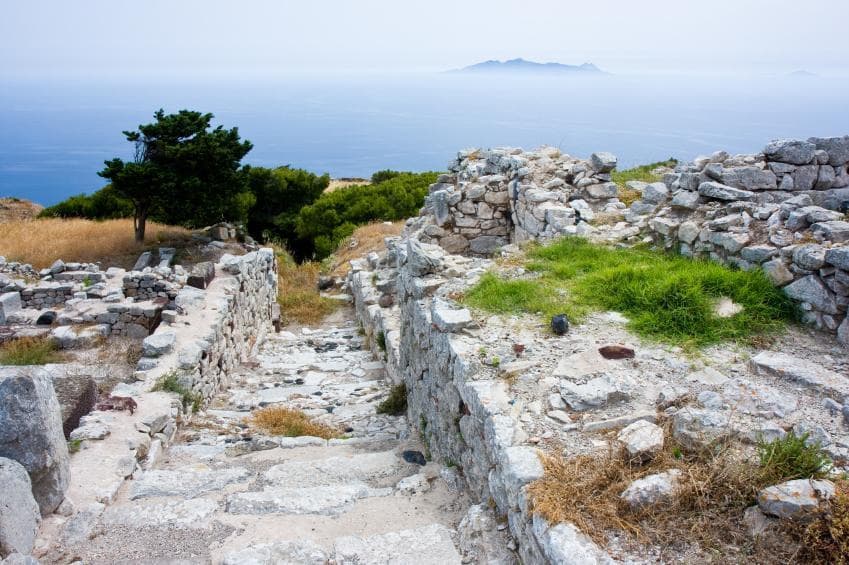
The path begins in the heat of a low, whitewashed village and climbs, relentless and honest, up the bare spine of Mesa Vouno. Behind you, the black beach at Perissa unfurls like a wound of cooled lava; ahead, stone ruins sit square-shouldered on the ridge, a city that gazes out to sea with a view older than the word travel. Walking to Ancient Thera is less about discovery than translation — every stone step, every shuttered doorway and broken column reads like a margin note in an island's long biography.
You reach the summit sweaty and quiet, because the wind does the talking up here. It tugs at visor brims, rolls across the stripped limestone and seems to dare you to stand still. From this perch you can trace the island's shape: the crescent caldera to the northwest, the flat apron of sand at Perissa below, and the blue corridor of the Aegean that carried Phoenicians, Dorians and Romans to this outcrop over three millennia. The ruins of Ancient Thera are spare but eloquent — a Hellenistic grid, Roman houses, Byzantine churches — a palimpsest of occupation that feels, on a bright day, both intimate and monumental.
Ancient Thera sits on Mesa Vouno, the steep promontory that separates Perissa and Kamari on Santorini's southeast coast. It was founded by Dorian colonists around the 9th century BC and occupied through Hellenistic, Roman and Byzantine times. The site is frequently referenced in archaeological tours of Santorini and features on organized itineraries such as the Santorini History & Archaeology Tour, which pairs the ruins with the island's other major ancient sites. For travelers who prefer flexibility, the island’s many tailor-made private tours will drop you at the trailhead and leave time for sea-side taverna lunches afterward.
Geologically, Mesa Vouno is a child of volcanic violence. Santorini’s dramatic profile was shaped by eruptions that buried settlements and forged new landforms, and the black sand beaches below are a direct result of those fires. The mountain itself is scoured and stony, where olive trees struggle and the scrub clings in ragged pockets. Weathered stone becomes both the story and the surface of the hike — good footwear and steady footing matter.
The approach: most visitors start in Perissa. From the black-sand main drag a signed stone staircase climbs roughly one mile (1.6 km) to the archaeological site, with an elevation gain of about 350–370 meters. The track is a mix of stone steps and loose switchbacks; expect exposed sun and wind, and allow roughly 1–1.5 hours to ascend at a comfortable pace. The site itself can be explored in 45–90 minutes depending on your curiosity and how much you linger at the viewpoints.
This is not a technical climb. The trail’s biggest enemies are heat and complacency. Start early to experience the ruins in softer light and avoid the midday crush when day boats disgorge passengers across the island. If you prefer a guided perspective, book the History & Archaeology Tour for expert context; private tailor-made tours are ideal if you want a driver-guide to craft a half-day that includes Perissa’s beach and a winery detour.
Practical: bring at least 1.5 liters of water per person in warm months, sun protection (hat, sunscreen), and shoes with good tread — the stone can be slippery if you descend fast. There is a small admission fee to the archaeological site; hours vary seasonally, so confirm on arrival. Facilities are limited on the mountain; plan to use restrooms in Perissa before you leave.
Culture and food after the hike is part of the ritual here. Perissa’s tavernas are unapologetically local — fresh fish, roasted eggplant, fava puree and Santorini’s famed cherry tomatoes with a squeeze of lemon. Pair it with a glass of assyrtiko, the island’s volcanic white, which tastes of stone and citrus — a fitting post-hike signature.
If you go in spring or fall, you’ll walk under a light that makes every ruin take on the hue of old bone. Summer presents the island at its loudest and busiest; winter is quieter but some services are reduced. Wherever you arrive, respect the stones: Ancient Thera is fragile, and each footprint matters. Seek out local guides who can place the ruins into the island’s long timeline — a coin hoard here, a carved lintel there — and you’ll find the site rewards deliberate attention.
For the active traveler, pairing the ascent to Ancient Thera with a southeast coast tour rounds the day beautifully: a morning hike, a wine-tasting interlude at a family-run vineyard, and then a slow sea-side meal. For families or those who want zero fuss, a tailor-made private tour can arrange transport, a flexible schedule and local recommendations for the best beach-side tavernas. But there's also something irreplaceable about climbing the steps yourself: the steady rhythm of footfalls, the wind that insists you stop and look, the small, sharp joy when the ruins first come into view.
Ancient Thera is not Santorini's postcard — it is the island's margin, where people lived and worked away from the caldera's cliff-top theatrics. It is an island experience that levels you down to the scale of human lives lived against a volcanic landscape. The reward is not only the ruin, but the perspective: looking back at the strip of black sand and knowing that islands are written in layers, and you are standing on one of the older, rougher pages.
If you go: start early, climb steady, bring water, and leave your footprints only on the trail. Whether you arrive with a historian at your side or find the ruins in the wind on your own, Ancient Thera will ask for patience and give back quiet, expansive viewable time — exactly the kind of place a good travel memory needs to become real.
Trail wisdom
Small choices, better day.
Start at first light
Begin the ascent early to avoid midday heat and tour-boat crowds; the light at sunrise softens the ruins and cools the climb.
Sip, don’t gulp
Carry at least 1.5 liters of water and sip regularly; there are no reliable water sources on the trail or at the summit.
Grip over style
Wear shoes with solid tread — stone steps and loose scree make sandals and flip-flops a poor choice.
Hire local context
Consider the Santorini History & Archaeology Tour or a private tailor-made tour to add archaeological insight and logistics ease.
Local knowledge
Read the place, not just the route.
Watch for native species including Aegean lizards sunning on rocks, Seabirds such as shearwaters and gulls circling the cliffs.
Keep an eye out for wildlife during the transition between areas and habitats. Respect distance guidelines.
Erosion and foot traffic threaten fragile archaeological features; visitors are encouraged to stay on designated paths and support local preservation efforts.
Follow the guide's instructions on size limits, ethical handling, and leave-no-trace practices.
The viewpoint above Perissa where the ruins align with the black-sand crescent — best at sunrise. Small family-run tavernas in Perissa serving local assyrtiko wine and tomato keftedes
Locally recommended viewpoints and quiet spots known best to local operators.
Founded by Dorian settlers in the 9th century BC, Ancient Thera saw continuous occupation through Hellenistic, Roman and Byzantine periods and served as a regional trading and military outpost.
Maritime roots and regional tradition shape the waterways and working coasts.
Seasonal guide
Four versions of the same landscape.
Spring
Best forcooler hiking conditions · wildflowers · fewer crowds
Challengesvariable winds · occasionally reduced ferry services
Spring offers cool temperatures and blooming scrub, making the ascent comfortable and the views crisp; expect breezy conditions at the summit.
Summer
Best forlong daylight hours · post-hike beach time · full tour services available
Challengeshigh heat and strong sun · peak crowds
Summer is busy and hot; start early, bring ample water and plan a return to the beach or a shaded taverna after the hike.
Fall
Best formild weather · harvest-season cuisine · less crowded viewpoints
Challengesshorter days · sporadic service reductions late in season
Autumn balances warm days and cooler nights, ideal for combining the hike with wine tastings and coastal drives.
Winter
Best forquiet ruins · budget travel · dramatic skies
Challengesreduced tour schedules · possible site closures
Winter is quiet and atmospheric but services are limited; check opening hours and local transport before planning the trip.
Pack with intention
What to bring.
Good to know
Common questions.
The ascent from Perissa is about 1.6 km one-way with roughly 350–370 meters of elevation gain; allow 1–1.5 hours to climb and 45–90 minutes to explore the ruins.
Plan the edges
The details that make the day easier.
Ancient Thera was established by Dorian colonists in the 9th century BC and contains layered remains from Hellenistic, Roman and Byzantine occupations, reflecting Santorini's long role in Aegean trade and settlement.
Perissa’s beachfront tavernas are where locals and hikers meet; try roasted sea bream, fava puree and a glass of assyrtiko for a taste of the island’s volcanic terroir.
- Trailhead
- Perissa; Distance
- elevation
- ~1.6 km one-way, ~350–370 m gain; Time: 2–4 hours round-trip including exploration; Facilities: limited; Best time: early morning; Tours: Santorini History & Archaeology Tour or private tailor-made tours available.
Stick to marked trails, pack out litter, support local guides and family-run businesses, and avoid climbing on fragile masonry to preserve the site for future generations.
Explore by topic
Follow the threads.
Keep exploring
Make the story part of the trip.
Set out from Bass Harbor for a private, customizable day on Blue Hill Bay — lighthouses, puffins, seals, and the chance to feel Acadia from the water. Small groups, local captains, unforgettable views.
In four hours you can move from shaded canyon ferns to wind-scoured coastal ridgelines, guided by someone who knows where the light—and the hidden views—live. This private half-day hike on the Monterey Peninsula or Big Sur is compact, curated, and perfect for travelers who want depth without a multiday commitment.
 Related story
Beneath a sky of shifting light, Skaftafell’s ice reads like a map of time. This three-hour guided glacier hike mixes technical instruction with geology and culture: compact, safe, and unforgettable.