
What the day feels like
The first thing you notice about Vitosha is how suddenly the city falls away. One moment you’re in Sofia’s broad avenues and café terraces; the next you’re lunging uphill through a beechwood that muffles traffic and smells of wet stone. On clear mornings the TV tower at Kopitoto perches like a guardian on the mountain’s shoulder; by noon the summit rakes sunlight across a sea of tile roofs and the distant Balkans. Vitosha is a mountain of close contrasts—urban and wild, clipped trails and ragged ridgelines—perfect for short, high-impact adventures that begin and end in the same day.
Geology and human history are stitched together here. Vitosha’s granite tors—the iconic stone blocks called "kurtons"—are leftovers from ancient uplift and erosion, giving the ridges their blocky silhouette. Those rocks frame trails that have been used for centuries: shepherd paths, wartime tracks, and pilgrim routes that now serve hikers, bikers, and paragliders. In 1934 Vitosha became one of the earliest nature parks on the continent; its protection reflects a national impulse to preserve the forested slopes that cradle Bulgaria’s capital.
Culturally, Vitosha is stitched into Sofia’s rhythm. Weekends see families at Aleko hut, students training on the slopes, and older residents walking the gentle meadows near Boyana. The medieval Boyana Church—its 10th- and 13th-century frescoes a UNESCO treasure—sits like a calm cousin to the mountain’s more physical attractions. Local guides often fold in a visit to Boyana or a stop at Kopitoto’s overlook with a mountain bike loop or a paragliding flight: this is a landscape designed for mixed experiences.
What to actually do depends on how you want to spend your hours. The archetypal Vitosha day starts at Aleko parking (1,810 m) and climbs to Cherni Vrah (Black Peak, 2,290 m). It’s close enough to be accessible—expect a sustained uphill of roughly 6 km one-way with ~450–500 m of elevation gain, depending on the route. Trails are stony but well-marked; some sections are stepped with stone, others run along open scree where wind has room to breathe. Plan 2.5–4 hours one way if you’re hiking at a steady pace.
If you prefer speed and flow, the southern slopes of Vitosha are a draw for mountain bikers. Tracks descending toward Dragalevtsi and Boyana offer a mix of fast fireroads and technical singletrack that suits riders of mixed abilities; private guiding here helps you match lines to skill level and avoid the wash of weekend traffic. For an entirely different view, Hike-and-Fly paragliding launches give you the rare experience of walking uphill and then flying back over Sofia. Flights typically last 10–30 minutes depending on thermals, and certified tandems make this accessible to non-pilots.
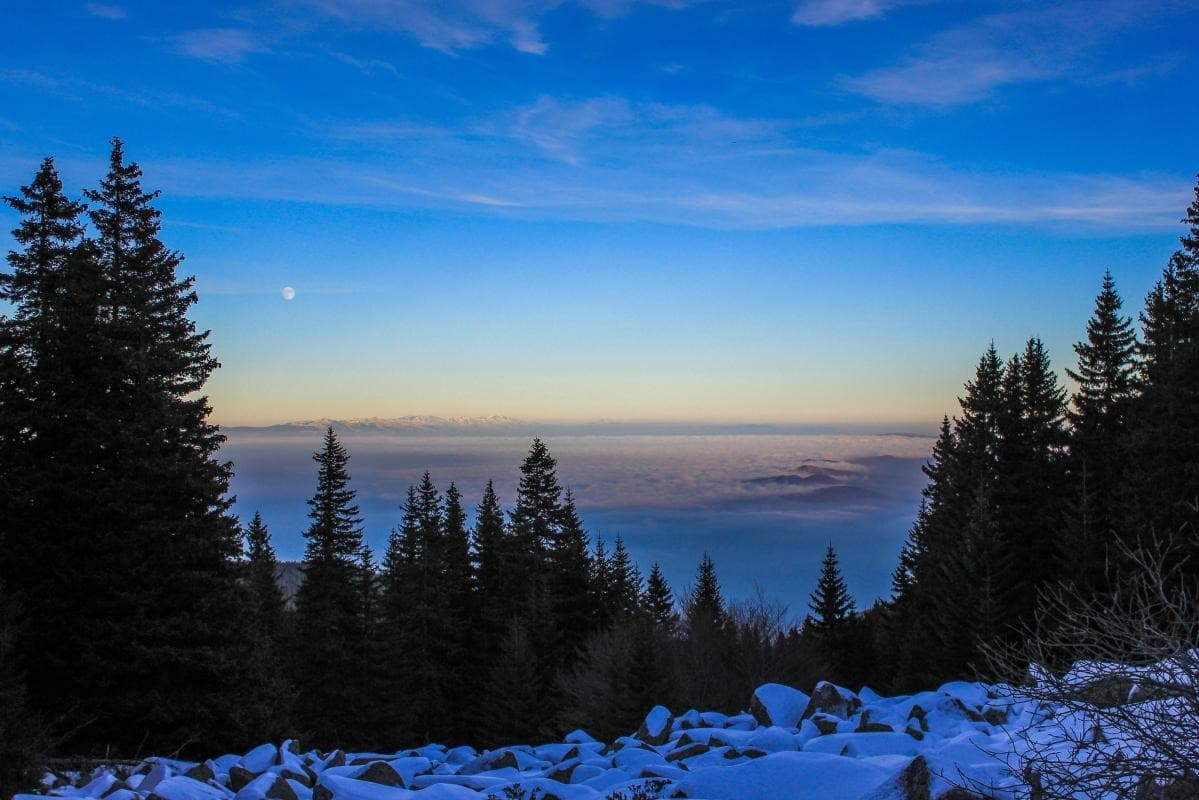
Evening and night change the tone. Guided night walks peel the mountain’s bright daytime palette down to charcoal and stars: salamanders slip through leaf litter, owls shift silhouette in the canopy, and Sofia below becomes a spread of concentrated light—the city’s constant hum turned visual. A moonlit summit is an oddly urban experience: you’re technically in wilderness, but the city’s orange glow keeps you anchored.
Practicalities matter here. The weather turns quickly—carry layers even in summer—and the microclimate means wind and sudden rain near the ridgeline are common. Footwear with ankle support and a grippy sole is worth the carry; on winter days the summit sits under snow and ice and requires crampons and experience. Water sources exist at lower huts, but filtration is wise if you plan a long loop. Transport is easy: buses and taxis from central Sofia reach trailheads like Simeonovo and Aleko, and guided tours often include pickup.
Why go? Vitosha is an unusually immediate mountain: you can breakfast in Sofia and stand above the capital by lunchtime. That proximity lets you do more—bike in the morning, ride a paraglider in the afternoon, and finish with a country-style dinner below Boyana. It’s a place for quick, repeatable adventures where the reward—the wide, approachable views, the clean stone air—feels earned but never remote.
For anyone who travels for altitude with a small time budget, Vitosha is exceptional. It’s a training ground for bigger trips, a playground for technical riders and paragliders, and a cultural foil to Sofia’s urban history. Go with a plan, respect the mountain’s quick weather, and you’ll find an entire Alpine mood an hour from the city center.
Trail wisdom
Small choices, better day.
Start early from Aleko
Morning light reduces crowds and gives you firmer trail conditions on the ascent to Cherni Vrah.
Layer for wind
Temperatures drop and gusts increase above 1,800 m—bring a windproof shell even on warm days.
If biking, hire a guide
Guides route you onto the best singletrack for your skill level and handle bike shuttles where needed.
Reserve paragliding in advance
Flights depend on weather and certified pilots; book ahead to secure your preferred window.
Local knowledge
Read the place, not just the route.
Watch for native species including European salamander, red deer and chamois in higher, less-used sectors.
Keep an eye out for wildlife during the transition between areas and habitats. Respect distance guidelines.
Stay on marked trails and avoid picking alpine plants; the park authority enforces rules to protect fragile high-mountain meadows.
Follow the guide's instructions on size limits, ethical handling, and leave-no-trace practices.
The Kopitoto cliff walk for unobstructed views over Sofia. The quiet meadow paths near Boyana Church for weekday solitude
Locally recommended viewpoints and quiet spots known best to local operators.
Vitosha was designated a nature park in 1934, one of the earliest protected areas in the Balkans.
Maritime roots and regional tradition shape the waterways and working coasts.
Seasonal guide
Four versions of the same landscape.
Spring
Best forwildflower meadows · early-season ridge hikes
Challengesmuddy trails · variable snow at higher elevations
Spring thaws open lower trails and paint the meadows, but expect mud and lingering snow above 1,800 m.
Summer
Best forday hikes to Cherni Vrah · mountain biking · paragliding
Challengesafternoon storms · crowds on weekends
Warm days and firm trails make summer ideal, though plan early starts to avoid storms and crowds.
Fall
Best forleaf-color hikes · clear long-views
Challengesrapid temperature drops · shorter daylight
Crisp air and clear visibility reward autumn trips—bring warm layers for colder ridgelines.
Winter
Best forsnowshoeing · alpine training
Challengesice, avalanche risk on exposed slopes · need for winter gear
Snow turns Vitosha into a true winter mountain; technical gear and local experience are essential.
Pack with intention
What to bring.
Good to know
Common questions.
Public buses and taxis run from central Sofia to trailheads like Simeonovo and Aleko; many guided tours include pickup from the city center.
Plan the edges
The details that make the day easier.
Vitosha Nature Park was established in 1934, making it one of the earliest nature reserves in the Balkans and among the oldest protected areas in Europe.
Mountain taverns around Boyana and Aleko serve hearty Bulgarian dishes—think grilled meats, Shopska salad, and banitsa—paired with rakia; local guides often recommend combining a summit hike with a traditional meal in the foothills.
- Distance from Sofia center
- ~15–20 minutes by car to trailheads; highest point Cherni Vrah: 2,290 m; no permits required for day hikes; best single-day options: Aleko→Cherni Vrah or Kopitoto viewpoint; nearest city: Sofia.
Stick to marked trails, pack out all trash, and avoid trampling alpine meadows; support local guiding services that contribute to trail maintenance and education.
Explore by topic
Follow the threads.
Keep exploring
Make the story part of the trip.
Set out from Bass Harbor for a private, customizable day on Blue Hill Bay — lighthouses, puffins, seals, and the chance to feel Acadia from the water. Small groups, local captains, unforgettable views.
In four hours you can move from shaded canyon ferns to wind-scoured coastal ridgelines, guided by someone who knows where the light—and the hidden views—live. This private half-day hike on the Monterey Peninsula or Big Sur is compact, curated, and perfect for travelers who want depth without a multiday commitment.
 Related story
Beneath a sky of shifting light, Skaftafell’s ice reads like a map of time. This three-hour guided glacier hike mixes technical instruction with geology and culture: compact, safe, and unforgettable.