
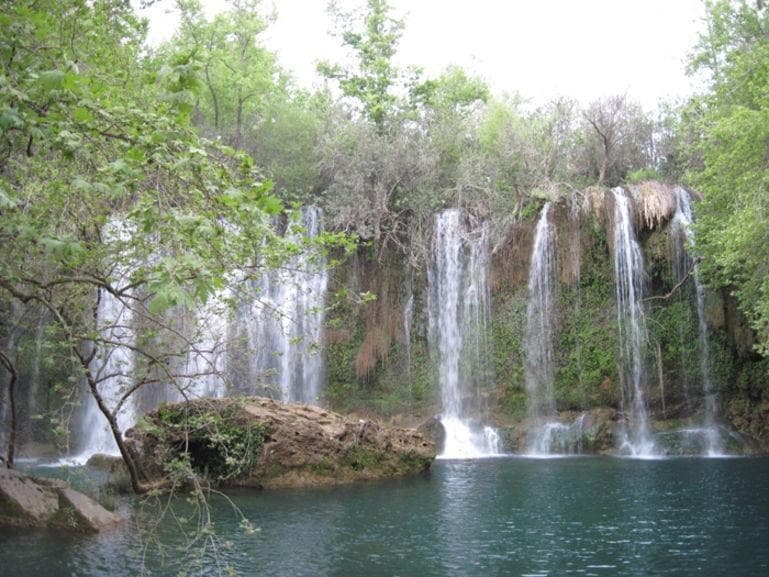
What the day feels like
You step off the narrow road and into a different tempo: damp earth, the green hush of plane trees, and the constant, unhurried voice of falling water. Kursunlu Waterfalls (Kursunlu Şelalesi) is not a thunderous, Instagram-ready drop; it’s a cluster of cascades and turquoise pools threaded by wooden boardwalks and shadowed by reed beds. Close to Antalya yet feeling worlds away, the park compresses everything a day-tripper hopes for—cool shade, easy trails, plentiful birds—and rewards a small investment of time with repeated, quietly dramatic angles on water and light.
The approach is part of the story. The Aksu River winds into a shallow limestone basin here, and over millennia its flow has etched terraces and channels through soft travertine. The result is a series of stepped rapids rather than a single cliff-face tumble: water veils over mossy ledges, threads through fallen logs, and pools into slow-moving basins where dragonflies hover and kingfishers dart. Boardwalks carry you close enough to watch minnows partition the shallows yet keep the fragile banks intact—a measured intimacy between visitor and river.
Kursunlu’s human history is modest but persistent. The park sits within a landscape that has supported settlements since antiquity, and the Aksu has long been a lifeline for fields and orchards downstream. Modern conservation efforts have focused on preserving the riparian corridor and the small wetlands that form behind the falls—places that punch well above their ecological weight for the number of species they shelter. Locals have always come for picnics and afternoon tea; today visitors arrive with cameras and hiking shoes, seeking a framed moment of coolness away from the summer heat.
Geologically, the falls are a study in soft-rock erosion. The travertine terraces and calcareous sediments give the pools their pale-blue sheen and encourage the slow, sculptural shapes of the cascades. Because the bedrock is forgiving, walking routes are gentle: a compact loop of boardwalks and dirt trails totaling roughly 1–1.5 kilometers with minimal elevation gain. It’s an easy walk but one that demands attention—roots, damp planks, narrow viewpoints—so sensible footwear matters.
Culturally, Kursunlu is an antidote to the polished resort experience of Antalya’s coastline. You’ll find local families picnicking under the trees, older men playing backgammon at shaded tables, and small kiosks serving Turkish tea and gözleme. Combine the falls with a stop in Antalya’s Old Town to taste layered history, or pair it with nearby natural sights such as Düden Waterfalls for a day that alternates between urban charm and riverine calm.
Practical nuts-and-bolts: expect to spend 60–90 minutes on the loop if you’re photographing and pausing to watch wildlife; half a day if you picnic or explore every hidden corner. The path is suitable for fit families and casual hikers—children can manage it—and the park has defined trails that minimize impact on sensitive riparian areas. Facilities are basic: a small entrance kiosk, benches, picnic areas, and a modest café; bring water and snacks in high season if you want more options.
When to go? Spring is the sweet spot. By April–May the river is lively, the surrounding orchards are blossoming, and the sun is warm but not punishing. Summer delivers strong light and hot temperatures—early morning or late afternoon visits work best—while autumn brings softer color and fewer crowds. Winters are quiet and green but occasionally wet; boardwalks can be slippery.
Conservation is part of the experience here. Stay on the boardwalks, don’t feed wildlife, and carry out any trash: the park’s fragile reed beds are wintering and breeding habitat for birds and amphibians. The management charges a small entrance fee that supports upkeep and habitat protection—an example of how modest visitor contributions can keep a place like Kursunlu functioning as a living ecosystem rather than a photo backdrop.
For travelers based in Antalya, Kursunlu is a practical half-day escape that feels like a mini expedition. It demands nothing extreme—no ropes, no creek crossings—but rewards attentiveness: follow the kingfisher past a reed bend, catch sunlight slanting through plane-tree leaves onto a shallow pool, and you’ll understand why so many visitors fold the falls into a longer exploration of Antalya’s natural and cultural edges.
If you’re packing for the trip, prioritize comfort and versatility: light layers for shade-to-sun changes, shoes that grip when planks are wet, and a small kit for insect protection. For photographers, a neutral-density filter will let you smooth the water without overexposing highlights; for birdwatchers, a pair of binoculars and a patient timeline will pay back in colorful kingfishers and herons.
Kursunlu isn’t a remote waterfall that requires a day of trekking, nor is it a theme-park spectacle. It’s a modest, well-loved landscape where water persists through shade and stone, where the environment still sets the pace. For a traveler in Antalya who wants to trade heat and crowds for green shade and the steady soundtrack of moving water, Kursunlu delivers a quietly memorable dose of nature that’s easy to reach and hard to forget.
Trail wisdom
Small choices, better day.
Go early or late
Visit in the morning or late afternoon to avoid midday heat and to see more active birds like kingfishers and herons.
Grip your footing
Wear sturdy, closed-toe shoes—the boardwalks and damp trails can be slippery after rain or heavy use.
Bring cash for the kiosk
There’s a small entrance fee and local kiosks may accept only cash for tea or snacks.
Respect the habitat
Stay on designated paths and avoid touching vegetation or wildlife to protect fragile reed beds and nesting areas.
Local knowledge
Read the place, not just the route.
Watch for native species including common kingfisher (Alcedo atthis), grey heron (Ardea cinerea).
Keep an eye out for wildlife during the transition between areas and habitats. Respect distance guidelines.
A small entrance fee supports trail maintenance and habitat protection—stay on paths and carry out waste to reduce human impact.
Follow the guide's instructions on size limits, ethical handling, and leave-no-trace practices.
A quiet downstream bend accessed from the eastern boardwalk where kingfishers hunt at eye level. An early-morning misty corridor near the picnic area that makes for excellent macro shots of dew and dragonflies
Locally recommended viewpoints and quiet spots known best to local operators.
Kursunlu sits on the Aksu River and has long been a local freshwater resource; the area was set aside as a nature park to protect its riparian habitat and species.
Maritime roots and regional tradition shape the waterways and working coasts.
Seasonal guide
Four versions of the same landscape.
Spring
Best forwildflowers and blooms · higher water flows · birdwatching
Challengesmuddy paths · increased insects
Spring (April–May) brings lively cascades, blossoming trees, and active birdlife—ideal for photos and comfortable hiking.
Summer
Best forearly-morning visits · picnics · combining with coastal trips
Challengeshigh daytime heat · larger crowds
Summer is hot but popular; arrive early to enjoy cool shade and quieter boardwalks before mid-day crowds.
Fall
Best forsofter light for photography · fewer tourists · pleasant temperatures
Challengesshorter daylight hours · occasional rain
Autumn offers comfortable temperatures and gentle light—great for photographers and calm walks.
Winter
Best forgreen landscapes · storm-washed colors · solitude
Challengeswet, slippery surfaces · limited kiosk services
Winters are quiet and green; bring waterproof layers and expect fewer amenities to be open.
Pack with intention
What to bring.
Good to know
Common questions.
Plan on 45–90 minutes to complete the main loop at a relaxed pace, longer if you stop for photos or a picnic.
Plan the edges
The details that make the day easier.
Kursunlu Waterfalls lie on the Aksu River about 20 km northeast of Antalya and are one of the closest waterfall nature parks to the city.
Locals picnic under plane trees and buy tea and gözleme from small kiosks; pairing a visit with Antalya’s Old Town lets you shift from river tranquility to Ottoman-era streets and seafood meyhanes.
- Distance from Antalya
- ~20 km (30–40 minutes by car). Typical visit length: 1–2 hours. Difficulty: easy. Facilities: small kiosk, picnic spots, restrooms. Best time: spring and early morning in summer.
Stick to boardwalks, pack out trash, and avoid feeding wildlife; entrance fees contribute to habitat upkeep—support local conservation by following park rules.
Explore by topic
Follow the threads.
Keep exploring
Make the story part of the trip.
 Related story
Less than two hours from Nairobi, Kereita Forest pairs hands-on canopy adventure with quiet montane trails and a sobering colonial history—perfect for families, teams, and curious travelers seeking a full-day pulse of nature.
Set out from Bass Harbor for a private, customizable day on Blue Hill Bay — lighthouses, puffins, seals, and the chance to feel Acadia from the water. Small groups, local captains, unforgettable views.
In four hours you can move from shaded canyon ferns to wind-scoured coastal ridgelines, guided by someone who knows where the light—and the hidden views—live. This private half-day hike on the Monterey Peninsula or Big Sur is compact, curated, and perfect for travelers who want depth without a multiday commitment.