
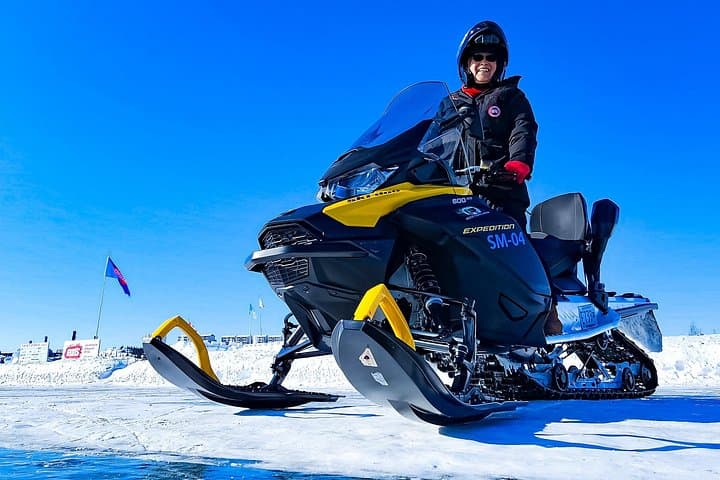
What the day feels like
The first time you let the throttle breathe on a northern snowmobile, the world rearranges itself: sound compresses into a single, steady thrum, your cheeks press into crisp air, and everything past the windshield becomes spare and immediate. Outside Yellowknife the city shrinks to a ribbon of lights while plains of snow open up—flat as a white ocean, punctuated by the dark ribs of jack pine and the occasional frozen inlet that dares you to cross it. On a 90-minute tour, an expert guide hands you the controls, points to the horizon, and you find that speed translates into something like calm—an oddly meditative forwardness across lakes that have been silent through deep winter.
This is not a stunt sports run. It’s a measured introduction to a vast subarctic landscape that has shaped human lives for millennia. The land here is defined by ice: Great Slave Lake’s ribs freeze into highways and off-lake trails cut through black spruce and tundra that remembers the last glacial scrape. The Dene and other Indigenous peoples have traveled and hunted across these expanses since long before Yellowknife became the capital of the Northwest Territories. Today, snowmobiling is a practical way to cross terrain that would otherwise be inaccessible in winter and an honest way to feel the rhythm of the north.
Geology and weather are inseparable partners in the experience. The landscape is a record of glaciation—glacial till, exposed bedrock outcrops, and flat basins that fill with water in summer and harden into ice in winter. Temperatures commonly sit well below freezing; on clear nights the bite of wind can make the world feel like glass. That glass is part of what makes snowmobiling here so cinematic: the vast frozen lake reflects the sky and, after dark, becomes a stage for the aurora.
Culturally, this ride is an informal bridge between town life in Yellowknife—where museums like the Prince of Wales Northern Heritage Centre preserve regional history—and the working wilderness beyond. Guides are often local outdoorspeople and trappers with practical, earned knowledge: where the ice is thin, where beaver activity undermines a shoreline, how to read the sky for fast changes. They teach you not only to ride, but how to move through an ecosystem that can be unforgiving if you’re unprepared.
Practicalities are straightforward: the tour lasts about 90 minutes, runs over groomed trails and frozen lake surfaces, and is rated for beginners through experienced riders. There’s minimal elevation gain—this is flat country—but the technical demands aren’t about climbing as much as they are about cold-weather judgment and machine handling. You’ll get a brief safety and handling lesson, helmets, and instruction on following a lead guide. For photographers and aurora chasers, timing matters: midday rides are easier on the cold and give sharper, high-key landscapes; twilight runs offer the chance to catch that northern light shift; evening excursions that head out after dinner increase your chances of seeing the aurora, though they require more time in the cold.
Safety is not optional. Dress in insulating layers, bring a face mask or balaclava, and accept the guide’s advice on speed and spacing—the sled ahead is your primary read on changing conditions. Keep a compact windproof shell as your outer layer and gloves rated for subzero temps. The machines are designed for cold-weather reliability, but mechanical savvy helps: simple checks—fuel, throttle, and brake response—before you push off can prevent a roadside freezeout.
Why go? Because this ride compresses a full northern adventure into something manageable: the thrill of speed without the technical demands of alpine touring, the closeness to wilderness you can’t reach by road alone, and the practical joy of moving across ice like people have for generations. It’s also accessible—no prior snowmobile experience required—and for many travelers an efficient way to sample Yellowknife’s winter offerings in a single morning or evening.
If you’re planning, consider adding a stop in Old Town afterward: a short drive back to Yellowknife will put you close to local cafes, a museum, and often the chance to warm up with a local brew and swap photos. And when you want to book, look for reputable operators who outfit riders with proper helmets and thermal suits and who emphasize trail etiquette and environmental care. For a ready-to-book option and more details, check this local expert listing for a guided option that explores frozen lakes and northern wilderness: <a href="https://app.advcollective.com/local-experts/snowmobile-adventure-from-yellowknife-explore-frozen-lakes-and-northern-wilderness">Snowmobile Adventure from Yellowknife</a>. That page has specifics on timing and what the operator provides, which helps you plan layers, camera gear, and whether to pursue an evening run for aurora potential.
This ride isn’t only about speed. Slow stretches between throttle bursts allow you to listen—the soft crunch under skis, the distant caw of ravens, the muffled slap of wind on snow. That’s when the north asserts its personality: patient, expansive, and always a little bit wild. Leave the race mentality at the trailhead. Here, moving deliberately and respectfully through ice and forest is what makes the experience rewarding and safe.
Trail wisdom
Small choices, better day.
Dress in Layers
Base layer with moisture-wicking fabric, insulating mid-layers, and a windproof outer shell will keep you comfortable during 90 minutes on open ice.
Book for Optimal Light
Choose midday for landscape photography and twilight or evening runs if your goal is aurora viewing.
Follow the Guide
Keep spacing between sleds and follow the guide’s line—ice conditions can change suddenly near shorelines and in river mouths.
Protect Your Face
Windburn and frostnip are real; bring a balaclava or face mask and goggles to stay safe and warm.
Local knowledge
Read the place, not just the route.
Watch for native species including Snowy owl, Arctic hare.
Keep an eye out for wildlife during the transition between areas and habitats. Respect distance guidelines.
Operators typically use established trails to minimize impact on tundra and ice habitats; avoid venturing off guided routes to protect fragile winter ecosystems.
Follow the guide's instructions on size limits, ethical handling, and leave-no-trace practices.
Old Town waterfront viewpoints for quiet aurora watching. Small ice-shelf coves that offer striking blue ice patterns
Locally recommended viewpoints and quiet spots known best to local operators.
Yellowknife developed as a winter transportation hub and capital; the name references the local Dene people and early trade in copper knives.
Maritime roots and regional tradition shape the waterways and working coasts.
Seasonal guide
Four versions of the same landscape.
Spring
Best forLonger daylight · Photos of blue ice
ChallengesThinning ice near shore · Unpredictable freeze-thaw
Late winter into spring lengthens days and softens temperatures, but be cautious of thin ice near shorelines and slushy sections.
Summer
Best forN/A—tour not available · N/A
ChallengesNo snow or ice access
Summer brings open water and trails are not rideable—this experience is winter-only.
Fall
Best forAurora season ramping up · Changing light
ChallengesEarly-season thin ice in late fall · Variable trail grooming
Early or late fall can see quick temperature swings; operators typically wait until stable freeze before running tours.
Winter
Best forStable ice travel · Aurora viewing · Snow-covered trails
ChallengesExtreme cold nights · Short daylight in midwinter
Winter is prime season—expect reliable frozen lakes and groomed trails, but prepare for very cold conditions and limited daylight in deep winter.
Operator details
What the booking data adds.
Included
- ✓Snowmobile
- ✓Air-conditioned vehicle
- ✓Use of helmet
- ✓Safety Briefing & Snowmobile Operations Technics
Not included
- —Gratuities
- —Meals
Good to know
- ✓Not recommended for travelers with spinal injuries
- ✓Not recommended for travelers with poor cardiovascular health
- ✓Not recommended for pregnant travelers
- ✓Travelers should have at least a moderate level of physical fitness
- ✓A minimum number of 4 people is required for the tour to be viable. In the event that the minimum number has not been achieved, the tour will be rescheduled to the next available time.
- ✓The duration of transfers are approximate, the exact duration will depend on the time of day and traffic conditions
- ✓Tour times can change depending on actual bookings and weather on requested tour date. Supplier will notify you for any tour time changes.
Pack with intention
What to bring.
Good to know
Common questions.
No—this tour is suitable for beginners; guides provide a safety and handling briefing before departure.
Plan the edges
The details that make the day easier.
Yellowknife is the capital of Canada’s Northwest Territories and sits on the northern shore of Great Slave Lake—the lake is one of the deepest in North America.
After the ride head to Old Town for local flavor: warm up with hearty northern fare and seek out Bullock’s Bistro or a downtown brewpub to swap photos and stories. The Prince of Wales Northern Heritage Centre offers a compact cultural primer on the region’s Indigenous and mining history.
- Closest airport
- Yellowknife Airport (YZF)
- Typical drive to trailhead
- 10–30 minutes from downtown
- Cell service
- Good in town, patchy on lakes
- Permits
- None typically required for guided tours—operator provides gear and guidance
Stay on groomed trails, do not stop on fragile shoreline vegetation, and pack out any trash; local operators follow best practices to minimize noise and habitat disturbance.
Explore by topic
Follow the threads.
Keep exploring
Make the story part of the trip.
 Related story
Less than two hours from Nairobi, Kereita Forest pairs hands-on canopy adventure with quiet montane trails and a sobering colonial history—perfect for families, teams, and curious travelers seeking a full-day pulse of nature.
Set out from Bass Harbor for a private, customizable day on Blue Hill Bay — lighthouses, puffins, seals, and the chance to feel Acadia from the water. Small groups, local captains, unforgettable views.
In four hours you can move from shaded canyon ferns to wind-scoured coastal ridgelines, guided by someone who knows where the light—and the hidden views—live. This private half-day hike on the Monterey Peninsula or Big Sur is compact, curated, and perfect for travelers who want depth without a multiday commitment.