
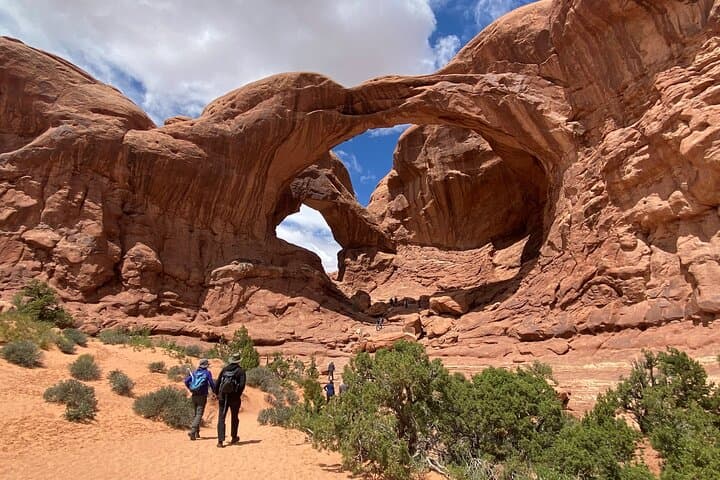
What the day feels like
First light skims the Entrada Sandstone and the rock wakes up, trading its dusky purple for a deep, convincing red. The desert doesn’t shout—it invites. On a half-day private tour of Arches National Park, you cross the threshold near Moab and the landscape begins a quiet conversation: fins whispering in lines, wind-carved amphitheaters humming with swallows, and stone windows widening as the sun climbs.
A private guide sets the pace. Some mornings it looks like easy sightseeing with short, fragrant strolls through juniper and pinyon to balanced boulders and tidy arches. Other days it unfolds as a series of longer hikes stitched together by stories—how the salt bed far below these slickrock domes rose, buckled, and fractured, and how time and water teamed up to carve more than 2,000 documented arches from the park’s layered geology. Here, nature has agency: monsoon storms chisel, freeze-thaw cycles pry, and the desert varnish paints its own dark signatures on pale walls.
You might begin at Park Avenue, where sheer walls form a corridor that feels like the opening credits of the Colorado Plateau. The sandstone here—mostly Entrada with flavors of Navajo and Dewey Bridge—shows its history in cross-bedding and color bands. Your guide points out cryptobiotic soil at your feet, a living crust that stitches the desert together. Step around it and you’re doing the small work of conservation; crush it and the landscape loses its armor. The desert notices.
Arches rewards curiosity. Pullouts that people rush past—Garden of Eden, Petrified Dunes—become slow-burn favorites when you know what you’re looking at. At the Windows Section, the scale finally lands: North Window framing a cobalt sky, Turret Arch keeping watch, Double Arch looming like twin portals. The trail rolls on solid slickrock with honest traction, though your calves feel each contour. In a private group, there’s time to linger for photographs, to wait for a cloud to move, to watch a raven ride thermals like it owns the joint. It does.
History threads in at Wolfe Ranch, a former homestead where wind-scuffed wooden beams tell a story of stubbornness and scarcity. Nearby, Ute petroglyphs sketch riders and bighorn sheep, historical record pressed into rock. Your guide will make it clear: this is a sacred archive. Look, learn, but do not touch. The desert remembers fingers.
If your group is feeling ambitious, the approach to Delicate Arch becomes the morning’s heart rate. The route climbs steadily over open slickrock, angles toward a sandstone ledge, and then—there it is. A freestanding arch, 52 feet tall, curving over air. It doesn’t need the hype. The La Sals stack blue on the horizon, the basin folds below, and the arch holds the wind like a question. In shoulder seasons, you can find quiet here; in summer, it’s a parade. The arch doesn’t mind. It endures.
The beauty of a private half-day tour is the calibration. Have kids or a traveler new to desert hiking? Your guide can prioritize short, scenic loops—Sand Dune and Broken Arch, Skyline’s lookouts, the broad overlook for Fiery Furnace—so you get the shapes without the strain. Want a steady effort? Stitch together Park Avenue, the Windows, and parts of Devils Garden to touch fins and spires with more walking, still within a comfortable half-day window. The park’s web of trails offers options, and an air-conditioned vehicle resets the day between stops, with cold water and snacks smoothing out the edges.
If you’ve never hiked on slickrock, it’s a confidence boost to learn its language. Rubber soles grip well on dry sandstone; avoid sandy marbles on top of rock, and watch for black ice in winter. Sun is the bigger obstacle. In summer, the heat pushes forward by mid-morning, so dawn departures are a smart play. Spring and fall let you breathe—cooler temperatures, calmer crowds—and winter paints the arches with a sugar dusting of snow that photographs like a dream, though icy patches can turn trails into puzzles.
The park’s cultural context is as layered as its rock. The Ancestral Puebloans and Fremont people moved through this region long before roads and entrance stations, leaving subtle traces in rock art and tools. In the modern era, Arches shifted from a remote curiosity to a national park in 1971, cementing its status as one of the crown jewels of the Colorado Plateau. With popularity came timed-entry reservations in peak seasons—one of those practical realities your guide can navigate so you spend more time exploring and less time at a gate.
By late morning, the light hardens and shadows narrow. It’s a different kind of beauty—honest, high-desert daylight. Maybe you end at Balanced Rock, its improbable capstone daring gravity, or at Panorama Point where the eye can rest on a horizon that refuses to be contained. The tour wraps, but the park lingers. Sandstone has a way of getting under your skin, recalibrating your sense of scale and time. The desert doesn’t hurry you; it just nudges you to notice.
Practical takeaways travel home with you. Hydration isn’t optional. Good footwear pays you back on the slickrock. Respect the biological soil crust, and stay on durable surfaces. Pack layers—mornings can be crisp, afternoons intense. And let a guide knit the landscape together with geology and story; Arches is more than its postcard arches. It’s the silence between the wind gusts, the lizard that pauses to eye you, the way the sun makes cathedral light from stone windows. The place is alive. The rock keeps speaking long after you leave.
Trail wisdom
Small choices, better day.
Start at First Light
Beat heat and crowds by entering the park near sunrise; the soft light makes the Windows, Park Avenue, and Balanced Rock pop.
Hydrate Like a Local
Carry at least 2 liters of water per person—even for a half day. Refill at the Visitor Center before heading deeper into the park.
Grip Matters on Slickrock
Wear trail shoes with solid rubber and tread; slickrock grips well when dry but sandy patches behave like ball bearings.
Watch Monsoon Skies
In late summer, storms can bring lightning and flash floods; your guide will adjust plans if clouds build fast.
Local knowledge
Read the place, not just the route.
Watch for native species including Desert bighorn sheep, Collared lizards.
Keep an eye out for wildlife during the transition between areas and habitats. Respect distance guidelines.
Stay on rock or established trails to protect fragile biological soil crusts. Pack out all trash and microplastics—wind can scatter even small bits far into the desert.
Follow the guide's instructions on size limits, ethical handling, and leave-no-trace practices.
Garden of Eden pullouts for uncrowded fins and spires. Panorama Point for wide-open views and sunset color
Locally recommended viewpoints and quiet spots known best to local operators.
Arches became a national park in 1971 after decades as a national monument; Ute and Paiute peoples have deep cultural ties here, and historic ranching remnants remain at Wolfe Ranch.
Maritime roots and regional tradition shape the waterways and working coasts.
Seasonal guide
Four versions of the same landscape.
Spring
Best forCooler hiking temps · Wildflowers along sandy washes
ChallengesUnpredictable wind · Occasional late storms
Spring brings ideal walking weather and blooming desert plants. Mornings can be crisp—pack a light layer.
Summer
Best forEarly sunrise missions · Long daylight hours
ChallengesHigh heat, 90–100+ °F · Heavy visitation and limited parking
Go early to beat heat and crowds, and plan short hikes with shade breaks. Hydration and sun protection are non-negotiable.
Fall
Best forStable weather · Golden light and thinner crowds
ChallengesPopular weekends · Cooler mornings
Autumn serves up comfortable temps and clear views—arguably the sweet spot for a half-day tour.
Winter
Best forSnow-dusted photos · Quiet trails
ChallengesIcy slickrock · Occasional road closures
Expect cold mornings and possible ice; traction aids are helpful after storms. The serenity is worth it.
Pack with intention
What to bring.
Good to know
Common questions.
Your guide customizes the day—anything from short, 0.25–1 mile walks to a 3–5 mile outing that may include Delicate Arch or parts of Devils Garden.
Plan the edges
The details that make the day easier.
Arches National Park contains more than 2,000 cataloged natural stone arches, including Delicate Arch, which stands about 52 feet high.
Back in Moab, refuel at Quesadilla Mobilla for trail-friendly eats or grab a burger and a cold house brew at Moab Brewery. Coffee before dawn? Moab Coffee Roasters opens early. If you have time, swing by the Moab Museum for context on Indigenous history and the town’s mining-to-adventure evolution.
- Closest airports
- Canyonlands Field (CNY, ~20 minutes) and Grand Junction (GJT, ~2 hours); Park entrance is ~5 miles from downtown Moab. Cell service is spotty to none past the Visitor Center. Timed-entry reservations are required seasonally—your tour operator typically covers park entry. Restrooms at major trailheads; water at Visitor Center.
This high-desert ecosystem is fragile. Stay on durable rock or sand to protect biological soil crusts, pack out every scrap of trash, and resist carving or touching rock surfaces—those oils and marks last.
Explore by topic
Follow the threads.
Keep exploring
Make the story part of the trip.
In four hours you can move from shaded canyon ferns to wind-scoured coastal ridgelines, guided by someone who knows where the light—and the hidden views—live. This private half-day hike on the Monterey Peninsula or Big Sur is compact, curated, and perfect for travelers who want depth without a multiday commitment.
 Related story
Beneath a sky of shifting light, Skaftafell’s ice reads like a map of time. This three-hour guided glacier hike mixes technical instruction with geology and culture: compact, safe, and unforgettable.
 Related story
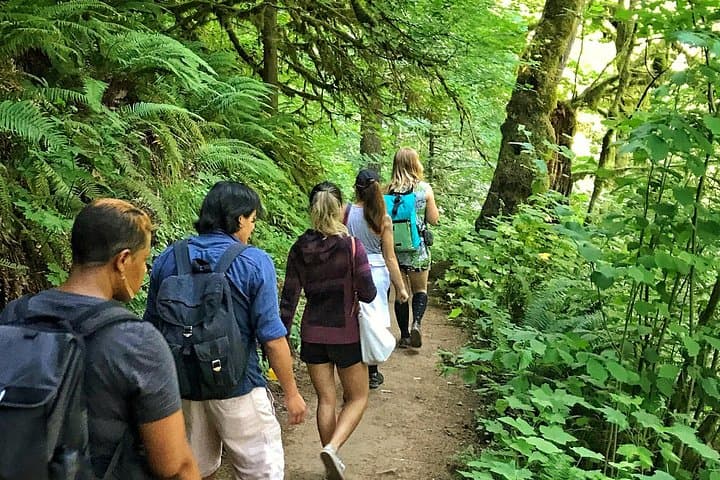
Lose the city for a few hours without leaving it: this 5-mile, 900-foot-gain Forest Park loop threads old-growth pockets, city viewpoints, and cultural landmarks for a compact taste of Portland’s wild side. Expect moss, roots, and stories.