
What the day feels like
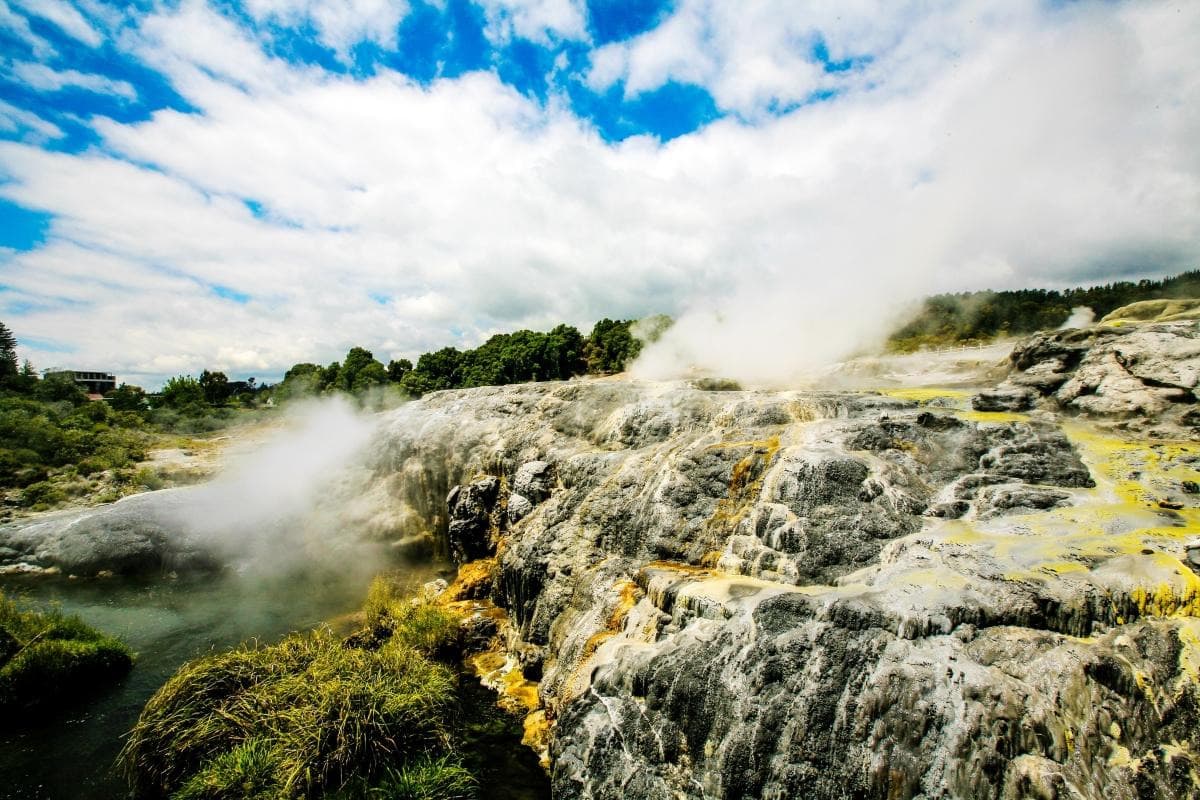
You step off the bus and the air meets you like a story: warm, mineral-rich, threaded with the sour snap of sulfur. Steam threads up between native pines and the carved whare of the Arts and Crafts Institute, punctuating Rotorua’s low, volcanic hum. Ahead, Pōhutu—Te Puia’s signature geyser—draws a crowd the way a lighthouse draws mariners: expectant, a little reverent, waiting for the next plume to rip through the sky.
Te Puia is a place that asks to be experienced at two speeds. There’s the slow way—lingering at the Kiwi Conservation Centre, watching a bemused kiwi forage under red light; listening to the cadence of tohunga telling whakapapa (ancestral stories) in a carved meeting house; tasting the iron-rich tang of a hangi-cooked meal. And there’s the abrupt, elemental speed of a geyser eruption or the roiling, viscous boil of a mud pool. Together they create a counterpoint: culture kept alive in an actively shifting, volcanic landscape.
Geology and history are braided at Te Puia. You’re standing inside the Taupō Volcanic Zone, one of the planet’s most geothermally active belts. The boiling pools and steam vents are surface punctuation marks of heat and pressure that come from deep within the crust. Māori have lived and adapted here for centuries; the thermal energy shaped settlement patterns, food preparation (the earth oven, or hangi), and spiritual ties to land and water. Te Puia, formally the New Zealand Māori Arts and Crafts Institute, opened in the 20th century as a living center to teach carving and weaving traditions that were at risk of being lost—so the place is both a geology textbook and a cultural conservatory.
This combination makes Te Puia uniquely suited to a handful of travel approaches. It’s a stand-alone half-day experience for culture-seekers and photographers; it slots neatly into a Rotorua loop that includes Wai-O-Tapu’s alien-colored springs, the Redwoods Treewalk’s dappled suspension bridges, or the restorative Polynesian Spa. For travelers based in Auckland, guided options—day trips that pair Te Puia with Waitomo’s glowworm caves or Hobbiton’s movie-set rolling hills—turn a long day into a string of signature North Island experiences.
On arrival your route will likely follow boardwalks and well-signed trails: easy walking but not without sensory warnings. Scalding steam can hiss from vents inches from the path; the mud pools bubble with slow theatricality. A guided Māori cultural performance is often the emotional high note of a visit—haka, waiata (songs), and poi, followed sometimes by a hangi meal where geothermal steam has been part of the cooking process.
Practicalities: a typical guided visit at Te Puia runs about 90 minutes to two hours if you stay for the carving school and Kiwi Centre; combine it with a performance and hangi and budget a half to three-quarters of a day. Most tours include transportation from Rotorua or Auckland; morning departures from Auckland can be early (pickups around 06:00) but they deliver a day rich with rural Waikato landscapes en route. The site is family-friendly and mostly accessible, but some paths include steps and uneven boardwalks—sturdy footwear matters. Expect sulfur on your clothes; a breath mint helps.
For photographers, the geyser’s eruptions are dynamite—use a fast shutter to freeze the silhouette against sky, but also take wide-angle shots that place the plume among trees and carved buildings to blend the natural and cultural narrative. Early morning or late afternoon light softens the steam; midday can be harsh but it’s when thermal colors pop.
Combine Te Puia into wider sightseeing for a fuller sense of the region. Wai-O-Tapu’s neon hot springs and Lady Knox geyser offer a more flamboyant color palette; Waimangu Volcanic Valley provides a walking experience that reads like a post-eruption geological field trip; the Redwoods Treewalk lifts you above the forest floor for a different kind of vertical perspective. Small-group and private options let you add hangi lunch or a spa hour at Polynesian Spa—perfect for shaking the day’s road dust.
A few on-site realities to respect: the geothermal features are fragile and sometimes unpredictable—stay on marked boardwalks, don’t toss anything into pools, and follow guides’ instructions. Much of the cultural programming is delivered by local iwi (tribal) groups; engaging respectfully—arriving on time for performances, asking before photographing people in ceremonial contexts—makes the experience richer for everyone.
If you go with a day tour from Auckland, you’ll trade sleep for a long but highly concentrated travel day: expect nine to twelve hours on the move depending on traffic and tour inclusions, but also a chance to tick off multiple North Island highlights in a single, well-guided lap. If you’re based in Rotorua, slow it down—pair Te Puia with an evening soak in geothermal pools, a trail run in the Redwoods at dawn, and a local craft beer in town.
Te Puia is not a one-note attraction. It is steam and song, mud and meticulous carving, endangered bird conservation and volcanic theatre. It’s a place that wants you to hear the land: the geyser’s cough, the artisan’s rasp at wood, the low chorus of guide voices explaining why certain trees are left standing and why certain stones are sacred. It asks you to listen and to leave less than you found. For travelers who want their nature and culture conjoined—where the smell of the earth tells a story as clearly as carved cedar—the visit pays back in memory, and in the small, memorable details: the warmth of a hangi potato on a cold Rotorua morning, the sudden hush before a geyser speaks.
Trail wisdom
Small choices, better day.
Book cultural performances in advance
Haka performances and hangi lunches fill quickly—reserve a tour or performance slot to ensure you don’t miss the live cultural program.
Stay on boardwalks
Geothermal features are fragile and dangerously hot—do not stray from marked paths or touch the water.
Morning light for photos
Visit early for softer light and fewer crowds around Pōhutu; late afternoon is a good secondary option.
Combine nearby attractions
Pair Te Puia with Wai-O-Tapu, Waimangu or the Redwoods Treewalk for a full-day loop that shows different geothermal expressions.
Local knowledge
Read the place, not just the route.
Watch for native species including Kiwi (Stewart Island / brown kiwi in conservation enclosures), Native birdlife like tūī and kererū in surrounding forests.
Keep an eye out for wildlife during the transition between areas and habitats. Respect distance guidelines.
Te Puia participates in kiwi conservation and cultural preservation; visitors are encouraged to follow boardwalks and support Māori-run experiences to reduce impacts and sustain local stewardship.
Follow the guide's instructions on size limits, ethical handling, and leave-no-trace practices.
Early-morning walk to nearby Whakarewarewa thermal area for quieter pools. Carving school demonstrations—ask for hands-on sessions or times when apprentices work
Locally recommended viewpoints and quiet spots known best to local operators.
Te Puia houses the New Zealand Māori Arts and Crafts Institute, established to revive and pass on traditional carving and weaving skills; it sits within Rotorua’s long-settled geothermal landscape tied to Ngāti Whakaue and other iwi.
Maritime roots and regional tradition shape the waterways and working coasts.
Seasonal guide
Four versions of the same landscape.
Spring
Best forcooler morning steam photography · blooming native flora
Challengesoccasionally rainy days · variable road conditions if touring from Auckland
Spring brings crisp light and wildflowers; steam contrasts well with fresh greens but pack a rain layer for showery spells.
Summer
Best forlonger daylight for extended touring · pairing with outdoor activities like Redwoods Treewalk
Challengeslarger crowds · strong midday sun
Summer gives extended visiting hours and easier regional travel—expect more tourists and stronger sun exposure.
Fall
Best forsoft evening light · fewer crowds · crisp air accentuating steam
Challengesshortening days · cooler mornings
Autumn’s light is excellent for photography and cooler temperatures make geothermal steam more dramatic.
Winter
Best fordramatic steam against cold air · quieter site visits
Challengescold mornings, possible frost · reduced restaurant hours in town
Winter’s cold makes geyser plumes photographically striking—dress warmly and expect quieter trails.
Pack with intention
What to bring.
Good to know
Common questions.
Plan 1.5–2 hours for the core geothermal and carving displays; add time for a haka performance, hangi lunch, or the Kiwi Centre—these can extend your visit to half a day.
Plan the edges
The details that make the day easier.
Pōhutu Geyser is often described as the largest active geyser in the southern hemisphere and can erupt multiple times a day, shooting steam and water more than 30 meters high.
Te Puia is a hub for Māori arts: watch carvers and weavers at work, sample hangi-cooked fare, and support on-site galleries selling hand-carved pieces—many programs are run by local iwi, offering direct cultural connection.
- Know-before-you-go
- Allow 1.5–3 hours; major guided tours depart from Rotorua and Auckland (early pickup); boardwalks and interpretive signage; onsite Kiwi Centre and performance schedule—book in advance.
Stay on marked paths, don’t remove geothermal material, and favor Māori-led tours and local crafts to ensure cultural and environmental benefits stay in the community.
Explore by topic
Follow the threads.
Keep exploring
Make the story part of the trip.
 Related story
Less than two hours from Nairobi, Kereita Forest pairs hands-on canopy adventure with quiet montane trails and a sobering colonial history—perfect for families, teams, and curious travelers seeking a full-day pulse of nature.
Set out from Bass Harbor for a private, customizable day on Blue Hill Bay — lighthouses, puffins, seals, and the chance to feel Acadia from the water. Small groups, local captains, unforgettable views.
In four hours you can move from shaded canyon ferns to wind-scoured coastal ridgelines, guided by someone who knows where the light—and the hidden views—live. This private half-day hike on the Monterey Peninsula or Big Sur is compact, curated, and perfect for travelers who want depth without a multiday commitment.