
What the day feels like
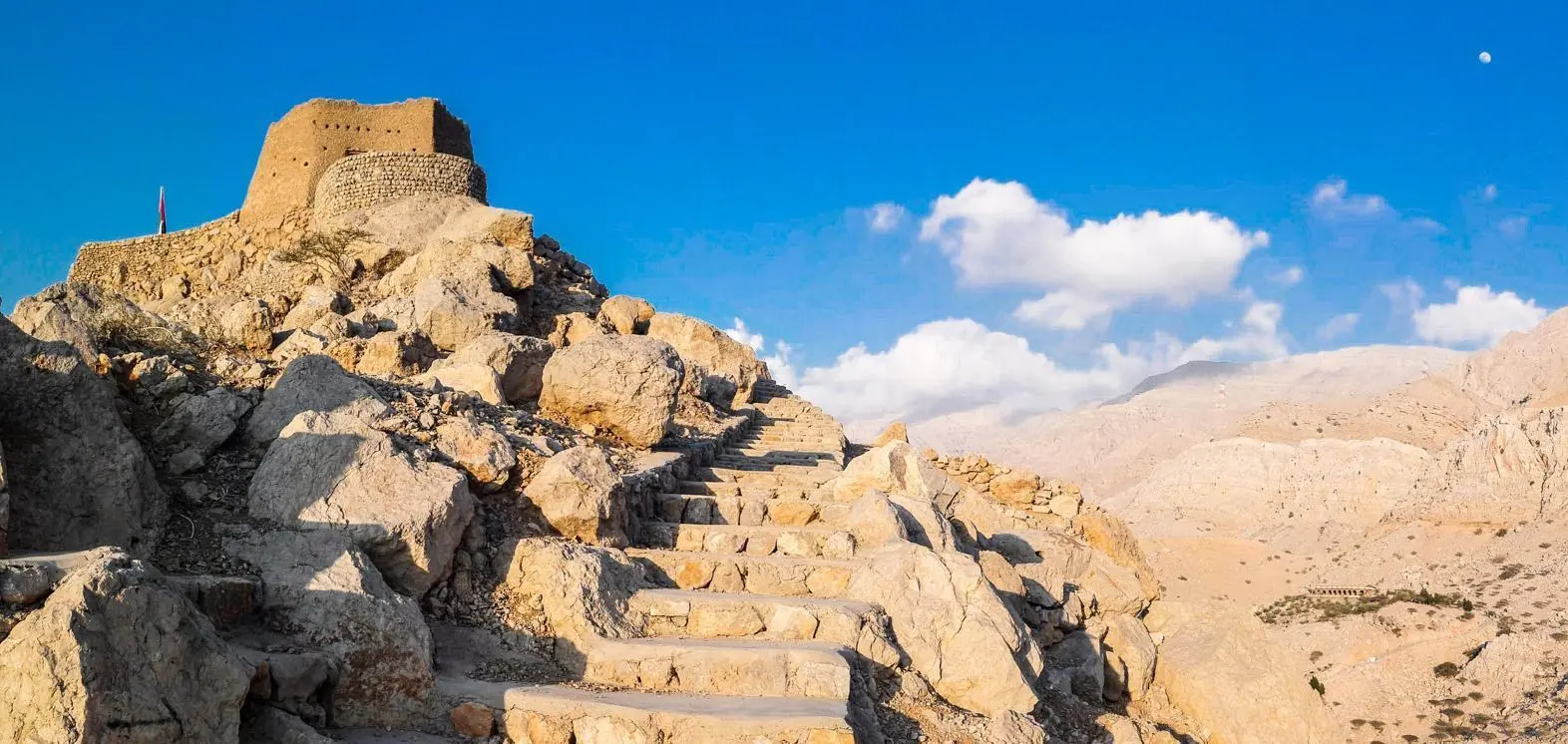
You arrive at Dhayah Fort as the light softens—the sun lowering over a flat Arabian plain of palms and saltwater lagoons, the Hajar Mountains a distant serrated backbone. The fort perches like a fossilized crown atop a rocky knuckle, its ochre stonework warmed by late-afternoon sun. There’s no fanfare here: no ticket booth, no coffee shop, only low mud-brick walls, a scattering of tourists and local families, and a narrow stone stair that winds up to the fort’s final ramparts. The climb is short but honest, and the payoff is immediate: a 360-degree view that reads as a condensed atlas of Ras Al Khaimah—date plantations, the sweep of the Gulf, the small, scattered islands of Al Marjan, and the ghost-lines of old fishing villages.
Dhayah Fort is compact, muscular, and unapologetically historic. Built and rebuilt over centuries, it sits on a small granite summit that was fortified to control inland routes and sea approaches. The stone is older than the nation that now claims it; beneath your boots are broken walls that narrate invasions, sieges and a way of life long tied to the sea. The fort’s most famous chapter came in the early 19th century when it was the site of a siege during the British punitive expedition against the local Qawasim power—its surrender marked a turning point in the region’s relationship with imperial navies and the geopolitics of the Gulf. Stand on the roof and you feel the weight of that history, as well as a clearer story of human adaptation: how communities clustered around water and trade, and how forts like Dhayah were both defensive bulwarks and symbols of local authority.
Geologically the hill is stubborn: a flinty outcrop of older rock rising out of alluvial plain and sand. That hardness made it ideal for fortification and gives the site its rugged texture—the stone steps are carved, worn in places, and uncompromising underfoot. The fort’s architecture is spare, utilitarian, and resolutely unary: a few towers, connecting walls and a central keep where defenders would have mustered. The masonry is typical of coastal forts across the Gulf, pragmatic work meant to last, stitched into the land rather than imposed on it.
You’ll visit Dhayah most often as part of a broader Ras Al Khaimah day: the fort appears on itineraries that combine cultural stops—National Museum, Mohammed Bin Salim Mosque—with coastal scenery like Al Marjan Islands and the preserved fishing village of Jazirat Al Hamra. Operators offering private or small-group tours (including convenient pick-up from Dubai) fold Dhayah into a well-paced loop—arrive mid-morning, climb before the heat of midday, then cool off with a seaside lunch or a walking tour through Jazirat Al Hamra, whose deserted lanes whisper of the emirate’s pearl-diving past.
Practical details you’ll want to know: the climb is short but steep—expect roughly 100–150 stone steps and a net elevation gain in the order of 80–120 meters (a brisk 20–30 minute round trip from the parking area to the ramparts and back for most people). The terrain is solid rock and well-trodden, but the steps can be uneven and sun-exposed. On its own, Dhayah is a half-hour adventure; combined with nearby heritage sites it makes a compact half-day or a relaxed full day if you’re adding a museum, old souk shopping, or a beach stop.
Footwear matters: choose grippy shoes, not flip-flops. Bring water, sun protection, and a light wind layer for late afternoons—the Gulf wind can turn cool after sunset. If you’re shooting photos, come for golden-hour; the light is flattering and the shadows on the stone create texture that reads beautifully in-camera.
For culture-minded travelers, the fort is an excellent primer in Ras Al Khaimah’s layered identity: a maritime emirate whose fortunes rose with pearl-diving and overland trade, and whose modern reinvention includes luxury islands, mountain escapes and archaeological work that stretches back millennia. Local guides will wind anecdotes and dates into your climb—how families moved between the coast and the inland wadis, how forts like Dhayah joined a network of defensive architecture, and why the nearby abandoned village of Jazirat Al Hamra is such a rare survival of traditional architecture in the Gulf.
Combine Dhayah with a walking tour through Ras Al Khaimah town or a private transfer from Dubai for maximum flexibility. Tours that include the National Museum give richer context; visiting Jazirat Al Hamra afterward feeds your curiosity about daily life before oil and large-scale development. If you want to stretch the day into leisure, finish with an hour on Al Marjan Islands—a civilized, easy coastline where the water invites cooling off.
The fort is small enough to avoid feeling like a destination trapped under a tourist stampede, but popular enough that mornings and late afternoons are the best windows for quiet and shade. There’s a particular pleasure in watching families arrive, climb, and exchange quiet satisfaction at the summit—a reminder that this is still a place of communal memory, not just a postcard.
Dhayah Fort is not a strenuous wilderness challenge; it’s an elevation of perspective. It asks for little: an hour of your time, sensible shoes, and an appetite for history and open skies. In return it gives something disproportionately large—a compact, tactile lesson about the Gulf’s past and a horizon-wide view that ties the emirate’s sandy, salted present back to the rocks people once used to keep watch and to keep the sea honest.
Trail wisdom
Small choices, better day.
Time your climb
Avoid midday heat—start early or late afternoon for cooler temperatures and better light for photos.
Wear grip shoes
Stone steps are uneven and can be slippery; low-profile hiking shoes or trainers with good traction are best.
Carry water and sun protection
There’s little shade on the approach; bring at least 1 liter of water per person and a wide-brim hat.
Combine nearby sites
Pair Dhayah with Jazirat Al Hamra or the National Museum to turn a quick visit into a half-day cultural loop.
Local knowledge
Read the place, not just the route.
Watch for native species including Osprey and other coastal raptors, Eurasian hoopoe and local passerines near date plantations.
Keep an eye out for wildlife during the transition between areas and habitats. Respect distance guidelines.
The site is archaeological and fragile—stick to established paths, avoid climbing on unstable ruins, and support local guides who promote respectful visitation.
Follow the guide's instructions on size limits, ethical handling, and leave-no-trace practices.
Walk the shoreline near Al Marjan Islands at low tide for quiet coastal views. Explore the narrow lanes of Jazirat Al Hamra to see intact coral-stone architecture and old pearl-diving houses
Locally recommended viewpoints and quiet spots known best to local operators.
Dhayah Fort played a pivotal role during the early 19th century when British forces attacked coastal settlements; its 1819 siege is a notable event in the region’s modern history.
Maritime roots and regional tradition shape the waterways and working coasts.
Seasonal guide
Four versions of the same landscape.
Spring
Best formild weather · wildflower sightings nearby · comfortable sightseeing
Challengesoccasional wind · variable temperatures early/late
Spring brings mild days ideal for climbing Dhayah and exploring nearby heritage sites—pack a light layer for breezy mornings.
Summer
Best forfewer tourists · cheap off-season rates
Challengesextreme heat · midday closures of outdoor activities
Summer is very hot; schedule climbs for pre-dawn or late evening and avoid prolonged sun exposure.
Fall
Best forpost-monsoon clarity · good hiking conditions · photography
Challengesstill-warm afternoons · shortening days
Autumn offers warm days and clear horizons—late afternoons are especially pleasant for views and photos.
Winter
Best forcool, clear weather · full-day sightseeing · combining beach and culture
Challengeshigher visitor numbers · book tours in advance
Winter is peak season: cool, clear and ideal for combining Dhayah with beaches or museums—expect more tourists.
Pack with intention
What to bring.
Good to know
Common questions.
The climb from the parking area to the ramparts typically takes 10–20 minutes; allow 30–60 minutes round trip including time to explore and photograph.
Plan the edges
The details that make the day easier.
Dhayah Fort was the site of a notable 1819 siege during a British punitive expedition, an event that shaped the region’s early 19th-century history.
Ras Al Khaimah balances fishing and date-farming traditions with modern tourism—sample grilled seafood along the coast, try local date-based sweets, and seek out small cafés serving Arabic coffee and karak tea.
- Nearest city
- Ras Al Khaimah (drive ~45–60 minutes from Dubai); visit time: 30–90 minutes; access: short steep climb; best time: Nov–Mar; combine with Jazirat Al Hamra and National Museum.
Respect fragile masonry and archaeological areas—stay on paths, avoid littering, and choose small-group tours that use local guides and support heritage preservation.
Explore by topic
Follow the threads.
Keep exploring
Make the story part of the trip.
 Related story
Aksla is the small mountain that makes Ålesund legible: 418 steps, sweeping panoramas, and a short tour that threads architecture and coastline into 90 minutes of memorable sightlines. Perfect for anyone who wants a quick, high-reward encounter with Norway’s west coast.
 Related story
The New York Public Library’s Main Branch is more than a photo stop—it's a civic living room, an architectural landmark, and a waypoint for walking tours that stitch together Midtown’s history, films, and holiday rituals. Here's how to make the most of a visit.
 Related story
Five miles of riverfront walking that reveal NYC’s quieter rhythms—Riverside Park pairs easy urban hiking with history, birdlife and a front-row view of the city’s climate resiliency efforts. Walk a stretch or follow the Greenway; either way, the Hudson makes its presence felt.