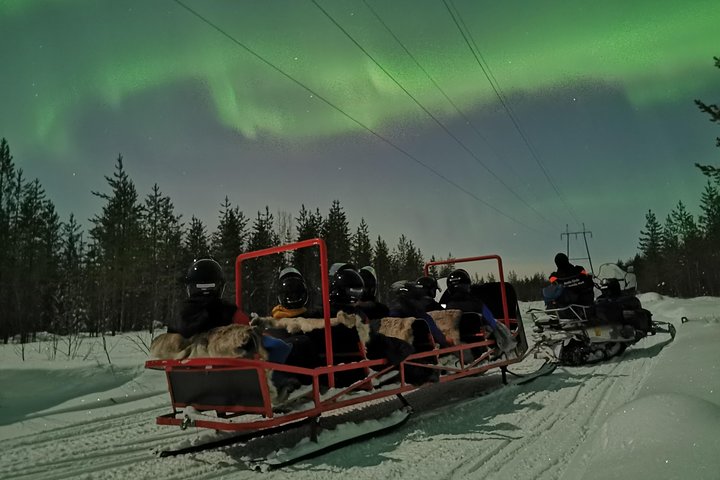
Night Ride Under the Auroras: A Northern Lights Sledge Ride from Rovaniemi
A two-hour guided sledge ride from Rovaniemi that puts you under the aurora and into Lapland’s winter wilds.
The engine tugs, the sledge sighs, and the forest leans in close—the trees a notch of black against a sky that starts to move. At first the aurora is a green wash, as if the night has been brushed from the inside. Then it tightens into curtains and coils that fold and unfurl like slow-motion waves. The driver nudges the sled across a frozen clearing. The snow underfoot has a voice—soft and cracking—and the night answers with a long, cold breath that smells faintly of pine and metal from the snowmobile. For two hours, you are held between the machine’s steady hum and a sky that insists on performing.
Trail Wisdom
Layer for Stillness
Dress to stay warm while standing still—use a weighty midlayer and insulated outer shell; bring mittens rather than thin gloves.
Protect Your Batteries
Cold reduces battery life—carry spares for cameras and phones in an inner pocket close to your body.
Stabilize Your Camera
Bring a compact tripod or use a steady surface for long exposures to capture the aurora clearly.
Trust the Guide
Follow the guide’s safety briefing—snowmobile-trail etiquette and distance from wildlife keep everyone safe.
Local Knowledge
Hidden Gems
- •Open frozen lakebeds around Rovaniemi—excellent for unobstructed sky viewing
- •Small family-run reindeer farms that offer short daytime visits and cultural context
Wildlife
Reindeer, Hares
Conservation Note
Operators aim to minimize light pollution and respect wildlife by using established trails and designated viewing spots; guests are encouraged to follow leave-no-trace principles.
Rovaniemi developed rapidly after World War II and was rebuilt according to Alvar Aalto’s postwar plan; it now serves as the administrative center of Finnish Lapland.
Seasonal Guide
spring
Best for: Longer daylight windows, Quieter trails
Challenges: Unstable weather, Thawing snow surfaces
Late winter/early spring can still produce auroras while offering slightly milder nights; be ready for variable snow conditions.
summer
Best for: Not applicable for this tour, Midnight sun activities
Challenges: No auroras during midnight sun, No snow for sledding
Summer months aren’t suitable—the midnight sun drowns auroras and there’s no snow for sledges.
fall
Best for: Dark nights returning, Autumn aurora chances
Challenges: Unreliable snow cover, Cool but not freezing temperatures
Early autumn offers the first aurora windows, but snow and sled operations are limited until consistent winter conditions arrive.
winter
Best for: Aurora viewing, Snow-covered scenery, Snowmobile and sledge operations
Challenges: Extreme cold nights, Short daylight hours
Winter is the ideal season—stable snow, regular tour operations, and the darkest skies for aurora viewing.
Photographer's Notes
What to Bring
Insulated ParkaEssential
Keeps you warm during long stretches of stillness under the night sky.
Insulated, Waterproof BootsEssential
Protects feet from cold and snow while standing on frozen ground.
Compact Tripod
Stabilizes your camera for long-exposure aurora photography.
Spare Batteries (in inner pocket)Essential
Cold drains batteries; keep spares warm to preserve power.
Common Questions
How likely am I to see the Northern Lights on this tour?
Aurora visibility depends on solar activity and cloud cover; operators pick dark, open sites to maximize chances but sightings cannot be guaranteed.
Do I need to drive a snowmobile?
No—the guide handles the snowmobile; guests ride in a sledge for the viewing portion and do not need any snowmobile experience.
What should I wear?
Wear thermal base layers, a warm midlayer, a windproof outer shell or parka, insulated boots, wool socks, mittens, and a hat; operators often provide additional outerwear if needed.
Is the tour suitable for children?
Many families participate; check age restrictions with the operator—small children should be securely seated and dressed warmly.
Can the tour operate in extreme cold or high winds?
Tours run within safety limits; very low temperatures or dangerous wind conditions may cause cancellations for guest safety.
Is photography allowed and will there be time to set up?
Yes—guides usually allow time for photographs and offer tips; bring a tripod and spare batteries for best results.
What to Pack
Insulated gloves (to keep hands functional for cameras), spare batteries (cold-resistant and warm in pocket), compact tripod (for long exposures), warm hat and neck gaiter (retain head heat and protect face).
Did You Know
Rovaniemi lies directly on the Arctic Circle and is officially marketed as the capital of Finnish Lapland.
Quick Travel Tips
Book transfers from Rovaniemi hotels ahead of time, check aurora forecasts the morning of your tour, keep electronics warm to preserve battery life, confirm pickup details with the operator
Local Flavor
After the ride, warm up with poronkäristys (sautéed reindeer) at a local restaurant like Nili or Roka, visit Arktikum museum for Arctic science and Sámi culture, and sample local craft beers or cloudberry desserts to round out the evening.
Logistics Snapshot
Closest airport: Rovaniemi Airport (RVN, ~10 km from city center); Meeting point: central Rovaniemi hotels or pickup (drive to wilderness viewpoints typically 15–40 minutes); Cell service: good in town, patchy in remote viewing spots; Permits: none required for commercial tours.
Sustainability Note
Choose operators that minimize light pollution, use established trails, and brief guests on reducing disturbance to wildlife—pack out all waste and avoid unnecessary flash photography.