
What the day feels like
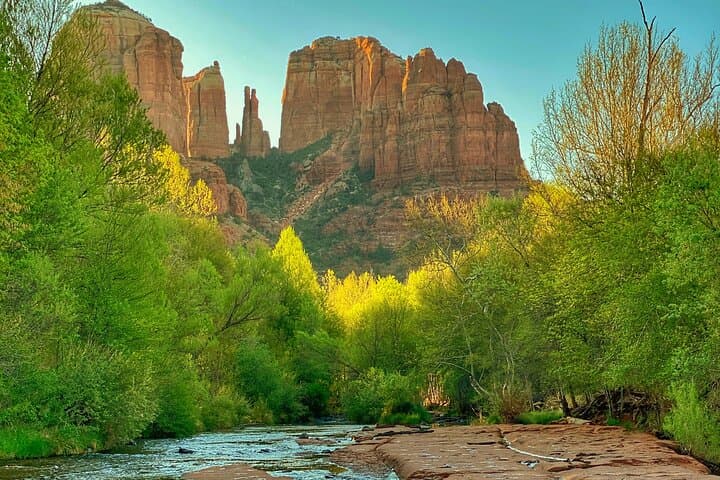
Morning finds Oak Creek wide awake. The current shivers over shallow riffles, shouldering past smooth stones and beckoning your boots to fall in step. Cottonwoods shake out their green flags, and somewhere a raven tosses a comment on the wind. Your guide lets the silence linger—Sedona does its best work when we listen—before pointing downstream to a bright window of red rock: Cathedral, rising like a verdict from the earth.
This is the Creekside of Cathedral hike, a private meander with a purpose. It begins low and soft in the riparian zone, where water sculpts the pace and temperature, then leans into the sandstone backbone that defines Red Rock Country. The trail traces the river’s cool breath, slipping past willow thickets and polished boulders, then gains to slickrock ledges where the land tilts toward the sky and views stack like postcards: Bell Rock and Courthouse Butte to the southeast, Twin Buttes and Gibraltar Rock shouldering the skyline, Wilson Mountain hulking to the north, and Airport Mesa catching last light like a landing strip for the sun.
Sedona’s fame is earned. The color alone—iron-rich sandstone baked to a deep, saturated red—makes the place feel otherworldly, but the story lives in layers. The monoliths here are sculpted from the Permian-age Schnebly Hill Formation, dunes that lithified into rock nearly 280 million years ago. Oak Creek, patient and relentless, sawed a corridor through the plateau and left these buttes and spires to weather the rest of the tale. The Yavapai and Apache people lived and traveled this landscape long before Sedona had a name, reading its seasonal cues and moving with the water. In the late 1800s, homesteaders worked the fertile flats along the creek; the old ranch at Crescent Moon is a relic of those days, now a day-use park where Cathedral Rock reflects perfectly in quiet pools when the wind sits down.
The hike here feels tuned—more considered than the straight-up scramble of the Cathedral Rock Trail from Back O’ Beyond, less crowded than the marquee circuits that trend on social media. With a private guide, timing is everything: you’ll thread early or late windows when the sun slides sideways and the sandstone glows. Desert varnish paints dark streaks on the cliffs. Lizards dart, mule deer materialize in the brush, and great blue herons stitch slow arcs over the creek, eyeing your progress. The path shifts underfoot—packed dirt to sand to slickrock—each step asking for a little more attention as you approach the base of Cathedral. The rock itself feels animate: heat loosens from its ribs, and the wind hums along the alcoves like a tuning fork.
Sedona’s “vortex” lore also breathes here. Whether you subscribe to the idea of energetic hotspots or simply appreciate a place that invites you to exhale, Cathedral Rock is one of the city’s most cited sites. The name may be modern, but the sensation is ancient: a landscape that steadies your pulse and then challenges it as you climb. Your guide will choose a route that balances solitude and scenery, often a loop that keeps you close to the creek on the approach before curving up the Templeton-linked slickrock benches to the base of the butte for a perch with space to sit, snack, and let the view do its work.
Expect a moderate outing—roughly 3–5 miles round-trip with 400–700 feet of cumulative gain, depending on exact routing—made easier by thoughtful pacing and plenty of shade early on. The footing can be uneven, and the sandstone’s rounded steps will engage your calves, but this is still a hike most active travelers can enjoy. It shines at sunrise and sunset for photographers; the red rock blushes under oblique light and Oak Creek throws back clean reflections when the breeze calms.
The practical edge is part of the charm. Sedona’s popularity means parking fills early and trails can feel like parades by mid-morning. A private guide absorbs those logistics—steering you to smarter access points, managing time, and reading the day’s heat, wind, and crowds so you don’t have to. You’ll learn why the rock is red (iron oxidation), how cryptobiotic soil stitches the desert together (and why it’s vital to stay on durable surfaces), and where to look for seasonal blooms—primroses in spring, rabbitbrush and late wildflowers in fall. In summer, monsoon clouds muscle up by afternoon; your guide will keep one eye on the sky and one on Oak Creek, which can rise fast when storms unload above the canyon.
This, ultimately, is a hike about contrast: water and stone, shade and sun, rhythm and rise. Oak Creek keeps its own tempo, daring you to slow down. The slickrock insists on presence, a kind of moving meditation as you follow pockets and ledges upward. And Cathedral Rock—its buttresses and fins catching wind and light—remains what it has always been: a meeting place. You come for the views, but you leave with a recalibrated sense of pace and a pocketful of practical know-how for traveling the desert well.
When the day folds, you’ll hear the creek again. It nudges past your boots, persistent, unbothered, already rewriting the edges of the trail. You follow it back to the cottonwoods and, eventually, the trailhead—sun-warmed and creek-cooled, with a camera roll you don’t have to apologize for and a better map in your head of Sedona’s red heart.
Trail wisdom
Small choices, better day.
Start in the cool
Begin at sunrise or late afternoon for softer light and fewer people; the creek corridor stays cooler than open slickrock.
Wear real traction
Closed-toe hiking shoes with grippy soles handle Sedona’s rounded sandstone steps better than sandals.
Carry more water than you think
Plan on at least 2 liters per person and add electrolytes—dry air dehydrates quickly even in shoulder seasons.
Mind the cryptobiotic crust
Stay on established paths and slickrock to avoid crushing the living soil that holds this desert together.
Local knowledge
Read the place, not just the route.
Watch for native species including Mule deer browsing in the cottonwoods, Great blue heron patrolling Oak Creek.
Keep an eye out for wildlife during the transition between areas and habitats. Respect distance guidelines.
Oak Creek is a fragile riparian corridor; stay on durable surfaces, pack out all trash, and avoid stacking new cairns that can mislead hikers.
Follow the guide's instructions on size limits, ethical handling, and leave-no-trace practices.
Crescent Moon’s slickrock shelves where Cathedral reflects on windless mornings. A quiet ledge off the Templeton connector that frames Bell Rock and Courthouse Butte in one shot
Locally recommended viewpoints and quiet spots known best to local operators.
Cathedral Rock rises from the Permian-age Schnebly Hill Formation; the nearby Crescent Moon area was a historic ranch that later became a beloved day-use park.
Maritime roots and regional tradition shape the waterways and working coasts.
Seasonal guide
Four versions of the same landscape.
Spring
Best forWildflowers · Cool mornings
ChallengesVariable creek levels · Windy afternoons
March–May delivers mild temperatures, new leaves along Oak Creek, and crisp dawn light on Cathedral’s walls.
Summer
Best forEarly sunrise hikes · Creekside shade
ChallengesHigh heat · Monsoon storms and slick rock
Start early and finish by late morning; July–August monsoons can bring lightning and flash floods.
Fall
Best forCottonwood color · Stable weather
ChallengesBusy weekends · Cooler mornings
September–November is prime: golden foliage along the creek and warm, forgiving light for photographers.
Winter
Best forQuiet trails · Crisp air and long views
ChallengesIcy patches in shade · Short daylight
Expect chilly starts and occasional ice on slickrock; mid-day windows can be beautiful and uncrowded.
Operator details
What the booking data adds.
Included
- ✓Private transportation
- ✓Warm Weather Extras Included: 50UPF Hoodies, 30SPF Sunscreen, Cooling Spray, and Insect Repellant
- ✓Healthy Packaged Trail Snacks: Granola Bar, Fruit Leather, Fruit Bar, Almond Butter, Trail Cookies, Applesauce, Mixed Nuts, and Beef Jerky. Note: Snack Substitutions Are Made for Dietary Restrictions.
- ✓Private Hiking Guide
- ✓LaCroix Sparkling Water
- ✓Bottled Water for All Hikers Attending
- ✓Self-Guided Hike Planning: After your hike, our team can provide free maps to plan self-guided hikes
- ✓Hiking Gear Included: Osprey Hiking Backpack, Headlamps, Rain Ponchos, and Trekking Poles
- ✓Cold Weather Extras Included: Beanies, Gloves, Neck Gaiters, and Micro Spikes
- ✓Red Rock Pass Parking Fee
Not included
- —Gratuities
Good to know
- ✓Service animals allowed
- ✓Suitable for all physical fitness levels
Pack with intention
What to bring.
Good to know
Common questions.
It’s moderate, typically 3–5 miles round-trip with 400–700 feet of gain. Expect uneven footing, some slickrock, and short steady climbs.
Plan the edges
The details that make the day easier.
Cathedral Rock is composed primarily of the Permian Schnebly Hill Formation—ancient sand dunes cemented into sandstone—whose red color comes from iron oxide staining.
Refuel at Elote Cafe for modern Mexican with a sense of place, or grab a pint at Sedona Beer Company—try a crisp lager after the hike. For coffee and a quick bite on the way, Indian Gardens Cafe & Market in Oak Creek Canyon is a locals’ standby.
- Closest airports
- Flagstaff Pulliam (FLG, ~45–60 min) and Phoenix Sky Harbor (PHX, ~2 hours). Common trailheads: Crescent Moon or Back O’ Beyond (varies by guide plan). Driving: ~10–20 minutes from central Sedona. Cell service: Spotty along the creek; better on open slickrock. Passes: Red Rock Pass or day-use fees may apply—your guide will brief you.
This is Coconino National Forest land and a sensitive riparian zone. Pack out microtrash, stay on durable surfaces, and give Oak Creek a buffer—sunscreen and soaps can harm aquatic life.
Explore by topic
Follow the threads.
Keep exploring
Make the story part of the trip.
 Related story
Less than two hours from Nairobi, Kereita Forest pairs hands-on canopy adventure with quiet montane trails and a sobering colonial history—perfect for families, teams, and curious travelers seeking a full-day pulse of nature.
Set out from Bass Harbor for a private, customizable day on Blue Hill Bay — lighthouses, puffins, seals, and the chance to feel Acadia from the water. Small groups, local captains, unforgettable views.
In four hours you can move from shaded canyon ferns to wind-scoured coastal ridgelines, guided by someone who knows where the light—and the hidden views—live. This private half-day hike on the Monterey Peninsula or Big Sur is compact, curated, and perfect for travelers who want depth without a multiday commitment.