
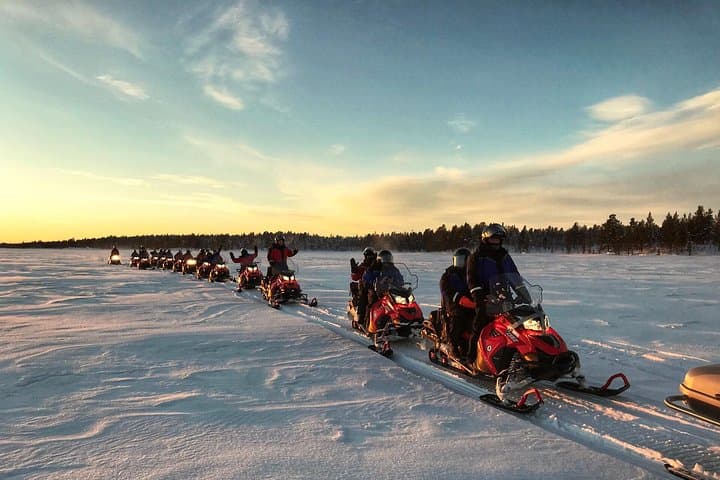
What the day feels like
You kick the starter and the first breath of a snowmobile is a promise: cold, clean, and fast. The world contracts to the hum under your palms and a ribbon of white ahead, trees like bronze fingers streaking past. In Lapland, where winter light is a rare and honest thing, a 2‑hour snowmobile safari out of Rovaniemi feels less like a tour and more like an induction into a different tempo—one measured by the crackle of ice, the distant bell of reindeer, and the wind that dares you to go faster.
This easy, 150‑minute run threads groomed trails through the river valleys that define the region. The Kemijoki and its tributaries carve the lowlands here into a patchwork of riparian forest and open floodplain; in winter the landscape becomes an austere cathedral of birch and spruce, their branches laced with powder. Guides steer you past hollowed riverbanks and over frozen crossings, narrating the quiet history of the place: how glaciers gouged this land, how Sami reindeer herders still read the seasons, and how Rovaniemi rebuilt itself after WWII, emerging as Lapland’s access point to the Arctic.
Snowmobiling in these parts has practical roots. Locals used snow machines for decades to reach winter pastures and remote cabins; today that utility is held alongside leisure. That duality is what makes this safari worthwhile. It’s not only adrenaline: it’s a way to travel across the terrain and meet the region’s story in motion. Alongside the thrill you'll notice small things that say Lapland—tracks of a fox cutting across the trail, a steam plume from a distant lodge, the hush deeper than any winter city can offer.
For culture and context, Rovaniemi is as much a service town as it is an emblem. It sits near the Arctic Circle and functions as a hub for Sámi traditions, winter sports, and research into northern life. The land itself tells a geological tale of ice and water: rounded moraines, ancient soils, and rivers that have repeatedly redefined the valley. The result is a landscape that rewards modest speed; you feel both grounded and airborne as the trail drops into gullies and opens onto broad, wind-swept flats.
Practicalities are simple but essential. This snowmobile safari is billed as suitable for beginners through more experienced drivers, and the route is groomed and guided—so there’s little technical demand beyond basic coordination and a driver’s license for the lead driver if required by the operator. Expect steady speeds with brief bursts of open‑field running. Dress thermal, layer smart, and protect your face from wind and glare. The operator provides helmets and basic instruction; still, bring a quality pair of goggles and keep your camera handy for those low, horizontal sun moments that turn the snow into glass.
Safety and stewardship pair in Lapland. The region supports fragile winter ecosystems and a living culture. Guides will route you to avoid active reindeer corridors and sensitive shoreline habitats—trust them. The etiquette of snowmobiling here is straightforward: follow trail rules, give wildlife a wide berth, and keep noise in check when near villages or herding areas. Doing so preserves the silence that makes Lapland special.
If you’re wondering how to plan this into a short Arctic itinerary, slot the safari as an afternoon escape after a morning in town or a visit to Santa Claus Village. It’s a neat counterpoint to museum time—immersive, kinetic, and a way to feel the landscape at speed without committing to a multi‑day expedition. For photographers it’s a compact chance to shoot winter light in motion: frozen rivers as leading lines, trees as repeating patterns, and the occasional reindeer silhouette punctuating a white field. Consider a small mirrorless camera in a protective dry bag and use burst mode to capture crisp action frames.
To book, look for operators that include complimentary outerwear or a clear list of what you need. Check confirmation terms for instant booking and free cancellation if your plans shift. For a good starting point—local guides who set safe, scenic routes and offer insight into the valley—see this Rovaniemi snowmobile safari to compare options and read on for specifics: https://app.advcollective.com/local-experts/rovaniemi-snowmobile-safari-explore-laplads-frozen-wilderness
Why go? Because in two hours you cover a lot of what makes Arctic winter sing: speed, solitude, and scenery that changes with each bend. It’s neither an endurance slog nor an empty thrill; it’s a way to be briefly, deliciously exposed to a northern landscape that asks you to pay attention. And when you return to town, warmed and part exhilarated, you’ll carry with you a clearer sense of how people and nature meet at the top of the world.
Trail wisdom
Small choices, better day.
Layer for wind chill
Temperatures can feel much colder at speed—use a windproof outer layer and insulated midlayers to trap warmth without bulk.
Protect eyes and camera
Wear anti-fog goggles and use a padded case or wrist strap for cameras to prevent drops in cold conditions.
Follow the guide’s pace
Keep to the guide’s instructions—trail conditions vary and local knowledge avoids thin ice or wildlife corridors.
Fuel and hydration
Bring an insulated bottle and hydrate before setting out; short cold rides can still dehydrate you quickly.
Local knowledge
Read the place, not just the route.
Watch for native species including Reindeer, Arctic fox (tracks more common than sightings).
Keep an eye out for wildlife during the transition between areas and habitats. Respect distance guidelines.
Stay on groomed trails to protect winter vegetation and avoid driving near known reindeer herding routes to minimize stress on animals.
Follow the guide's instructions on size limits, ethical handling, and leave-no-trace practices.
A quiet bend on the Kemijoki where steam fog forms at dawn. A small lakeside lean‑to used by locals for winter fishing
Locally recommended viewpoints and quiet spots known best to local operators.
Rovaniemi was rebuilt after WWII and grew as a gateway to Lapland; its proximity to the Arctic Circle shaped local livelihoods in reindeer herding and winter travel.
Maritime roots and regional tradition shape the waterways and working coasts.
Seasonal guide
Four versions of the same landscape.
Spring
Best forLonger daylight hours · Transition wildlife sightings · Milder daytime temps
ChallengesVariable snowpack · Slushy trails in late season
Late March to April brings more daylight and softer light, but trail conditions can be inconsistent as snowpack starts to melt.
Summer
Best forN/A
ChallengesSnowmobiles not available · Operator closures
Summer is outside the snowmobile season; operators typically run snowmobile safaris in winter and early spring only.
Fall
Best forChilly preludes to winter · Sporadic early snow
ChallengesShort daylight · Unpredictable snow cover
Autumn is transitional—some operators may offer early-season rides if conditions allow, but expect variable terrain.
Winter
Best forStable snow cover · Northern lights potential · Full winter infrastructure
ChallengesExtreme cold spells · Limited daylight early/late winter
December through March is prime: reliable snow, groomed trails, and the classic Arctic experience—dress for serious cold.
Operator details
What the booking data adds.
Included
- ✓Twin driving on a snowmobile
- ✓Winter equipment: helmet, balaclava, gloves, boots and thermal overall
- ✓2h snowmobile safari
- ✓Professional guide. Guiding in English, other languages on request
- ✓Driving and safety instructions
- ✓Transfer Access Lapland Office to the activity starting point and back
Good to know
- ✓Public transportation options are available nearby
- ✓Infants and small children can ride in a pram or stroller
- ✓Suitable for all physical fitness levels
Pack with intention
What to bring.
Good to know
Common questions.
Requirements vary by operator—many allow beginners to ride but may ask for a valid driver’s license for the primary driver; check booking terms.
Plan the edges
The details that make the day easier.
Rovaniemi lies on the Arctic Circle and is known as the official hometown of Santa Claus; the town was largely rebuilt after WWII under the influence of architect Alvar Aalto.
After the ride, warm up in Rovaniemi with reindeer stew at Restaurant Nili, try local smoked salmon, and sample Lappish craft beers at a cozy downtown pub—finish with a stop at Santa Claus Village if you want a classic Arctic souvenir.
- Closest airport
- Rovaniemi Airport (RVN)
- Typical driving time to trailhead
- 10–30 minutes from central Rovaniemi
- Cell service
- Good near town, spotty in remote valleys
- Permits
- No government permit required, but follow operator rules and provide ID
Respect reindeer herding areas and stay on designated trails; avoid driving near riverbanks and pack out all trash to protect fragile winter ecosystems.
Explore by topic
Follow the threads.
Keep exploring
Make the story part of the trip.
 Related story
Less than two hours from Nairobi, Kereita Forest pairs hands-on canopy adventure with quiet montane trails and a sobering colonial history—perfect for families, teams, and curious travelers seeking a full-day pulse of nature.
Set out from Bass Harbor for a private, customizable day on Blue Hill Bay — lighthouses, puffins, seals, and the chance to feel Acadia from the water. Small groups, local captains, unforgettable views.
In four hours you can move from shaded canyon ferns to wind-scoured coastal ridgelines, guided by someone who knows where the light—and the hidden views—live. This private half-day hike on the Monterey Peninsula or Big Sur is compact, curated, and perfect for travelers who want depth without a multiday commitment.