
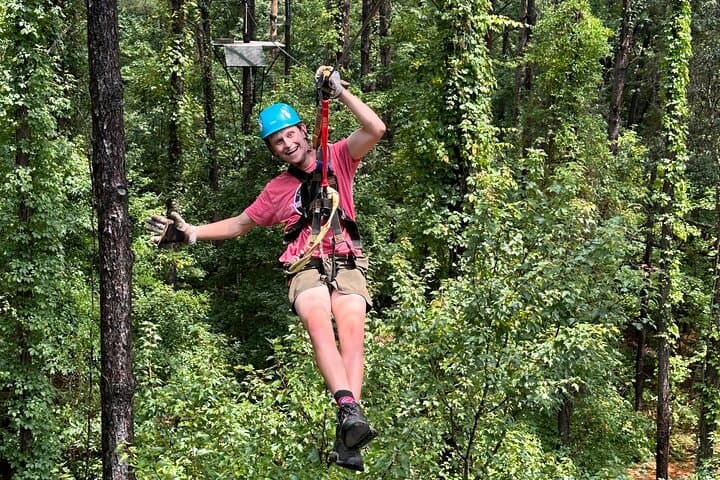
What the day feels like
The morning fog over the Lowcountry lifts like a curtain and the forest exhales. You step onto a wooden platform and the world narrows to rope, harness, and the hush of live oaks brushing the skyline. The first cable takes you away from solid ground with a gentle shove—gravity becomes companion, not threat—and the woods rearrange themselves into a new map: trunks elongated, Spanish moss drifting like smoke, the marsh beyond flickering silver where the Cooper River meets tidal creeks. This is Charleston Adventure Forest reduced to its essentials: speed, height, and the delight of seeing a familiar place from an angle most visitors never do.
Set on roughly 10 acres of preserved forest, the Zipline Canopy Tour and Climbing Wall Package is as much an introduction to the Lowcountry’s canopy as it is a straightforward adrenaline fix. Over about two and a half hours, you’re guided across seven ziplines, through swinging bridges, and up a 65-foot tower that ends with an optional 65-foot climbing wall for anyone who wants to make their descent deliberate and triumphant. The final 750-foot zipline is the kind of send-off that sharpens memory: long, fast, and free enough to make strangers grin like old friends.
There’s a geography lesson tucked into every view. The Charleston region sits on a ribbon of sedimentary plains shaped by coastal tides and riverine deposition; the live oak and palmetto-dominated canopy here is resilient but fragile, buffering shorelines and shading the marshes below. The trees you’ll zip past have roots that trade saltwater stories with crabs and shrimp; the forest floor below is a living interface between sea and city. Historically, these woods have been part working landscape—rice and indigo fields, plantation plots—and part refuge for townspeople seeking shade and for wildlife finding corridors through suburban sprawl. Today the canopy tour is a modern interpretation of that relationship: a managed access point that lets people pass through without tearing holes in the land.
The culture of Charleston hangs everywhere: it’s in the polite way the guides call out safety checks, in the low, dry humor that keeps nerves steady, and in the local snacks offered afterward—sweet tea and a quick local biscuit if you’re lucky. Families come here for communal challenge; couples book ziplines for a different kind of date; corporate groups use the ropes to practice literal and figurative trust falls. If you want to dig deeper into local color, take a short drive to see the Angel Oak on Johns Island, a living testament to the region’s arboreal longevity, or wind down with shrimp and grits in downtown Charleston’s historic district.
Practicality is part of the appeal. Tours run about 150 minutes, include trained guides who clip and re-check harnesses, and are open to participants age 10 and up. Expect a blend of instruction and momentum—safety briefings are thorough but not ponderous. Most people find the exertion moderate: you’ll climb ladders and walk short, uneven bridges, but heavy aerobic output isn’t required unless you opt for the climbing-wall finish. Weather matters here; summer humidity turns harnesses into personal greenhouses and rain can make platforms slick. Mornings in spring and fall offer the sweet spot: lower humidity, clear views, and a more comfortable grip.
If you’re planning the day, think layers and purpose. Closed-toe shoes and socks are non-negotiable; gloves help with braking on longer lines; a small hydration pack is perfect—no bulky packs allowed on platforms. Arrive with sunscreen on, hair tied back, and a willingness to follow directions. Guides will take care of technical checks, but how much you get out of the tour depends on how quickly you lean into the process: step forward, breathe through the first weird seconds, and then enjoy the canopy’s patient motion.
For photographers, the best frames aren’t from the longest zip alone but from the pauses: a mid-zip platform where light filters through the Spanish moss, or the top of the 65-foot tower where marsh edges appear like stitched fabric. Shoot in burst mode to capture motion, and use a wrist strap if you’re taking a small camera—phones can be used, but tether them.
This is a family-friendly, low-barrier way to experience Charleston’s wild side without needing technical climbing experience. It’s also a reminder that adventure here is seasonal: spring and fall bring the most comfortable conditions, while summer tests your patience with heat and winter occasionally forces cancellations in raw wind. Whatever season you choose, the key is to arrive prepared, wear sensible shoes, and expect the ground to look different when you return—closer, somehow, and less like home.
If you want a deeper preview or to reserve a spot, check the local tour page for specifics and booking options: <a href="https://app.advcollective.com/local-experts/charleston-zipline-canopy-tour-7-line-forest-canopy-65-ft-climbing-wall">Charleston zipline canopy tour and climbing wall</a>. It’s an accessible, short-format adventure that still leaves room for that elemental thrill—moving through a living architecture of branches, seeing the Lowcountry unfold, and finishing with a line that forces you to laugh as you fly.
Trail wisdom
Small choices, better day.
Wear closed-toe shoes
Sturdy sneakers with good tread are required—platforms and ladders can be slick, especially in humidity or after rain.
Hydrate before you go
Bring a small hydration pack or water bottle; you’ll feel hotter than expected in full harness and sun.
Secure loose items
Tuck phones and sunglasses into pockets or secure them with straps—most tours require tethers for belongings.
Ask about weight limits
Operators enforce weight and health limits for safety—double-check if you’re close to limits or have mobility concerns.
Local knowledge
Read the place, not just the route.
Watch for native species including White-tailed deer, Great blue heron.
Keep an eye out for wildlife during the transition between areas and habitats. Respect distance guidelines.
The canopy tour operates within a managed forest area—stick to designated paths, avoid disturbing undergrowth, and pack out all trash to protect fragile coastal ecology.
Follow the guide's instructions on size limits, ethical handling, and leave-no-trace practices.
Angel Oak Tree on Johns Island—an ancient live oak with sweeping limbs. Folly Beach—an easy post-adventure beach stop for sunset and seafood
Locally recommended viewpoints and quiet spots known best to local operators.
Charleston (originally Charles Town) was founded in 1670; the region’s marshes and live oaks have long shaped settlement and local livelihoods.
Maritime roots and regional tradition shape the waterways and working coasts.
Seasonal guide
Four versions of the same landscape.
Spring
Best forComfortable temps · Wildflower displays · Family outings
ChallengesOccasional rain showers · Busy weekends
Spring delivers mild weather and blooming understory—expect pleasant temps and lively trails, but book ahead on weekends.
Summer
Best forLong daylight · School vacations
ChallengesHigh heat and humidity · Afternoon thunderstorms
Summer is peak season for families; go early to avoid heat and keep an eye on storm forecasts.
Fall
Best forCrisp mornings · Lower humidity · Clear views
ChallengesVariable temps · Shorter days
Fall offers some of the best conditions for zipping—the air clears and the woodlands feel refreshed after summer.
Winter
Best forOff-season quiet · Cool, brisk air
ChallengesWindy cancellations · Cooler rope rigging
Winter can be calm and uncrowded, but wind and cold can force schedule changes—dress warmly in layers.
Operator details
What the booking data adds.
Included
- ✓Admission fee
Good to know
- ✓Infants and small children can ride in a pram or stroller
- ✓Not recommended for travelers with spinal injuries
- ✓Not recommended for pregnant travelers
- ✓Not recommended for travelers with poor cardiovascular health
- ✓Travelers should have at least a moderate level of physical fitness
Pack with intention
What to bring.
Good to know
Common questions.
Participants must be at least 10 years old; weight and health requirements also apply for safety—check with the operator before booking.
Plan the edges
The details that make the day easier.
Charleston was founded in 1670 as Charles Town and has a long history tied to coastal trade and maritime landscapes.
After the tour, head into Charleston for Lowcountry fare—shrimp and grits or oyster po’boys pair well with a local craft beer. For a relaxed post-adventure meal, try a waterfront café downtown or a brewery in Mount Pleasant to trade stories.
- Closest airport
- Charleston International Airport (CHS); Driving from downtown Charleston: ~20–30 minutes depending on traffic; Cell service: generally available but can be spotty under dense canopy; Permits: none required—bookings through the operator are sufficient.
The canopy tour operates on preserved forest land—please stay on designated routes, pack out all trash, and avoid feeding wildlife to help protect the Lowcountry ecosystem.
Explore by topic
Follow the threads.
Keep exploring
Make the story part of the trip.
 Related story
Less than two hours from Nairobi, Kereita Forest pairs hands-on canopy adventure with quiet montane trails and a sobering colonial history—perfect for families, teams, and curious travelers seeking a full-day pulse of nature.
Set out from Bass Harbor for a private, customizable day on Blue Hill Bay — lighthouses, puffins, seals, and the chance to feel Acadia from the water. Small groups, local captains, unforgettable views.
In four hours you can move from shaded canyon ferns to wind-scoured coastal ridgelines, guided by someone who knows where the light—and the hidden views—live. This private half-day hike on the Monterey Peninsula or Big Sur is compact, curated, and perfect for travelers who want depth without a multiday commitment.