
What the day feels like
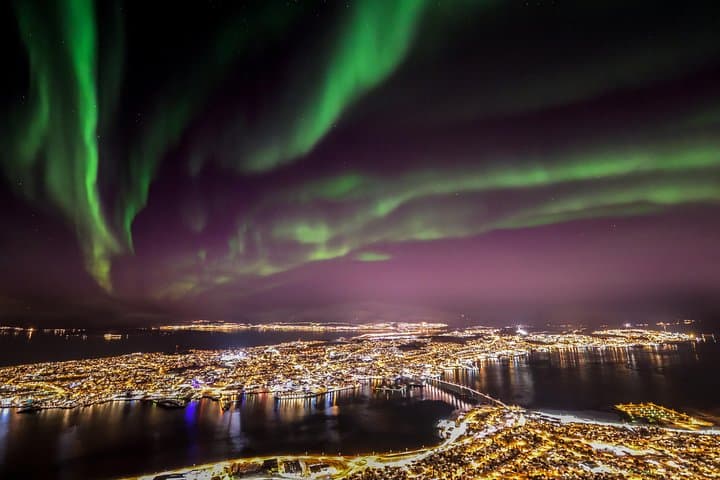
The cable car jolts once, then smooths into a measured climb. Below, Tromsø’s street grid tightens into a scatter of sodium lamps that tremble and shrink—the city yielding to fjord, ridge, and the long Arctic sky. You arrive at Storsteinen with steam from a fresh waffle in your hands and a guide pointing toward the north, where the first pale fingers of aurora begin to unfurl. The light is not a static postcard; it breathes, pulls, and redraws the horizon in bands of green and mauve. On a clear night, standing above Tromsø with the city at your boots and the aurora doing its private choreography overhead, it’s easy to understand why people travel to this latitude not just to see but to be moved.
This three-hour cable car excursion is compact and well-paced: a comfortable return transfer from Tromsø’s center, a round-trip ride up Fjellheisen, a local guide to orient the sky and point out constellations and cultural notes, then coffee, cake or waffles at the mountaintop cafe as you watch the aurora. It’s a curated way of meeting the Arctic night—less scramble and more vantage point—perfect for those who want spectacle with a minimal learning curve.
Tromsø is a city shaped by sea and sky. Its history as a 19th-century whaling and trading hub and later as the 'Gateway to the Arctic' makes it a natural staging ground for aurora tourism. Geologically, northern Norway is the product of repeated ice ages: fjords were carved by glaciers that gouged deep U-shaped valleys between ridged, rocky shoulders. From Storsteinen, the landscape reads as a topographical relief map—dark water trenches, outcrops, and the serrated teeth of surrounding peaks that collect snow and cold like a lens for northern lights that originate in the upper atmosphere.
Culturally, the region sits in proximity to Sámi lands; reindeer herding and indigenous art are living threads in the tapestry of Arctic Norway. Local guides often weave practical sky-watching tips with short stories about Sami astronomical lore, the maritime histories of Tromsø, and how island communities learned to read weather and sea through centuries of necessity.
Why take this cable car excursion rather than chase aurora by minibus into the inland wilderness? For many travelers the answer is reliability and comfort. Weather and auroral activity are capricious; onsite experts maximize your odds by choosing nights with clearer skies and steady geomagnetic activity. The elevated site reduces light pollution without the multi-hour drives and roadside hazards of deep-ice roads. And there’s something to be said for the ritual of hot drink and cake between long stretches of sky-gazing.
Practicalities matter: the total experience is three hours long, includes round-trip transfers from Tromsø’s center, the cable car ticket, a local guide, and a sweet bite to warm your hands. Dress in layers: Arctic nights are dry and bone-cold, and a wind that feels negligible on flat ground can cut across open ridges. Footwear with good grip is essential in winter conditions. For photographers, a stable tripod, a fast wide lens, and remote shutter control are the baseline. Guides will help you compose shots and adjust settings, but the aurora’s pace can be unforgiving; practice framing on the city lights first so you’re ready when the sky erupts.
If you go in shoulder months—late autumn and early spring—you might find clearer skies and marginally warmer temperatures than the deep midwinter. However, the highest aurora activity often coincides with the darkest months. Book early: the excursion is popular and marks itself as likely to sell out on active nights. The ticketing included here is instant confirmation, which helps with itinerary planning.
Sensible expectations make the trip more satisfying. The aurora is a natural phenomenon; a guide can improve your odds and explain the science behind it, but no one can promise a curtain of light. What you can expect is a well-located, safe, and social way to spend an Arctic night—good coffee, local conversation, and a view that places the aurora in the full context of the Tromsø landscape.
For the traveler who wants to combine spectacle with ease, this cable car excursion is exactly that: an efficient, atmospheric introduction to the northern lights and a gentle immersion into Arctic time. Come ready with warm layers, a camera you know how to use, and patience. The sky will decide the show; your job is to arrive prepared to watch it unfold.
Trail wisdom
Small choices, better day.
Dress in layers
Temperatures drop fast after sunset—start with a moisture-wicking base, insulating mid-layer, and windproof shell.
Bring traction for boots
Icy paths at the top can be slick; microspikes or winter boots increase safety and confidence.
Charge and prep your camera
Cold drains batteries—start with spares warmed in an inner pocket and know manual settings before you go.
Time your visit
Book around new moon and check local aurora forecasts for the best odds of clear, active skies.
Local knowledge
Read the place, not just the route.
Watch for native species including Sea eagle, Reindeer.
Keep an eye out for wildlife during the transition between areas and habitats. Respect distance guidelines.
Light pollution and trail erosion are concerns—stay on paths, minimize artificial light, and pack out all waste to protect fragile Arctic environments.
Follow the guide's instructions on size limits, ethical handling, and leave-no-trace practices.
Ersfjordbotn viewpoint for intimate fjord and aurora views. Telegrafbukta beach for accessible coastal night skies
Locally recommended viewpoints and quiet spots known best to local operators.
Tromsø grew as a 19th-century Arctic hub for trade and polar expeditions and is often called the Gateway to the Arctic.
Maritime roots and regional tradition shape the waterways and working coasts.
Seasonal guide
Four versions of the same landscape.
Spring
Best forLonger daylight windows · Milder temperatures
ChallengesUnstable shoulder-season weather · Late snowmelt on trails
Spring brings slightly warmer nights and extended daylight; aurora viewing remains possible early and late in the season.
Summer
Best forMidnight sun · Hiking and daylight sightseeing
ChallengesNo darkness for aurora · High tourism in June-July
Summer is spectacular for daytime mountain views and boat trips, but the midnight sun means the northern lights are not visible.
Fall
Best forAurora returns with growing darkness · Fewer tourists
ChallengesRapid weather shifts · Early snow at higher elevations
Fall nights lengthen quickly, improving aurora chances while temperatures remain relatively moderate compared to deep winter.
Winter
Best forPeak aurora season · Snow-clad landscapes
ChallengesExtreme cold and short days · Snowy or icy access
Winter offers the highest likelihood of aurora sightings and dramatic Arctic scenery but requires sturdy cold-weather gear.
Pack with intention
What to bring.
Good to know
Common questions.
The full experience is about three hours, including transfers, cable car rides, time at the viewpoint, and refreshments.
Plan the edges
The details that make the day easier.
Tromsø sits above the Arctic Circle at roughly 69°N and has been a base for polar exploration since the 19th century.
After the ride, grab a waffle or soup at the Fjellstua cafe; back in town, dine at Emma’s Drømmekjøkken or sample local brews at Ølhallen and consider a Mack Brewery tour to connect the night’s sky to Tromsø’s culinary scene.
- Closest airport
- Tromsø Airport (TOS); Trailhead
- Station
- Fjellheisen lower station—about 5–10 minutes' drive from Tromsø center; Cell service: good in town, patchy at the summit in bad weather; Permits: none required; Transfer: return transfers included in the tour
Minimize light use, stick to designated paths to avoid trampling fragile tundra, pack out all trash, and respect local wildlife—these practices help protect the Arctic night for future visitors.
Explore by topic
Follow the threads.
Keep exploring
Make the story part of the trip.
 Related story
Less than two hours from Nairobi, Kereita Forest pairs hands-on canopy adventure with quiet montane trails and a sobering colonial history—perfect for families, teams, and curious travelers seeking a full-day pulse of nature.
Set out from Bass Harbor for a private, customizable day on Blue Hill Bay — lighthouses, puffins, seals, and the chance to feel Acadia from the water. Small groups, local captains, unforgettable views.
In four hours you can move from shaded canyon ferns to wind-scoured coastal ridgelines, guided by someone who knows where the light—and the hidden views—live. This private half-day hike on the Monterey Peninsula or Big Sur is compact, curated, and perfect for travelers who want depth without a multiday commitment.