THE ADVENTURE COLLECTIVE® · Independent discovery and booking for outdoor travel

Travel from Marrakech to Zagora over two days of desert roads, kasbahs and dune bivouacs. Expect long but scenic drives, sunset and sunrise camel rides, and a night under Saharan stars.
Travel from Marrakech to Zagora over two days of desert roads, kasbahs and dune bivouacs. Expect long but scenic drives, sunset and sunrise camel rides, and a night under Saharan stars.
Before dawn the road opens like a strip of ink across the High Atlas, and the bus hums south toward sun-baked earth. By midafternoon the landscape changes: red rock gives way to the palm-lined ribbon of the Draa Valley and then to wind-sculpted sand where Zagora’s dunes gather heat and hush. A sunset camel ride across those ripples offers a slow, deliberate rhythm — the dune pushing beneath your feet, the sky pulling the last light.
Verified experiences and guided adventures in the surrounding area.
Operated by Marvels Tours · Zagora, Drâa-Tafilalet
Before dawn the road opens like a strip of ink across the High Atlas, and the bus hums south toward sun-baked earth. By midafternoon the landscape changes: red rock gives way to the palm-lined ribbon of the Draa Valley and then to wind-sculpted sand where Zagora’s dunes gather heat and hush. A sunset camel ride across those ripples offers a slow, deliberate rhythm — the dune pushing beneath your feet, the sky pulling the last light.
This route threads history and geology: the fortified kasbahs of Ait Ben Haddou (UNESCO) recall caravan-era trade and film crews, while the Draa’s river terraces cradle ksour built from local mudbrick. The High Atlas is granite and schist uplifted by tectonics; the desert beyond is wind-worked silt and sand, with black basalt outcrops at the edge of the Sahara. Local culture is Berber and Saharan — expect shared meals, tea rituals, and storytelling at the bivouac under a vast night sky.
Practical guidance: the tour is mostly vehicle transfers (roughly 8–9 hours each day including stops) with short camel rides at sunrise and sunset. Dress in breathable layers, protect against sun and dust, and carry at least 2–3 liters of water per day; nights can drop sharply so a warm mid-layer is essential. Mobile signal is intermittent; bring cash for tips and local purchases. Respect private homesteads and ask before photographing people. If planning photography, aim for the golden hours — they’re worth the early wake-up.
moderate.
2 days (approx. 9 hours driving each day, 2–3 hours at stops).
Suitable for travelers with basic mobility; able to endure long vehicle transfers and short camel rides.
Sunset and sunrise camel rides are typically about 45–60 minutes, long enough for photos and to reach dune viewpoints.
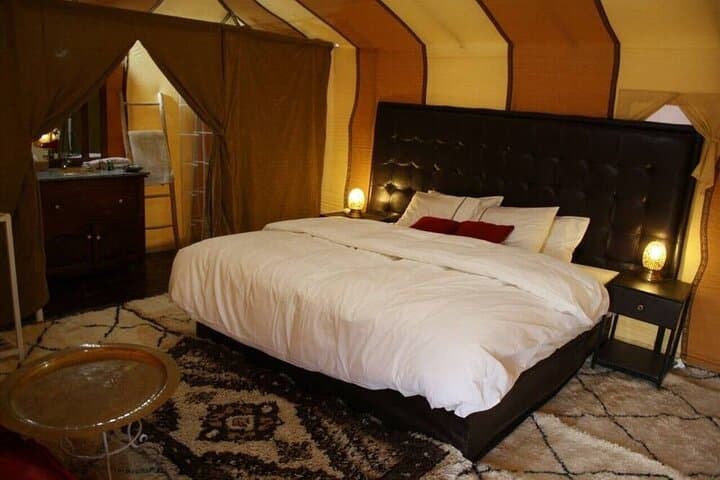
Bivouac tents provide basic mattresses and blankets; nights are shared communal spaces and comfort is rustic but warm when provided with blankets.
Yes — the itinerary includes stops in Ait Ben Haddou and the Draa Valley for breaks and meals; restroom options vary from cafes to roadside facilities.
Travel insurance covering medical evacuation is recommended; standard vaccinations should be up-to-date and consult your provider for region-specific advice.
The route follows ancient caravan corridors; kasbahs and ksour were defensive and storage hubs for Saharan trade in salt, dates and goods.
The region is sensitive to overuse; stick to established routes, avoid disturbing vegetation and minimize plastic waste — local groups encourage responsible tourism to protect oases.
Marvels Tours operates guided outdoor trips and adventures with an emphasis on safety, stewardship, and memorable experiences.
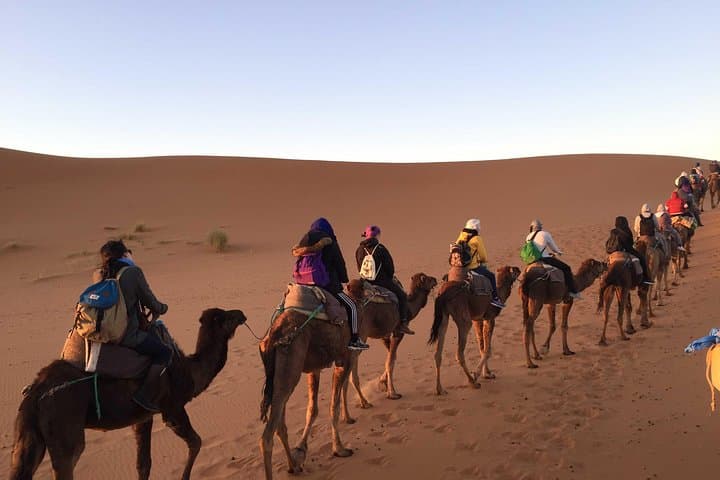
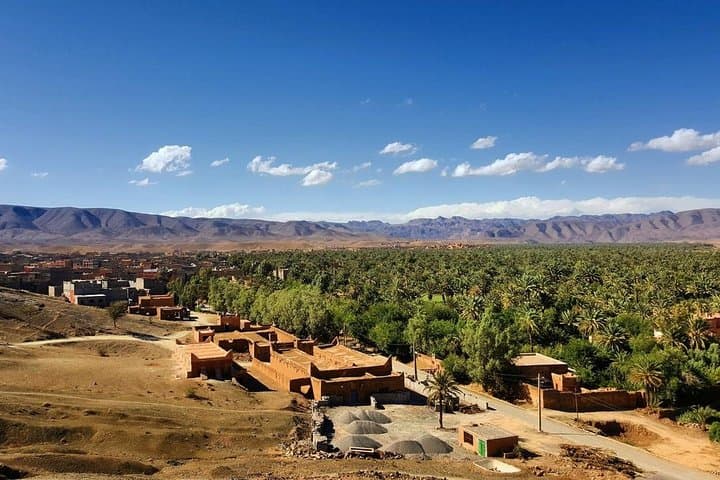
Before dawn the road opens like a strip of ink across the High Atlas, and the bus hums south toward sun-baked earth. By midafternoon the landscape changes: red rock gives way to the palm-lined ribbon of the Draa Valley and then to wind-sculpted sand where Zagora’s dunes gather heat and hush. A sunset camel ride across those ripples offers a slow, deliberate rhythm — the dune pushing beneath your feet, the sky pulling the last light.
Before dawn the road opens like a strip of ink across the High Atlas, and the bus hums south toward sun-baked earth. By midafternoon the landscape changes: red rock gives way to the palm-lined ribbon of the Draa Valley and then to wind-sculpted sand where Zagora’s dunes gather heat and hush. A sunset camel ride across those ripples offers a slow, deliberate rhythm — the dune pushing beneath your feet, the sky pulling the last light.
This route threads history and geology: the fortified kasbahs of Ait Ben Haddou (UNESCO) recall caravan-era trade and film crews, while the Draa’s river terraces cradle ksour built from local mudbrick. The High Atlas is granite and schist uplifted by tectonics; the desert beyond is wind-worked silt and sand, with black basalt outcrops at the edge of the Sahara. Local culture is Berber and Saharan — expect shared meals, tea rituals, and storytelling at the bivouac under a vast night sky.
Practical guidance: the tour is mostly vehicle transfers (roughly 8–9 hours each day including stops) with short camel rides at sunrise and sunset. Dress in breathable layers, protect against sun and dust, and carry at least 2–3 liters of water per day; nights can drop sharply so a warm mid-layer is essential. Mobile signal is intermittent; bring cash for tips and local purchases. Respect private homesteads and ask before photographing people. If planning photography, aim for the golden hours — they’re worth the early wake-up.