THE ADVENTURE COLLECTIVE® · Independent discovery and booking for outdoor travel

Make a high‑speed leap from Beijing to Xi'an to see the Terracotta Army in one streamlined day. This guided tour covers round‑trip train tickets, transfers, and focused time at the museum for travelers short on time.
Make a high‑speed leap from Beijing to Xi'an to see the Terracotta Army in one streamlined day. This guided tour covers round‑trip train tickets, transfers, and focused time at the museum for travelers short on time.
You step off a high‑speed train into Xi'an morning light, the platform humming as your driver appears with a name card. The road between the station and the museum runs through flat fields where sparrows wheel and low hills rise toward Mount Li — the landscape that once watched over an emperor's afterlife.
Verified experiences and guided adventures in the surrounding area.
Operated by Discover Beijing Tours · Xi'an, Shaanxi
You step off a high‑speed train into Xi'an morning light, the platform humming as your driver appears with a name card. The road between the station and the museum runs through flat fields where sparrows wheel and low hills rise toward Mount Li — the landscape that once watched over an emperor's afterlife.
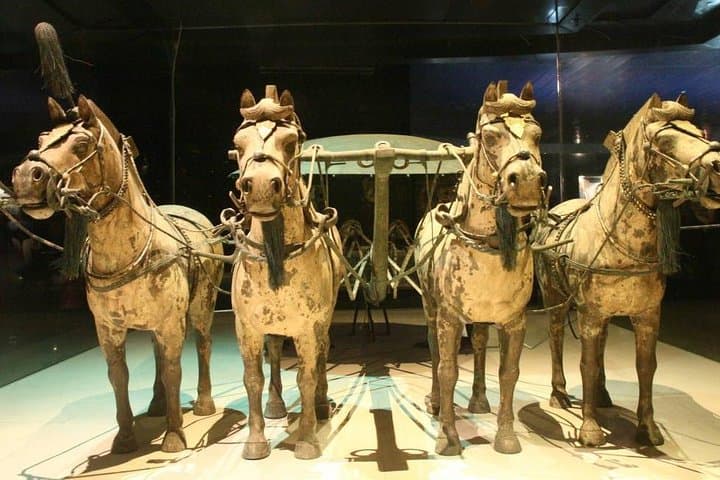
The Terracotta Army itself dates to the late 3rd century BC, buried with Qin Shi Huang in a burial complex meant to guard him beyond death. Discovered by farmers drilling a well in 1974, the site now opens into three main pits where thousands of life‑sized figures stand in rows, each face and armor plate hinting at individual craftsmen and military order. Lintong's loess soils preserved the clay works; modern conservation fights humidity and visitor impact to keep pigments and detail intact.
Culturally, Xi'an was the eastern terminus of the Silk Road and China’s early imperial heart — a city whose food, walls, and markets still echo that role. On a tight day trip from Beijing by bullet train you’ll trade hotel lobby pickup and long transit for focused interpretation: your guide concentrates on the pits, the museum displays, and local tilework techniques rather than leisurely exploration.
Practical guidance: bring your passport copy (required for train booking), wear comfortable walking shoes and a light layer for the museum’s climate control, and plan for an 8–12 hour day with limited free time. If you want more time on the city wall or at Huaqing Hot Springs, consider overnighting in Xi'an rather than returning the same day.
moderate.
8–12 hours.
Good for travelers with basic fitness and the ability to handle long days of transit and short periods of standing and walking.
Yes — a passport copy is required to book the train tickets and you should carry your passport when traveling.
Yes, upgrades are possible subject to availability; contact the operator before travel and expect to pay the fare difference.
Typical itineraries allot about two hours at the Terracotta Army exhibition, enough for the main pits and museum displays but not for extended exploration.
No — lunch is typically at your own expense; the guide can recommend nearby eateries if time allows.
The Terracotta Army was buried with Emperor Qin Shi Huang in the late 3rd century BC and rediscovered in 1974; the complex reflects imperial funerary practice and ancient statecraft.
The site operates active conservation programs to stabilize clay and pigment; visitors should follow roped routes and avoid touching figures to minimize wear.
Discover Beijing Tours operates guided outdoor trips and adventures with an emphasis on safety, stewardship, and memorable experiences.



You step off a high‑speed train into Xi'an morning light, the platform humming as your driver appears with a name card. The road between the station and the museum runs through flat fields where sparrows wheel and low hills rise toward Mount Li — the landscape that once watched over an emperor's afterlife.
You step off a high‑speed train into Xi'an morning light, the platform humming as your driver appears with a name card. The road between the station and the museum runs through flat fields where sparrows wheel and low hills rise toward Mount Li — the landscape that once watched over an emperor's afterlife.
The Terracotta Army itself dates to the late 3rd century BC, buried with Qin Shi Huang in a burial complex meant to guard him beyond death. Discovered by farmers drilling a well in 1974, the site now opens into three main pits where thousands of life‑sized figures stand in rows, each face and armor plate hinting at individual craftsmen and military order. Lintong's loess soils preserved the clay works; modern conservation fights humidity and visitor impact to keep pigments and detail intact.
Culturally, Xi'an was the eastern terminus of the Silk Road and China’s early imperial heart — a city whose food, walls, and markets still echo that role. On a tight day trip from Beijing by bullet train you’ll trade hotel lobby pickup and long transit for focused interpretation: your guide concentrates on the pits, the museum displays, and local tilework techniques rather than leisurely exploration.
Practical guidance: bring your passport copy (required for train booking), wear comfortable walking shoes and a light layer for the museum’s climate control, and plan for an 8–12 hour day with limited free time. If you want more time on the city wall or at Huaqing Hot Springs, consider overnighting in Xi'an rather than returning the same day.