THE ADVENTURE COLLECTIVE® · Independent discovery and booking for outdoor travel

A demanding one-day hike from Zagreb into Gorski Kotar, the Vihoraski Trail takes you over White Rocks and Samarske Rocks with exposed scrambles, karst ridgelines, and big valley views. This guide covers what to expect and how to prepare.
A demanding one-day hike from Zagreb into Gorski Kotar, the Vihoraski Trail takes you over White Rocks and Samarske Rocks with exposed scrambles, karst ridgelines, and big valley views. This guide covers what to expect and how to prepare.
Before dawn a minivan leaves Zagreb and the city’s hum thins into a ribbon of highway; by mid-morning the trees close in, the air sharpening with resin and stone.
The route climbs into Gorski Kotar — Croatia’s dense, mountainous “green lung” — and deposits hikers at White Rocks, a series of pale limestone faces that catch the sun and throw it into deep, forested valleys.
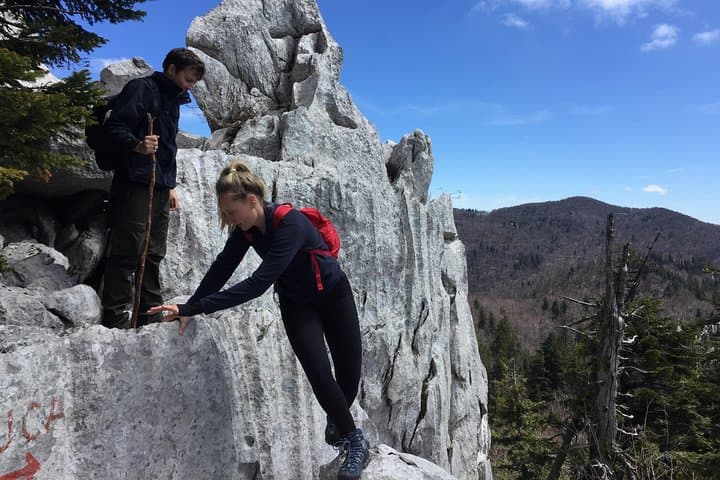
Geology here is karst: exposed limestone, vertical ribs, and pockets carved by millennia of frost and rain. The Vihoraski Put threads between Samarske Rocks and other crags, shifting from steep woodland approaches to exposed ledges and short technical sections, including the Ljuska scramble where hands and boots share the route.
Ogulin, the nearby town, carries folk‑tale echoes and long mountain‑use traditions; shepherd paths and wartime routes shaped many of the trails. Conservation-minded guides run these trips to limit impact and keep fragile karst vegetation intact.
Expect a long, demanding day — sustained ascent and descent, intermittent scrambling, and sweeping viewpoints that reward patience. The trail covers rough, often loose terrain; weather can switch fast: sun, wind, sudden showers.
Practical guidance: start early with a full day ahead, carry 2–3 liters of water, layered clothing and sturdy ankle-support boots, and be prepared to move steadily for 6+ hours of on-trail time. Guides provide local route-finding and first-aid; participants should be comfortable with exposure and basic scrambling. Return to Zagreb in the evening, the day feeling like two.
Verified experiences and guided adventures in the surrounding area.
Operated by Natural Croatia (Zemlja-Voda-Zrak) · Ogulin, Karlovac County
Before dawn a minivan leaves Zagreb and the city’s hum thins into a ribbon of highway; by mid-morning the trees close in, the air sharpening with resin and stone.
The route climbs into Gorski Kotar — Croatia’s dense, mountainous “green lung” — and deposits hikers at White Rocks, a series of pale limestone faces that catch the sun and throw it into deep, forested valleys.
Geology here is karst: exposed limestone, vertical ribs, and pockets carved by millennia of frost and rain. The Vihoraski Put threads between Samarske Rocks and other crags, shifting from steep woodland approaches to exposed ledges and short technical sections, including the Ljuska scramble where hands and boots share the route.
Ogulin, the nearby town, carries folk‑tale echoes and long mountain‑use traditions; shepherd paths and wartime routes shaped many of the trails. Conservation-minded guides run these trips to limit impact and keep fragile karst vegetation intact.
Expect a long, demanding day — sustained ascent and descent, intermittent scrambling, and sweeping viewpoints that reward patience. The trail covers rough, often loose terrain; weather can switch fast: sun, wind, sudden showers.
Practical guidance: start early with a full day ahead, carry 2–3 liters of water, layered clothing and sturdy ankle-support boots, and be prepared to move steadily for 6+ hours of on-trail time. Guides provide local route-finding and first-aid; participants should be comfortable with exposure and basic scrambling. Return to Zagreb in the evening, the day feeling like two.
challenging.
10–12 hours.
High level of cardiovascular fitness and leg strength; able to sustain long ascents, descents and short technical scrambling.
Ljuska includes short, exposed scrambling where hands are required; it’s not full rock-climbing but requires surefootedness and comfort with exposure.
Not recommended for true beginners — participants should have prior day-hike experience, good endurance, and no fear of exposure.
Yes — pickup and drop-off in Zagreb are included; pickup typically occurs around 6:00 AM.
The operator may reschedule or alter the route for safety; cancellations with full refund are typically available if weather prevents a safe outing.
Trails around Ogulin have shepherding and wartime heritage; the town is linked culturally to Croatian fairy-tale author Ivana Brlić-Mažuranić.
Gorski Kotar contains protected habitats; stay on trails, pack out waste, and avoid altering karst features to minimize erosion and vegetation loss.
Natural Croatia (Zemlja-Voda-Zrak) operates guided outdoor trips and adventures with an emphasis on safety, stewardship, and memorable experiences.



Before dawn a minivan leaves Zagreb and the city’s hum thins into a ribbon of highway; by mid-morning the trees close in, the air sharpening with resin and stone.
The route climbs into Gorski Kotar — Croatia’s dense, mountainous “green lung” — and deposits hikers at White Rocks, a series of pale limestone faces that catch the sun and throw it into deep, forested valleys.
Geology here is karst: exposed limestone, vertical ribs, and pockets carved by millennia of frost and rain. The Vihoraski Put threads between Samarske Rocks and other crags, shifting from steep woodland approaches to exposed ledges and short technical sections, including the Ljuska scramble where hands and boots share the route.
Ogulin, the nearby town, carries folk‑tale echoes and long mountain‑use traditions; shepherd paths and wartime routes shaped many of the trails. Conservation-minded guides run these trips to limit impact and keep fragile karst vegetation intact.
Expect a long, demanding day — sustained ascent and descent, intermittent scrambling, and sweeping viewpoints that reward patience. The trail covers rough, often loose terrain; weather can switch fast: sun, wind, sudden showers.
Practical guidance: start early with a full day ahead, carry 2–3 liters of water, layered clothing and sturdy ankle-support boots, and be prepared to move steadily for 6+ hours of on-trail time. Guides provide local route-finding and first-aid; participants should be comfortable with exposure and basic scrambling. Return to Zagreb in the evening, the day feeling like two.