THE ADVENTURE COLLECTIVE® · Independent discovery and booking for outdoor travel

Trace the footsteps of revolutionaries on a 90–120 minute self-guided audio walk from Long Wharf through Boston’s colonial core. Scholarly narration and offline maps turn streets and graveyards into a moving history lesson.
Trace the footsteps of revolutionaries on a 90–120 minute self-guided audio walk from Long Wharf through Boston’s colonial core. Scholarly narration and offline maps turn streets and graveyards into a moving history lesson.
You step off Long Wharf with harbor wind pushing at your collar and the city’s stones already beginning to tell a story. The audio starts at your feet: ships, merchants, and a port that once ferried goods and ideas across the Atlantic. The route threads through the old commercial spine—Chart House, Quincy Market, Faneuil Hall—each stop a pivot where commerce met protest.
Verified experiences and guided adventures in the surrounding area.
Operated by VoiceMap Audio Tours · Boston, MA
You step off Long Wharf with harbor wind pushing at your collar and the city’s stones already beginning to tell a story. The audio starts at your feet: ships, merchants, and a port that once ferried goods and ideas across the Atlantic. The route threads through the old commercial spine—Chart House, Quincy Market, Faneuil Hall—each stop a pivot where commerce met protest.
Boston's built fabric here dates to the 17th and 18th centuries; granite facades and narrow lanes still mark where debates, riots, and midnight rides shaped a nation. You'll pass the Old State House and the spot of the Boston Massacre, hear about the Old South Meeting House where the Boston Tea Party was planned, and stand among the weathered stones of Granary Burying Ground where Revere and Hancock rest. The tour also addresses harder histories, including Boston’s role in the Trans-Atlantic slave trade and contested public memory.
Practically, this is a self-guided GPS audio walk designed for 90–120 minutes. The app provides offline audio and maps, so you can wander at your own pace and pause to study a plaque or duck into an alley in the North End. Expect city sidewalks, occasional cobbles, and busy market noise; the route is wheelchair-accessible but crowded at peak times.
Bring a charged phone, comfortable walking shoes, and a water bottle. Start early to avoid midday crowds and to catch clearer harbor views. The audio’s scholarly narration adds context you won’t get from signs alone—history here feels immediate, civic, and still being written.
easy.
1.5–2 hours.
Suitable for most fitness levels—comfortable walking for up to two hours with brief stops
The tour begins at Long Wharf on Boston Harbor; the app provides directions and will trigger the first audio when you arrive.
Yes—this tour and its route are marked as wheelchair-accessible, with accessible surfaces noted in the app.
Yes—this self-guided GPS tour lets you pause, replay, or skip segments so you can explore at your own pace.
The primary offering is in English with scholarly narration by a PhD-level guide, focusing on historical context and critical interpretation.
This walk follows streets where 17th- and 18th-century merchants, clergy, and activists clustered—Boston’s port economy and civic debates accelerated revolutionary politics.
Stick to paths and respect grave markers; use public transit to reduce emissions and support continued preservation of historic sites.
VoiceMap Audio Tours operates guided outdoor trips and adventures with an emphasis on safety, stewardship, and memorable experiences.
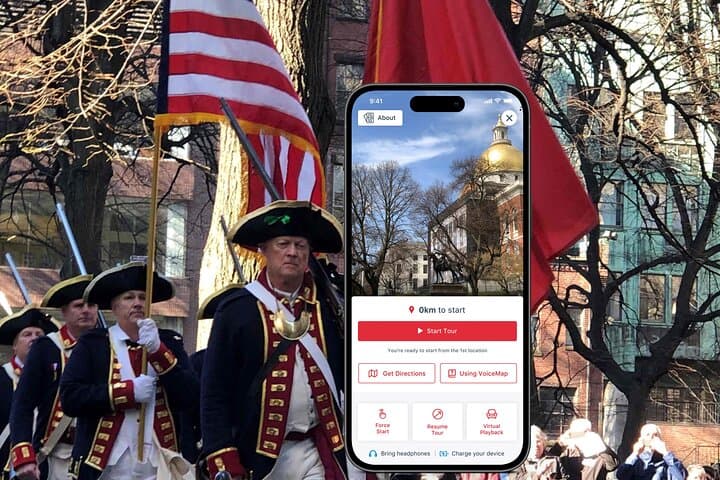



You step off Long Wharf with harbor wind pushing at your collar and the city’s stones already beginning to tell a story. The audio starts at your feet: ships, merchants, and a port that once ferried goods and ideas across the Atlantic. The route threads through the old commercial spine—Chart House, Quincy Market, Faneuil Hall—each stop a pivot where commerce met protest.
You step off Long Wharf with harbor wind pushing at your collar and the city’s stones already beginning to tell a story. The audio starts at your feet: ships, merchants, and a port that once ferried goods and ideas across the Atlantic. The route threads through the old commercial spine—Chart House, Quincy Market, Faneuil Hall—each stop a pivot where commerce met protest.
Boston's built fabric here dates to the 17th and 18th centuries; granite facades and narrow lanes still mark where debates, riots, and midnight rides shaped a nation. You'll pass the Old State House and the spot of the Boston Massacre, hear about the Old South Meeting House where the Boston Tea Party was planned, and stand among the weathered stones of Granary Burying Ground where Revere and Hancock rest. The tour also addresses harder histories, including Boston’s role in the Trans-Atlantic slave trade and contested public memory.
Practically, this is a self-guided GPS audio walk designed for 90–120 minutes. The app provides offline audio and maps, so you can wander at your own pace and pause to study a plaque or duck into an alley in the North End. Expect city sidewalks, occasional cobbles, and busy market noise; the route is wheelchair-accessible but crowded at peak times.
Bring a charged phone, comfortable walking shoes, and a water bottle. Start early to avoid midday crowds and to catch clearer harbor views. The audio’s scholarly narration adds context you won’t get from signs alone—history here feels immediate, civic, and still being written.