THE ADVENTURE COLLECTIVE® · Independent discovery and booking for outdoor travel

Explore Port Chalmers on a 60–90 minute self-guided audio walk that traces maritime history, Victorian architecture, and a thriving arts scene along Otago Harbour. The route is compact, largely paved, and offers a panoramic climb overlooking Quarantine Island and the Otago Peninsula.
Explore Port Chalmers on a 60–90 minute self-guided audio walk that traces maritime history, Victorian architecture, and a thriving arts scene along Otago Harbour. The route is compact, largely paved, and offers a panoramic climb overlooking Quarantine Island and the Otago Peninsula.
Morning light cuts across Otago Harbour; container cranes silhouette against a pale sky while gulls pick at the wake of a working launch. On this self-guided audio walk, the town moves at two speeds—industry edging the shore, and a quieter civic center full of 19th-century stone and timber. The route begins at the 1877 Port Chalmers Maritime Museum and threads through a compact grid of municipal buildings, churches, studios, and a commemorative garden.
Verified experiences and guided adventures in the surrounding area.
Operated by VoiceMap Audio Tours · Port Chalmers, Otago
Morning light cuts across Otago Harbour; container cranes silhouette against a pale sky while gulls pick at the wake of a working launch. On this self-guided audio walk, the town moves at two speeds—industry edging the shore, and a quieter civic center full of 19th-century stone and timber. The route begins at the 1877 Port Chalmers Maritime Museum and threads through a compact grid of municipal buildings, churches, studios, and a commemorative garden.
Port Chalmers began as the Māori settlement of Kōpūtai and rose to prominence in the 1840s and 1860s as a deep-water port during Otago’s gold rush. Geologically the harbour is a drowned river valley whose sheltering arms shaped shipping lanes and settlement patterns. Cultural life here is tangible: Ralph Hotere’s studio and public sculptures anchor a contemporary arts scene that grew from the town’s maritime past.
Practical guidance matters. The full loop takes about 60–90 minutes over mostly paved streets with a short, steady climb to a viewpoint that looks over Quarantine Island and the Otago Peninsula. Expect uneven footpaths near older buildings and some stairs to the lookout. Weather changes quickly—wind off the harbour can be brisk even on warm days—so pack a light shell, sturdy shoes, water, and your phone with the audio app and offline maps enabled. Public transport and limited parking are available; the tour’s audio and maps work offline so you can explore at your own pace. Whether you come for architecture, maritime history, or harbour views, this walk balances easy access with layered local stories.
easy.
1–1.5 hours.
Suitable for most fitness levels; requires basic walking ability and negotiating a short uphill climb
Expect 60–90 minutes to complete the loop at a relaxed pace, including time to visit the Maritime Museum and viewpoints.
Much of the route is paved, but there are stairs and some uneven historic footpaths; parts of the walk may be challenging for wheelchairs or standard strollers.
The tour provides lifetime access through the app as described in the listing; check the booking link for any purchase details.
Begin at the Port Chalmers Maritime Museum on the waterfront—the tour’s directions will trigger when you’re at the start point.
The area was originally the Māori settlement of Kōpūtai and became a strategic deep-water port in the 1840s; the gold rush of the 1860s transformed it into one of Australasia’s busiest harbours.
Visitors should avoid disturbing shoreline wildlife and nesting seabirds, stick to public paths, and respect local signage protecting sensitive areas.
VoiceMap Audio Tours operates guided outdoor trips and adventures with an emphasis on safety, stewardship, and memorable experiences.


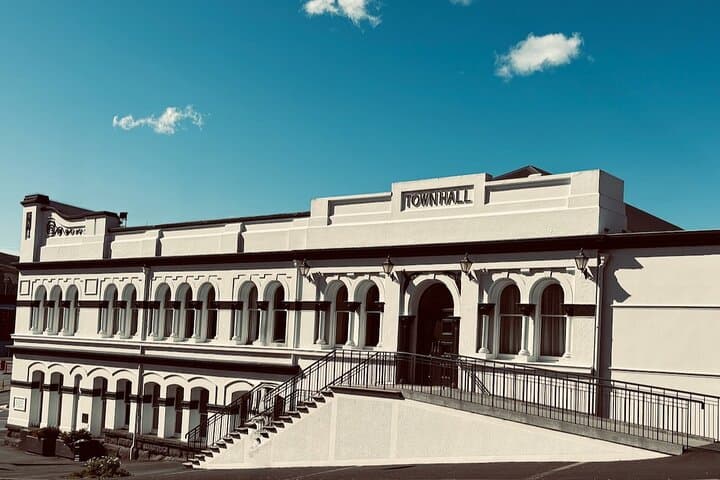
Morning light cuts across Otago Harbour; container cranes silhouette against a pale sky while gulls pick at the wake of a working launch. On this self-guided audio walk, the town moves at two speeds—industry edging the shore, and a quieter civic center full of 19th-century stone and timber. The route begins at the 1877 Port Chalmers Maritime Museum and threads through a compact grid of municipal buildings, churches, studios, and a commemorative garden.
Morning light cuts across Otago Harbour; container cranes silhouette against a pale sky while gulls pick at the wake of a working launch. On this self-guided audio walk, the town moves at two speeds—industry edging the shore, and a quieter civic center full of 19th-century stone and timber. The route begins at the 1877 Port Chalmers Maritime Museum and threads through a compact grid of municipal buildings, churches, studios, and a commemorative garden.
Port Chalmers began as the Māori settlement of Kōpūtai and rose to prominence in the 1840s and 1860s as a deep-water port during Otago’s gold rush. Geologically the harbour is a drowned river valley whose sheltering arms shaped shipping lanes and settlement patterns. Cultural life here is tangible: Ralph Hotere’s studio and public sculptures anchor a contemporary arts scene that grew from the town’s maritime past.
Practical guidance matters. The full loop takes about 60–90 minutes over mostly paved streets with a short, steady climb to a viewpoint that looks over Quarantine Island and the Otago Peninsula. Expect uneven footpaths near older buildings and some stairs to the lookout. Weather changes quickly—wind off the harbour can be brisk even on warm days—so pack a light shell, sturdy shoes, water, and your phone with the audio app and offline maps enabled. Public transport and limited parking are available; the tour’s audio and maps work offline so you can explore at your own pace. Whether you come for architecture, maritime history, or harbour views, this walk balances easy access with layered local stories.