THE ADVENTURE COLLECTIVE® · Independent discovery and booking for outdoor travel

Ride a camel through Wadi Rum’s painted rock walls and red dunes on a six-hour loop that hits Lawrence’s Spring, Khazali Canyon and the Little Bridge. Expect gentle walking, Bedouin tea, and expansive desert views—perfect for first-time desert travelers.
Ride a camel through Wadi Rum’s painted rock walls and red dunes on a six-hour loop that hits Lawrence’s Spring, Khazali Canyon and the Little Bridge. Expect gentle walking, Bedouin tea, and expansive desert views—perfect for first-time desert travelers.
The camel exhales a slow, warm breath and the valley opens like a turning page: flat salt pans, rippled red dunes and jagged sandstone ribs that rise and squat against a relentless blue. You set off from Wadi Rum Village at a steady, patient pace—camels preferring rhythm over hurry—while the desert reorganizes itself around you: wind-sculpted fins, shadowed alcoves and the distant silhouette of a natural bridge.
Verified experiences and guided adventures in the surrounding area.
Operated by Bedouin Life Style Day Tour · Wadi Rum Village, Ma'an Governorate
The camel exhales a slow, warm breath and the valley opens like a turning page: flat salt pans, rippled red dunes and jagged sandstone ribs that rise and squat against a relentless blue. You set off from Wadi Rum Village at a steady, patient pace—camels preferring rhythm over hurry—while the desert reorganizes itself around you: wind-sculpted fins, shadowed alcoves and the distant silhouette of a natural bridge.
This six-hour loop covers the highlights that made Wadi Rum both a modern adventure playground and an archaeological ledger. First stop is Lawrence’s Spring, a small trickle hiding in the lee of a mountain where you can climb a short slope to the source; the spring has long been a respite in a landscape that keeps time by sun and sand. The dunes that follow invite soft-footed climbs and the rush of descending sand—try sandboarding if you want a quick, sandy grin. Khazali Canyon narrows to a cool, carved corridor where Nabatean inscriptions and early Arab graffiti press against the stone, an intimate link to travelers who passed here centuries ago. A brief ascent to the so-called Little Bridge rewards you with perspective: channels of eroded rock and the flat, luminous sweep of the desert.
Geologically, Wadi Rum is an ancient theater of sandstone and granite. Wind and episodic flash floods have scored the mountains into arches, bridges and narrow canyons; the colors shift from rust to ochre as the sun slides. Culturally, the area is living Bedouin country—hosts pour sweet tea, fold flatbreads and tell routes the maps don’t show. The tour includes a simple Bedouin lunch and tea, small acts of hospitality that explain why visitors often leave feeling less like tourists and more like temporary companions.
Practical side: expect six hours with multiple short walks off the camels; terrain is soft sand, rocky ledges and packed trails. Temperatures can swing dramatically—early morning is cool, midday brings desert heat. Bottled water, lunch, snacks and tea are provided on the tour, and the pace is suitable for most fitness levels.
Tips for planning: book early morning slots to avoid the hottest hours, wear closed-toe shoes for canyon stretches, and layer a light wind shirt for the afternoon. Bring sunscreen, a wide-brim hat and a camera with extra battery—the views are expansive and the light is often cinematic. Respect Bedouin spaces and ask before photographing people in camps.
A day here is straightforward but elemental: the desert does not rush you, it simply waits and, if you move with it, reshapes the ordinary into a sequence of sharp, unforgettable frames.
easy.
6 hours.
Basic fitness for short walks and mounting/dismounting camels; standing and light climbing for viewpoints.
The full experience lasts about six hours including stops; camel travel is intermittent between sightseeing stretches and breaks.
Yes—tour notes list it as suitable for all fitness levels; children and seniors can ride camels and do short walks, though camels may be challenging for very young children without assistance.
Yes—bottled water, snacks, a Bedouin-style lunch and tea are provided as part of the tour.
Yes—guides typically allow sandboarding at the dune stop; bring suitable board gear or ask if the operator provides equipment.
Shade is limited to occasional rock overhangs and a tented cafe near Khazali Canyon; restroom options are basic—plan accordingly.
Tipping is customary; around 5–10 JD (or local equivalent) per person for the guide/handler is typical, adjusted based on service.
Wadi Rum bears traces of Nabatean travelers and later became associated with T.E. Lawrence—inscriptions and routes reflect centuries of desert movement.
Wadi Rum is part of a protected area where responsible tourism supports Bedouin livelihoods; stick to marked paths, avoid littering, and follow guide instructions to minimize impact.
Bedouin Life Style Day Tour operates guided outdoor trips and adventures with an emphasis on safety, stewardship, and memorable experiences.
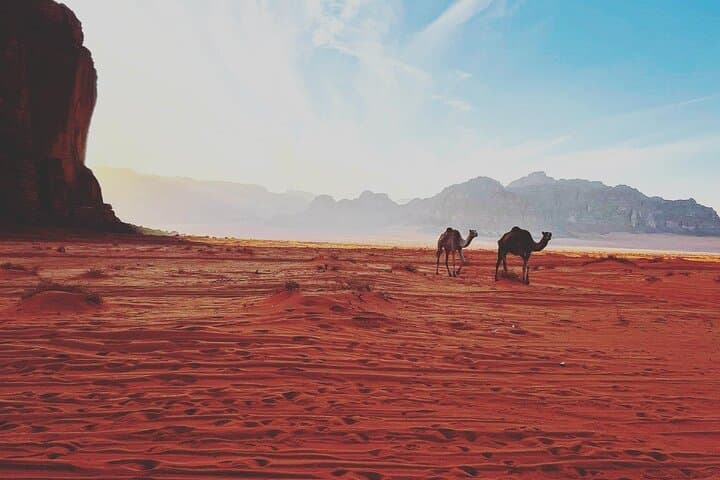


The camel exhales a slow, warm breath and the valley opens like a turning page: flat salt pans, rippled red dunes and jagged sandstone ribs that rise and squat against a relentless blue. You set off from Wadi Rum Village at a steady, patient pace—camels preferring rhythm over hurry—while the desert reorganizes itself around you: wind-sculpted fins, shadowed alcoves and the distant silhouette of a natural bridge.
The camel exhales a slow, warm breath and the valley opens like a turning page: flat salt pans, rippled red dunes and jagged sandstone ribs that rise and squat against a relentless blue. You set off from Wadi Rum Village at a steady, patient pace—camels preferring rhythm over hurry—while the desert reorganizes itself around you: wind-sculpted fins, shadowed alcoves and the distant silhouette of a natural bridge.
This six-hour loop covers the highlights that made Wadi Rum both a modern adventure playground and an archaeological ledger. First stop is Lawrence’s Spring, a small trickle hiding in the lee of a mountain where you can climb a short slope to the source; the spring has long been a respite in a landscape that keeps time by sun and sand. The dunes that follow invite soft-footed climbs and the rush of descending sand—try sandboarding if you want a quick, sandy grin. Khazali Canyon narrows to a cool, carved corridor where Nabatean inscriptions and early Arab graffiti press against the stone, an intimate link to travelers who passed here centuries ago. A brief ascent to the so-called Little Bridge rewards you with perspective: channels of eroded rock and the flat, luminous sweep of the desert.
Geologically, Wadi Rum is an ancient theater of sandstone and granite. Wind and episodic flash floods have scored the mountains into arches, bridges and narrow canyons; the colors shift from rust to ochre as the sun slides. Culturally, the area is living Bedouin country—hosts pour sweet tea, fold flatbreads and tell routes the maps don’t show. The tour includes a simple Bedouin lunch and tea, small acts of hospitality that explain why visitors often leave feeling less like tourists and more like temporary companions.
Practical side: expect six hours with multiple short walks off the camels; terrain is soft sand, rocky ledges and packed trails. Temperatures can swing dramatically—early morning is cool, midday brings desert heat. Bottled water, lunch, snacks and tea are provided on the tour, and the pace is suitable for most fitness levels.
Tips for planning: book early morning slots to avoid the hottest hours, wear closed-toe shoes for canyon stretches, and layer a light wind shirt for the afternoon. Bring sunscreen, a wide-brim hat and a camera with extra battery—the views are expansive and the light is often cinematic. Respect Bedouin spaces and ask before photographing people in camps.
A day here is straightforward but elemental: the desert does not rush you, it simply waits and, if you move with it, reshapes the ordinary into a sequence of sharp, unforgettable frames.