THE ADVENTURE COLLECTIVE® · Independent discovery and booking for outdoor travel

Drive into the green heart of Rio for sweeping views from Vista Chinesa and a guided walk through Tijuca Forest’s waterfalls and trails. This 4–5 hour excursion pairs a roadside viewpoint with short forest walks, ideal for travelers who want big scenery without a full-day hike.
Drive into the green heart of Rio for sweeping views from Vista Chinesa and a guided walk through Tijuca Forest’s waterfalls and trails. This 4–5 hour excursion pairs a roadside viewpoint with short forest walks, ideal for travelers who want big scenery without a full-day hike.
You pull off the winding Estrada da Vista Chinesa as the city shrinks beneath a blanket of cloud and humidity. The Chinese Pavilion (Vista Chinesa) sit upslope, its painted eaves framing a broad sweep of Rio: tiled roofs, Guanabara Bay, and the distant shape of Sugarloaf. Behind the viewpoint, the Tijuca Forest presses close — ferns, bromeliads, and trees that seem to lean toward the light.
Verified experiences and guided adventures in the surrounding area.
You pull off the winding Estrada da Vista Chinesa as the city shrinks beneath a blanket of cloud and humidity. The Chinese Pavilion (Vista Chinesa) sit upslope, its painted eaves framing a broad sweep of Rio: tiled roofs, Guanabara Bay, and the distant shape of Sugarloaf. Behind the viewpoint, the Tijuca Forest presses close — ferns, bromeliads, and trees that seem to lean toward the light.
Tijuca is not ancient wilderness but 19th‑century reclamation: one of the largest urban reforestation projects in the world, restored to protect reservoirs drained by earlier deforestation. Geologically, the area is part of the Serra do Mar basement massif — granite and gneiss sculpted into steep ridges and plunging ravines that feed the park’s waterfalls.
Culturally, these roads and viewpoints are woven into Carioca life, a weekend refuge where families picnic and runners chase cooling shade. Local guides will point out history, from imperial-era reforestation to the Chinese Pavilion built as an oriental-inspired lookout.
Practical guidance: the standard tour runs about 4–5 hours with short walks on uneven forest trails and lookout platforms. Expect humid conditions, quick temperature changes, and slick stone near cascades. Wear grippy shoes, bring at least 1–1.5 liters of water, and time your visit for morning light when vistas are clearest and wildlife — marmosets and howler monkeys — are most active. Note the operator requires a minimum of three people for the tour to proceed. Photography spots are abundant; leave no trace and respect restricted paths to protect fragile vegetation and watershed areas.
moderate.
4–5 hours.
Moderate fitness; comfortable walking on uneven, sometimes steep forest paths and stairs.
Yes — the tour listing includes transport from the meeting point to Vista Chinesa and within Tijuca Forest with a guide.
A minimum of three participants is required; availability should be confirmed in advance.
No — many viewpoints and waterfall approaches involve stairs, uneven paths, and slippery sections not suitable for wheelchairs.
Heavy rain or conditions that make roads or trails unsafe may prompt rescheduling; local operators monitor conditions closely.
Tijuca Forest was largely replanted in the 19th century to restore watersheds after earlier deforestation, creating one of the world’s largest urban forests.
Tijuca is managed as a national park with heavy visitor pressure; stick to marked trails and avoid leaving litter to protect water sources and native vegetation.
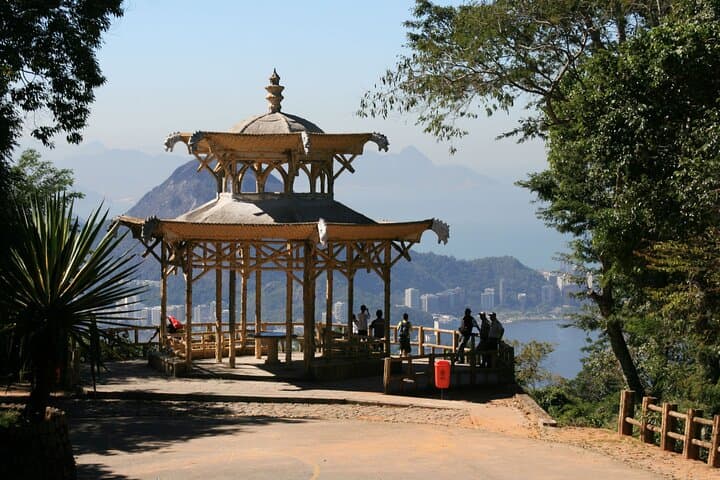
You pull off the winding Estrada da Vista Chinesa as the city shrinks beneath a blanket of cloud and humidity. The Chinese Pavilion (Vista Chinesa) sit upslope, its painted eaves framing a broad sweep of Rio: tiled roofs, Guanabara Bay, and the distant shape of Sugarloaf. Behind the viewpoint, the Tijuca Forest presses close — ferns, bromeliads, and trees that seem to lean toward the light.
You pull off the winding Estrada da Vista Chinesa as the city shrinks beneath a blanket of cloud and humidity. The Chinese Pavilion (Vista Chinesa) sit upslope, its painted eaves framing a broad sweep of Rio: tiled roofs, Guanabara Bay, and the distant shape of Sugarloaf. Behind the viewpoint, the Tijuca Forest presses close — ferns, bromeliads, and trees that seem to lean toward the light.
Tijuca is not ancient wilderness but 19th‑century reclamation: one of the largest urban reforestation projects in the world, restored to protect reservoirs drained by earlier deforestation. Geologically, the area is part of the Serra do Mar basement massif — granite and gneiss sculpted into steep ridges and plunging ravines that feed the park’s waterfalls.
Culturally, these roads and viewpoints are woven into Carioca life, a weekend refuge where families picnic and runners chase cooling shade. Local guides will point out history, from imperial-era reforestation to the Chinese Pavilion built as an oriental-inspired lookout.
Practical guidance: the standard tour runs about 4–5 hours with short walks on uneven forest trails and lookout platforms. Expect humid conditions, quick temperature changes, and slick stone near cascades. Wear grippy shoes, bring at least 1–1.5 liters of water, and time your visit for morning light when vistas are clearest and wildlife — marmosets and howler monkeys — are most active. Note the operator requires a minimum of three people for the tour to proceed. Photography spots are abundant; leave no trace and respect restricted paths to protect fragile vegetation and watershed areas.