THE ADVENTURE COLLECTIVE® · Independent discovery and booking for outdoor travel

Experience the ArtScience Museum’s blend of art, technology and science in Marina Bay. This guide outlines what to expect from immersive exhibits, practical tips for visiting, and how to plan a 1–4 hour cultural stop in Singapore’s waterfront precinct.
Experience the ArtScience Museum’s blend of art, technology and science in Marina Bay. This guide outlines what to expect from immersive exhibits, practical tips for visiting, and how to plan a 1–4 hour cultural stop in Singapore’s waterfront precinct.
You step off the promenade and the museum’s white, petal-like fingers reach toward the bay — a modern silhouette against the glass towers of Marina Bay Sands. Inside, galleries shift from darkened digital chambers to bright, hands-on labs where projection and physics share the same floor.
Verified experiences and guided adventures in the surrounding area.
You step off the promenade and the museum’s white, petal-like fingers reach toward the bay — a modern silhouette against the glass towers of Marina Bay Sands. Inside, galleries shift from darkened digital chambers to bright, hands-on labs where projection and physics share the same floor.
The ArtScience Museum opened in 2011 as part of the Marina Bay Sands complex and was designed by architect Moshe Safdie. Its shape and structural ribs are as much an architectural statement as a functional space: galleries arranged to host rotating exhibitions that cross art, design, technology and science. The building sits on reclaimed coastal land, so the experience includes the city’s engineered shoreline and the engineered backdrop of Singapore’s rapid modern development.
Exhibitions vary — expect immersive projection works, interactive science displays, and curated shows that pair contemporary art with technological themes. The flow is efficient: many exhibits are laid out for self-guided movement with timed-entry ticketing, quiet interpretation panels, and occasional guided segments.
Practical guidance: allow 1–4 hours depending on show scale; purchase timed tickets online to avoid queues. The museum is fully accessible, with elevators and step-free routes. Photography rules vary by exhibition, so look for signage; large bags may be subject to security checks. Combine the visit with a stroll across the Helix Bridge, an early-evening skyline view, or a stop at the nearby food options inside Marina Bay Sands.
Plan for humidity—bring water and light layers—and leave extra time if you want to linger in installations that reward slow observation.
easy.
1–4 hours.
Low; suitable for most visitors who can stand and walk short distances for several hours
Plan 1–4 hours depending on the exhibition size and whether you want to engage with interactive installations or guided components.
Many exhibitions include family-friendly, hands-on elements, but content varies by show—check specific exhibition descriptions before you go.
Yes; the building has elevators, ramps, accessible restrooms, and step-free gallery routes. Staff can assist with special needs on request.
Photography policies differ by exhibition—non-flash photography is often allowed, but look for gallery signage or ask staff to confirm.
Opened in 2011 and designed by Moshe Safdie, the museum was conceived as a cultural anchor for Marina Bay, focused on the intersection of art, science and technology.
The museum operates within a larger urban waterfront that prioritizes public transport and energy-efficient systems; visitors are encouraged to minimize waste and use public transit to reduce environmental impact.
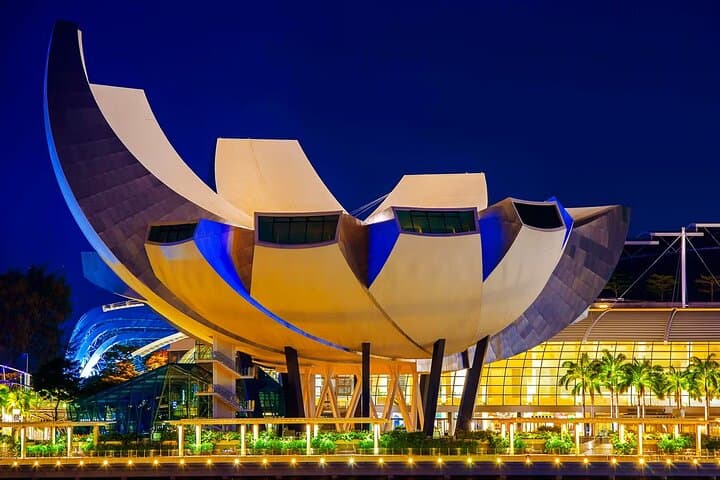
You step off the promenade and the museum’s white, petal-like fingers reach toward the bay — a modern silhouette against the glass towers of Marina Bay Sands. Inside, galleries shift from darkened digital chambers to bright, hands-on labs where projection and physics share the same floor.
You step off the promenade and the museum’s white, petal-like fingers reach toward the bay — a modern silhouette against the glass towers of Marina Bay Sands. Inside, galleries shift from darkened digital chambers to bright, hands-on labs where projection and physics share the same floor.
The ArtScience Museum opened in 2011 as part of the Marina Bay Sands complex and was designed by architect Moshe Safdie. Its shape and structural ribs are as much an architectural statement as a functional space: galleries arranged to host rotating exhibitions that cross art, design, technology and science. The building sits on reclaimed coastal land, so the experience includes the city’s engineered shoreline and the engineered backdrop of Singapore’s rapid modern development.
Exhibitions vary — expect immersive projection works, interactive science displays, and curated shows that pair contemporary art with technological themes. The flow is efficient: many exhibits are laid out for self-guided movement with timed-entry ticketing, quiet interpretation panels, and occasional guided segments.
Practical guidance: allow 1–4 hours depending on show scale; purchase timed tickets online to avoid queues. The museum is fully accessible, with elevators and step-free routes. Photography rules vary by exhibition, so look for signage; large bags may be subject to security checks. Combine the visit with a stroll across the Helix Bridge, an early-evening skyline view, or a stop at the nearby food options inside Marina Bay Sands.
Plan for humidity—bring water and light layers—and leave extra time if you want to linger in installations that reward slow observation.