THE ADVENTURE COLLECTIVE® · Independent discovery and booking for outdoor travel

Walk the Zimbabwe side of Victoria Falls across sixteen viewpoints that reveal the Main Falls in full panorama. This 4‑hour tour combines easy trails, dramatic geology and abundant photo opportunities—best timed for high water if you want maximum spray and a chance at the moonbow.
Walk the Zimbabwe side of Victoria Falls across sixteen viewpoints that reveal the Main Falls in full panorama. This 4‑hour tour combines easy trails, dramatic geology and abundant photo opportunities—best timed for high water if you want maximum spray and a chance at the moonbow.
Mist curls off the lip of the Zambezi and the air tastes of stone and spray. On the Zimbabwe side, a compact route threads along the gorge rim, offering sixteen distinct viewpoints that step you through the full breadth of the Main Falls—each aperture framing different angles of thunder, spray and the green gorge below.
Verified experiences and guided adventures in the surrounding area.
Operated by Beyond Africa Safaris (Pty)Ltd · Victoria Falls, Matabeleland North
Mist curls off the lip of the Zambezi and the air tastes of stone and spray. On the Zimbabwe side, a compact route threads along the gorge rim, offering sixteen distinct viewpoints that step you through the full breadth of the Main Falls—each aperture framing different angles of thunder, spray and the green gorge below.
The falls were first written about in European records by David Livingstone in 1855 and later named after Queen Victoria; today the site is a UNESCO World Heritage Area carved through a basalt plateau and scarred by the river’s relentless erosion. The geology delivers dramatic contrasts: hard Batoka basalts above and the deep, V-shaped Batoka Gorge cut by the river. The town of Victoria Falls supports a small tourism economy—local guides often point out craft stalls, birdlife and the communities that live downriver.
Practically, expect 2–3 km of walking across paved paths, stone steps and short boardwalks with minimal net elevation gain (roughly 50–100 m overall). Surfaces are often wet and slippery from constant spray; sections are fenced and well-maintained but can be uneven. Peak water runs March–May when flow is highest and spray at its most dramatic; dryer months (June–February) give clearer long-distance views.
Bring a waterproof layer, grippy footwear and a camera with a protective cover. Time visits for morning or late afternoon light to avoid mid-day crowds and to increase chances of spotting the lunar rainbow on full-moon nights. The walk pairs easily with a short transfer back to town or a combined visit to the Zambian side for alternate perspectives.
easy.
4 hours.
Suitable for most fitness levels—requires steady, moderate walking and ability to use steps and short slopes.
Yes; this tour includes the Zimbabwe national park entry fees as noted in the inclusions.
High water typically occurs March–May following seasonal rains—this is when spray and flow are at their maximum.
Yes; the route is classified as easy with maintained paths, but expect wet, slippery surfaces and bring appropriate footwear.
Yes; many travelers pair both sides for complementary perspectives—arranging border logistics requires additional time and documentation.
Victoria Falls was recorded by David Livingstone in 1855 and later designated a UNESCO World Heritage Site; the falls sit where the Zambezi cuts through ancient basalt flows.
Visitor pressure and upstream water management affect flow and habitat—stay on marked trails, avoid feeding wildlife and support local conservation fees that fund park protection.
Beyond Africa Safaris (Pty)Ltd operates guided outdoor trips and adventures with an emphasis on safety, stewardship, and memorable experiences.


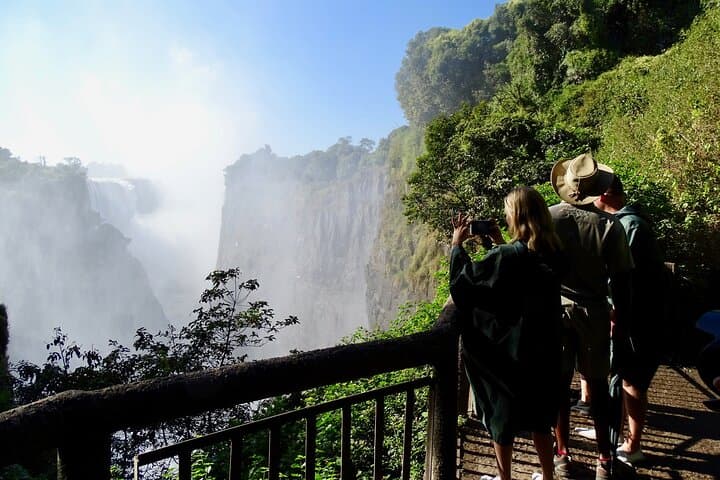

Mist curls off the lip of the Zambezi and the air tastes of stone and spray. On the Zimbabwe side, a compact route threads along the gorge rim, offering sixteen distinct viewpoints that step you through the full breadth of the Main Falls—each aperture framing different angles of thunder, spray and the green gorge below.
Mist curls off the lip of the Zambezi and the air tastes of stone and spray. On the Zimbabwe side, a compact route threads along the gorge rim, offering sixteen distinct viewpoints that step you through the full breadth of the Main Falls—each aperture framing different angles of thunder, spray and the green gorge below.
The falls were first written about in European records by David Livingstone in 1855 and later named after Queen Victoria; today the site is a UNESCO World Heritage Area carved through a basalt plateau and scarred by the river’s relentless erosion. The geology delivers dramatic contrasts: hard Batoka basalts above and the deep, V-shaped Batoka Gorge cut by the river. The town of Victoria Falls supports a small tourism economy—local guides often point out craft stalls, birdlife and the communities that live downriver.
Practically, expect 2–3 km of walking across paved paths, stone steps and short boardwalks with minimal net elevation gain (roughly 50–100 m overall). Surfaces are often wet and slippery from constant spray; sections are fenced and well-maintained but can be uneven. Peak water runs March–May when flow is highest and spray at its most dramatic; dryer months (June–February) give clearer long-distance views.
Bring a waterproof layer, grippy footwear and a camera with a protective cover. Time visits for morning or late afternoon light to avoid mid-day crowds and to increase chances of spotting the lunar rainbow on full-moon nights. The walk pairs easily with a short transfer back to town or a combined visit to the Zambian side for alternate perspectives.