THE ADVENTURE COLLECTIVE® · Independent discovery and booking for outdoor travel

Trace the steps of 1916 soldiers on a full-day Verdun battlefield tour from Paris. Visit Fort Douaumont, the Ossuary and the memorial museum with an expert historian guiding context and access.
Trace the steps of 1916 soldiers on a full-day Verdun battlefield tour from Paris. Visit Fort Douaumont, the Ossuary and the memorial museum with an expert historian guiding context and access.
You step out of the coach into a wind that still seems to push across shell-cratered fields — the plain around Verdun is wide and open, grass flattening toward low stone forts that hold the silence of decades.
Verified experiences and guided adventures in the surrounding area.
Operated by Royal Journey France · Verdun, Grand Est
You step out of the coach into a wind that still seems to push across shell-cratered fields — the plain around Verdun is wide and open, grass flattening toward low stone forts that hold the silence of decades.
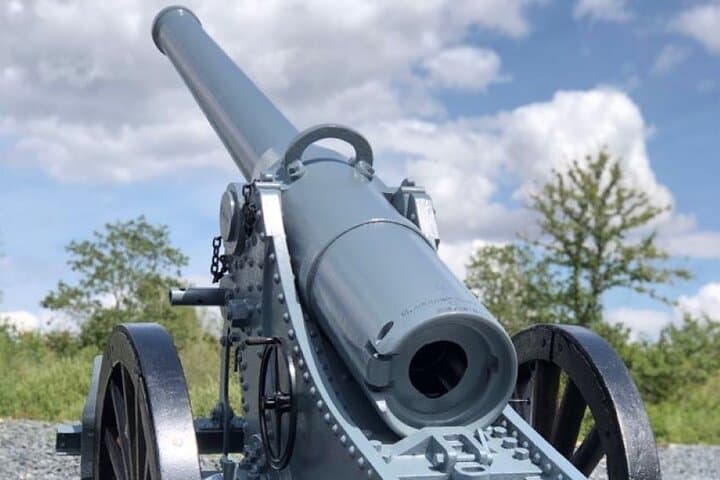
An expert guide leads the group along the route soldiers used in 1916, explaining trench layouts, artillery ranges and the strategic logic that made Verdun one of World War I’s longest battles. Fort Douaumont and Fort Vaux appear as concrete, earth and iron: their interiors show gun emplacements, narrow corridors and the human-scale engineering that defined defensive warfare.
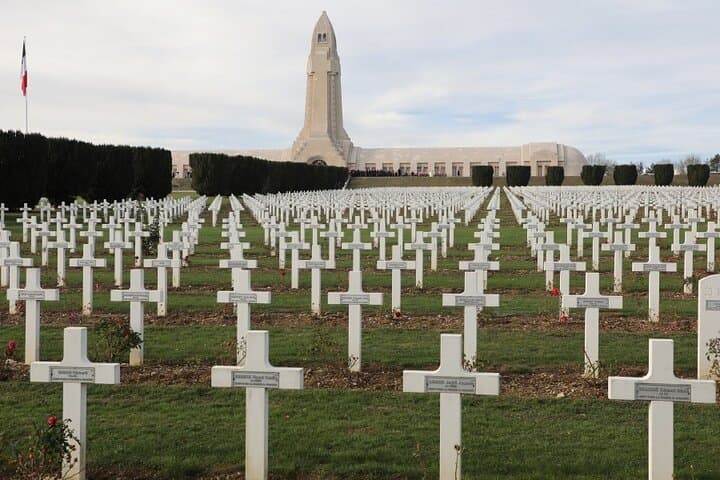
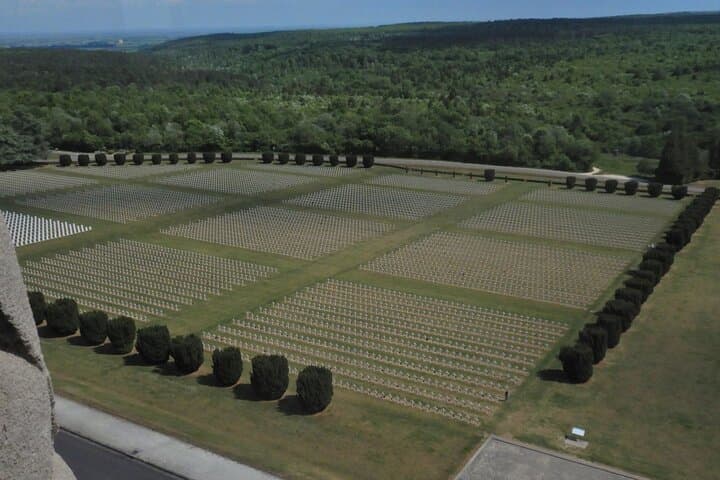
Geology is plain here: chalky loam and clay that preserved craters, shell holes and shattered trees. The Ossuary at Douaumont, its vaulted galleries and rank upon rank of crosses in the adjoining cemetery, speaks to scale more plainly than any statistic.
Local culture around Verdun centers on memory — small museums, preserved villages like Fleury-devant-Douaumont and commemorative monuments that mark lines on the landscape.
Practical guidance: the full-day excursion runs about six hours with included admissions and bottled water; expect paved and uneven walking, stair descents inside forts and exposed sections across fields. Wear sturdy shoes, layered weatherproof clothing and bring a refillable water bottle and sun protection. Photography is allowed in most outdoor sites but follow guide instructions indoors. The visit is emotionally heavy; allow time afterward to process or visit Verdun town for a quieter meal.
easy.
6 hours.
Suitable for most fitness levels; requires walking up to a few miles with stairs and uneven ground
Yes; the tour includes entry to Fort Douaumont and the Douaumont Ossuary as stated in the itinerary.
The coach departs from a central Paris pickup (parking behind Notre-Dame is used for this operator) and returns to the same point at the end of the day.
The tour is physically easy overall but includes stairs and uneven ground inside forts and across fields; it may be challenging for those with mobility issues.
Photography is generally allowed outdoors and in many museum spaces, but follow guide instructions and any restricted signage inside specific exhibits.
The Battle of Verdun (February–December 1916) was one of WWI’s longest engagements; the landscape still bears physical scars from artillery and trench lines.
Sites are actively preserved as memorials and archaeological areas—visitors must not remove artifacts and should stay on marked paths to protect fragile trenches and vegetation.
Royal Journey France operates guided outdoor trips and adventures with an emphasis on safety, stewardship, and memorable experiences.
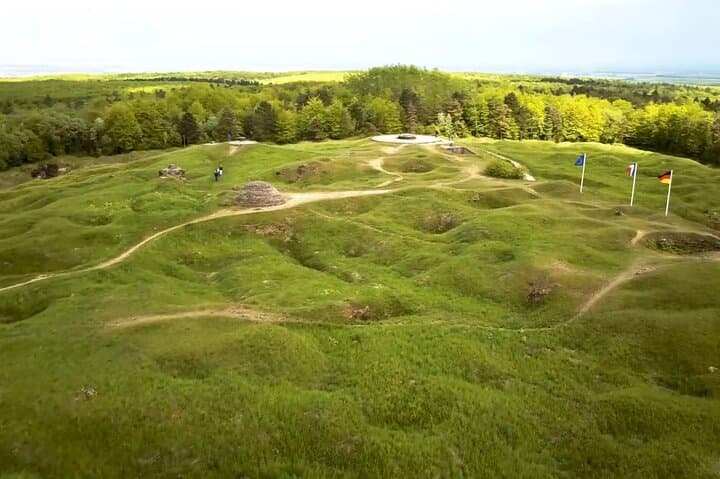
You step out of the coach into a wind that still seems to push across shell-cratered fields — the plain around Verdun is wide and open, grass flattening toward low stone forts that hold the silence of decades.
You step out of the coach into a wind that still seems to push across shell-cratered fields — the plain around Verdun is wide and open, grass flattening toward low stone forts that hold the silence of decades.
An expert guide leads the group along the route soldiers used in 1916, explaining trench layouts, artillery ranges and the strategic logic that made Verdun one of World War I’s longest battles. Fort Douaumont and Fort Vaux appear as concrete, earth and iron: their interiors show gun emplacements, narrow corridors and the human-scale engineering that defined defensive warfare.
Geology is plain here: chalky loam and clay that preserved craters, shell holes and shattered trees. The Ossuary at Douaumont, its vaulted galleries and rank upon rank of crosses in the adjoining cemetery, speaks to scale more plainly than any statistic.
Local culture around Verdun centers on memory — small museums, preserved villages like Fleury-devant-Douaumont and commemorative monuments that mark lines on the landscape.
Practical guidance: the full-day excursion runs about six hours with included admissions and bottled water; expect paved and uneven walking, stair descents inside forts and exposed sections across fields. Wear sturdy shoes, layered weatherproof clothing and bring a refillable water bottle and sun protection. Photography is allowed in most outdoor sites but follow guide instructions indoors. The visit is emotionally heavy; allow time afterward to process or visit Verdun town for a quieter meal.