THE ADVENTURE COLLECTIVE® · Independent discovery and booking for outdoor travel

Skip St. Mark’s and head into the alleys where Venice’s real architecture waits: private chapels, merchant palaces and marble miracles. This two-hour private walking tour focuses on artful details, local history and the hidden corners around Rialto.
Skip St. Mark’s and head into the alleys where Venice’s real architecture waits: private chapels, merchant palaces and marble miracles. This two-hour private walking tour focuses on artful details, local history and the hidden corners around Rialto.
You meet under the bronze statue of Carlo Goldoni in Campo San Bartolomeo, the Rialto bridge a few minutes' walk away and the canal traffic clicking like a slow metronome. Your guide unfolds a route that threads through alleys and campos where façades shift from Byzantine mosaics to Baroque flourishes; the city feels like an open archive, every doorway a page.
Verified experiences and guided adventures in the surrounding area.
Operated by Venice Events srl · Venice, Veneto
You meet under the bronze statue of Carlo Goldoni in Campo San Bartolomeo, the Rialto bridge a few minutes' walk away and the canal traffic clicking like a slow metronome. Your guide unfolds a route that threads through alleys and campos where façades shift from Byzantine mosaics to Baroque flourishes; the city feels like an open archive, every doorway a page.
The two-hour private tour deliberately drifts off the busiest axes. You pause at the modest house marked as Marco Polo’s family home, stand in the shadow of the austere Gothic frames at SS. Giovanni e Paolo, and step into the marble-smooth calm of Santa Maria dei Miracoli. Each stop is a lesson in how wealth, trade and water shaped form — merchants and ecclesiastical patrons translating commercial power into decorative art.
Venice’s story is geological as much as cultural. The city sits on a lagoon of shifting silt and salt; centuries of wooden pilings driven into compacted clay support palaces and churches whose ornate fronts conceal the engineering below. That combination—fragile ground and confident architecture—produces the peculiar tensions you see up close: sculptures weathered by salt air, mosaics repaired in layered hands over generations.
Culturally the tour is intimate. Guides point out workshop marks on stone, tell of guild rivalries, and explain how private chapels became stages for painters like Tintoretto and Veronese. There’s room for local textures: the cadence of boat horns, the baker on a corner selling fresh sfoglie, the occasional gondolier steering under a low bridge as if nudging the past forward.
Practical guidance is built into the pace. The route covers mostly flat ground but expects frequent bridge steps and narrow, sometimes damp alleys — bring shoes with good traction. Entrance fees to churches are not always included, and from time to time the municipal access fee for day visitors applies, so carry a few euros. Morning departures avoid the midday surge at Rialto and catch fresher light on stone and water.
For planning: reconfirm the meeting point the day before and tell your guide if you need pickup in the Rialto hotel zone. Expect a private, conversational visit rather than a rapid checklist; the tour’s value is in the close reading of material culture and a guide who can pivot to your interest in sculpture, stained glass or urban history. Leave room to linger — a tucked-away campo, an unexpected loggia — and you’ll walk away with a clearer sense of why Venice’s art and architecture feel like living arguments between commerce, craft and the sea.
easy.
2 hours.
Suitable for most travelers who can handle brief stair climbs on bridges and standing during stops.
Meet at the statue of Carlo Goldoni in Campo San Bartolomeo near Rialto; the guide will hold a sign with your name.
No, entrance fees are not included and should be paid on the spot when required.
Venice’s bridges and narrow alleys make full wheelchair access difficult; contact the supplier for specific accessibility arrangements.
Guides are available in English, French, German, Italian or Spanish—confirm language at booking.
Hotel pickup is optional for properties in the Rialto area; reconfirm with the operator the day before.
Tours can proceed if walkways are passable, but severe flooding may cause cancellations—check forecasts and the cancellation policy.
Venice rose from a lagoon, built on thousands of timber piles; centuries of trade funded elaborate churches and private chapels you'll see on this tour.
The city is vulnerable to rising water and overtourism; support licensed guides, avoid single-use plastics and respect restricted conservation areas.
Venice Events srl operates guided outdoor trips and adventures with an emphasis on safety, stewardship, and memorable experiences.

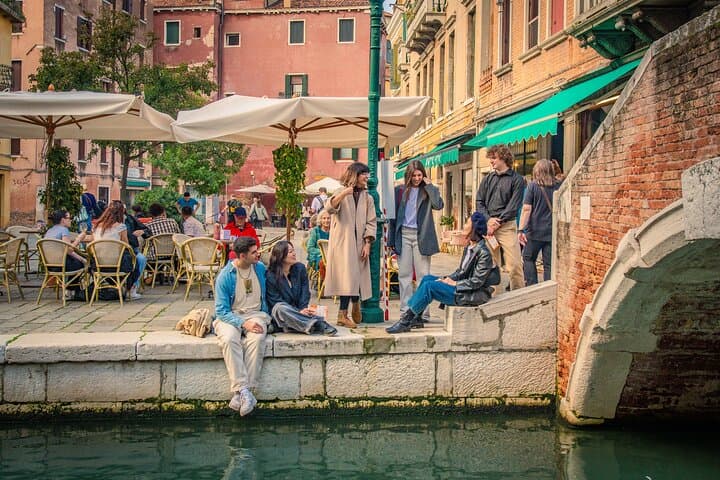

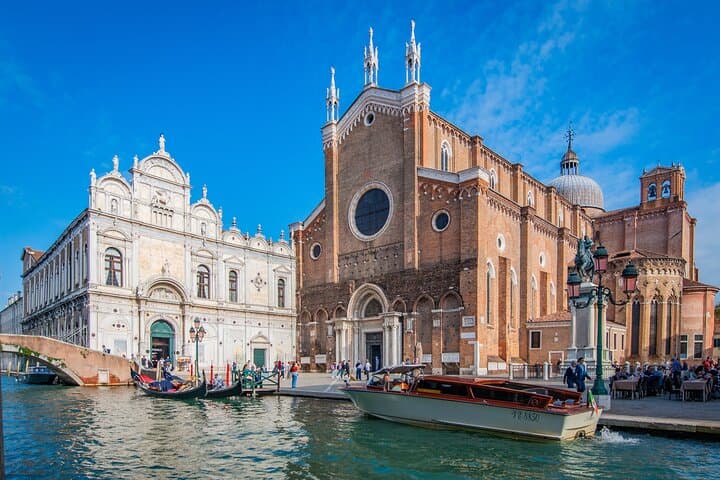
You meet under the bronze statue of Carlo Goldoni in Campo San Bartolomeo, the Rialto bridge a few minutes' walk away and the canal traffic clicking like a slow metronome. Your guide unfolds a route that threads through alleys and campos where façades shift from Byzantine mosaics to Baroque flourishes; the city feels like an open archive, every doorway a page.
You meet under the bronze statue of Carlo Goldoni in Campo San Bartolomeo, the Rialto bridge a few minutes' walk away and the canal traffic clicking like a slow metronome. Your guide unfolds a route that threads through alleys and campos where façades shift from Byzantine mosaics to Baroque flourishes; the city feels like an open archive, every doorway a page.
The two-hour private tour deliberately drifts off the busiest axes. You pause at the modest house marked as Marco Polo’s family home, stand in the shadow of the austere Gothic frames at SS. Giovanni e Paolo, and step into the marble-smooth calm of Santa Maria dei Miracoli. Each stop is a lesson in how wealth, trade and water shaped form — merchants and ecclesiastical patrons translating commercial power into decorative art.
Venice’s story is geological as much as cultural. The city sits on a lagoon of shifting silt and salt; centuries of wooden pilings driven into compacted clay support palaces and churches whose ornate fronts conceal the engineering below. That combination—fragile ground and confident architecture—produces the peculiar tensions you see up close: sculptures weathered by salt air, mosaics repaired in layered hands over generations.
Culturally the tour is intimate. Guides point out workshop marks on stone, tell of guild rivalries, and explain how private chapels became stages for painters like Tintoretto and Veronese. There’s room for local textures: the cadence of boat horns, the baker on a corner selling fresh sfoglie, the occasional gondolier steering under a low bridge as if nudging the past forward.
Practical guidance is built into the pace. The route covers mostly flat ground but expects frequent bridge steps and narrow, sometimes damp alleys — bring shoes with good traction. Entrance fees to churches are not always included, and from time to time the municipal access fee for day visitors applies, so carry a few euros. Morning departures avoid the midday surge at Rialto and catch fresher light on stone and water.
For planning: reconfirm the meeting point the day before and tell your guide if you need pickup in the Rialto hotel zone. Expect a private, conversational visit rather than a rapid checklist; the tour’s value is in the close reading of material culture and a guide who can pivot to your interest in sculpture, stained glass or urban history. Leave room to linger — a tucked-away campo, an unexpected loggia — and you’ll walk away with a clearer sense of why Venice’s art and architecture feel like living arguments between commerce, craft and the sea.