THE ADVENTURE COLLECTIVE® · Independent discovery and booking for outdoor travel

Walk Valencia’s layers of history with an official guide: from Roman ruins and the Cathedral to Europe’s largest fresh‑market and the UNESCO silk exchange. Two hours of compact, customizable storytelling and on‑the‑ground orientation.
Walk Valencia’s layers of history with an official guide: from Roman ruins and the Cathedral to Europe’s largest fresh‑market and the UNESCO silk exchange. Two hours of compact, customizable storytelling and on‑the‑ground orientation.
Morning light slices across Valencia’s stone facades as you fall into step with an official Valencian guide, threading narrow lanes toward the Cathedral’s carved portal.
Verified experiences and guided adventures in the surrounding area.
Operated by Valencia & Go · Valencia, Valencian Community
Morning light slices across Valencia’s stone facades as you fall into step with an official Valencian guide, threading narrow lanes toward the Cathedral’s carved portal.
This two-hour private walk moves at the pace of the city—brisk on sunlit plazas, deliberate where layers of history surface in the pavement. Expect flat, largely paved terrain with short stretches of cobblestone and a few steps at church entrances; overall distance is about 2–3 km but packed with stops: Roman ruins, the Cathedral and Basilica, Mercado Central, the 15th‑century Lonja de la Seda (Silk Exchange), and the Town Hall square.
Valencia, founded as Roman Valentia in the 2nd century BCE, bears Roman foundations, Visigothic and Islamic street patterns, and later expansion under the Crown of Aragon—evidence you’ll read in masonry, market stalls, and civic architecture. Geology has little drama here; instead the city’s story is urban: a port economy, a medieval silk industry, and modernist market halls that showcase iron and tile craftsmanship.
Practical guidance: wear comfortable, closed-toe shoes for uneven cobbles; carry a refillable water bottle and sun protection (summer mornings or evenings are best); bring a light layer for coastal breezes. Guides tailor the route—if you want sites outside the old quarter, a cab may be required. For history buffs and curious travelers, this tour pairs concise context with the liberty to ask deep questions—ideal for first-time visitors who want orientation and local tips before exploring further.
moderate.
2 hours.
Moderate: able to walk 2–3 km at a steady pace and stand during stops; suitable for most adults and older children with supervision.
Yes—most of the historic centre is accessible, but notify the operator in advance so the guide can adapt the route and avoid steps.
Yes—within the two-hour window the guide can emphasize architecture, archaeology, food stops or local tips; visits outside the old quarter may require taxi fare.
The standard tour discusses exterior and history; admission to paid attractions is typically not included—confirm specifics when booking.
Guides are often multilingual; request your preferred language when booking to ensure availability.
Valencia was founded as Roman Valentia in the 2nd century BCE; its prosperity peaked during the 15th–16th centuries with the silk trade, visible in the Lonja de la Seda (UNESCO).
Historic fabric is sensitive—stay on designated paths, avoid touching delicate carvings, and use refillable bottles to reduce plastic waste in busy market areas.
Valencia & Go operates guided outdoor trips and adventures with an emphasis on safety, stewardship, and memorable experiences.
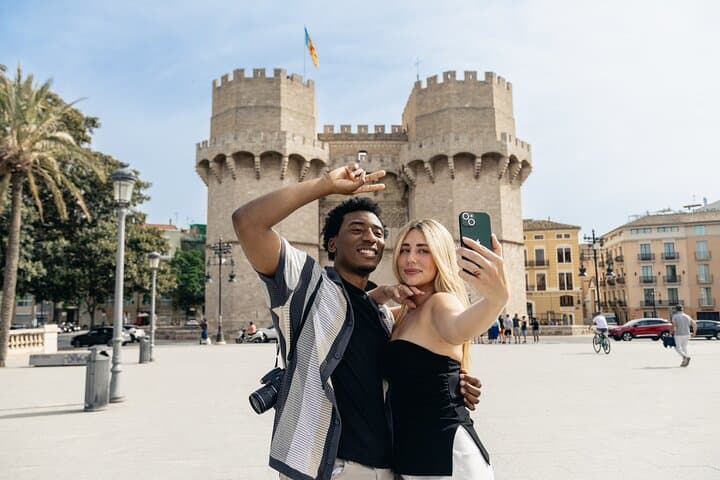


Morning light slices across Valencia’s stone facades as you fall into step with an official Valencian guide, threading narrow lanes toward the Cathedral’s carved portal.
Morning light slices across Valencia’s stone facades as you fall into step with an official Valencian guide, threading narrow lanes toward the Cathedral’s carved portal.
This two-hour private walk moves at the pace of the city—brisk on sunlit plazas, deliberate where layers of history surface in the pavement. Expect flat, largely paved terrain with short stretches of cobblestone and a few steps at church entrances; overall distance is about 2–3 km but packed with stops: Roman ruins, the Cathedral and Basilica, Mercado Central, the 15th‑century Lonja de la Seda (Silk Exchange), and the Town Hall square.
Valencia, founded as Roman Valentia in the 2nd century BCE, bears Roman foundations, Visigothic and Islamic street patterns, and later expansion under the Crown of Aragon—evidence you’ll read in masonry, market stalls, and civic architecture. Geology has little drama here; instead the city’s story is urban: a port economy, a medieval silk industry, and modernist market halls that showcase iron and tile craftsmanship.
Practical guidance: wear comfortable, closed-toe shoes for uneven cobbles; carry a refillable water bottle and sun protection (summer mornings or evenings are best); bring a light layer for coastal breezes. Guides tailor the route—if you want sites outside the old quarter, a cab may be required. For history buffs and curious travelers, this tour pairs concise context with the liberty to ask deep questions—ideal for first-time visitors who want orientation and local tips before exploring further.