THE ADVENTURE COLLECTIVE® · Independent discovery and booking for outdoor travel

Spend a full day from Mérida exploring Uxmal’s monumental Puuc architecture, the quieter Kabah ruins, and the Choco-Story Museum to trace cacao’s ancient role in Maya life. This guided tour blends archaeology, local food, and accessible trails for a rich cultural outing.
Spend a full day from Mérida exploring Uxmal’s monumental Puuc architecture, the quieter Kabah ruins, and the Choco-Story Museum to trace cacao’s ancient role in Maya life. This guided tour blends archaeology, local food, and accessible trails for a rich cultural outing.
A low sun breaks through the dry-season scrub as the van peels away from Mérida and the Puuc hills begin to rise—limestone ridges smoothed by millennia of wind, their crowns pierced by stepped stone. The day moves at an easy pace: a guided walk around Uxmal’s broad plazas, a quieter hour among Kabah’s carved façades, and a hands-on stop that traces cacao from pod to cup at the Choco-Story exhibit.
Verified experiences and guided adventures in the surrounding area.
Operated by Stap Travel Tours · Mérida, Yucatán
A low sun breaks through the dry-season scrub as the van peels away from Mérida and the Puuc hills begin to rise—limestone ridges smoothed by millennia of wind, their crowns pierced by stepped stone. The day moves at an easy pace: a guided walk around Uxmal’s broad plazas, a quieter hour among Kabah’s carved façades, and a hands-on stop that traces cacao from pod to cup at the Choco-Story exhibit.
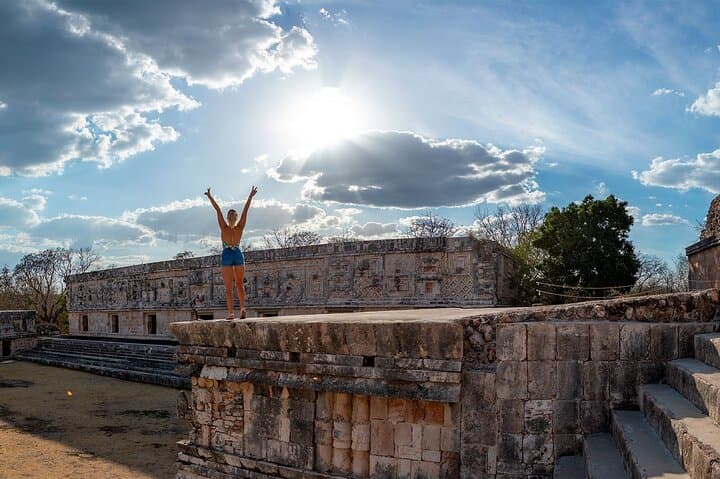
Uxmal is a late-classic Maya powerhouse, its governor’s palace and the House of the Magician showing the Puuc style—tight stone mosaics above plain lower walls—evidence of regional craft and political networks from the 8th–10th centuries. Kabah, farther along the Ruta Puuc, rewards those willing to step off the main path; its “Palace of Masks” façade is a quieter demonstration of the same stonework. Cacao’s story threads Maya ritual, colonial trade, and local agriculture together—at the museum you’ll see how the plant moved from sacred drink to global commodity.
Practically: expect 8–9 hours total, about 2 hours walking combined across mostly flat, uneven stone and packed-earth trails. Bring cash for local entrance fees and snacks, sun protection and a refillable water bottle, and wear closed shoes for traction on carved stairways and courtyard stones. Midday is hottest—plan to move between shaded ruins and the van for frequent breaks. The route is family-friendly but not wheelchair-accessible; sensitive travelers (spinal, cardiovascular, pregnant) should consult the operator before booking.
easy.
8–9 hours.
Suitable for most fitness levels; involves multiple short walks on uneven stone and standing during explanations.
Policies vary by operator; visitors should bring local cash—some tours include certain admissions, but Uxmal entry often requires payment on-site.
Expect an 8–9 hour day with 2–3 hours of walking total; the guide leads at an interpretive, family-friendly pace with van transfers between sites.
Some itineraries include a museum fee but many require separate payment on arrival—confirm with the tour operator and carry pesos just in case.
The operator notes this tour isn’t recommended for those with serious spinal or cardiovascular conditions or for pregnant travelers; consult the supplier before booking.
Uxmal and the Puuc towns flourished in the late-classic Maya period; the Puuc style emphasizes richly decorated upper façades and reflects regional craft specialization.
Stick to marked paths and respect closed areas—these sites limit climbing to protect stonework; using local guides and buying local food supports conservation and community livelihoods.
Stap Travel Tours operates guided outdoor trips and adventures with an emphasis on safety, stewardship, and memorable experiences.

A low sun breaks through the dry-season scrub as the van peels away from Mérida and the Puuc hills begin to rise—limestone ridges smoothed by millennia of wind, their crowns pierced by stepped stone. The day moves at an easy pace: a guided walk around Uxmal’s broad plazas, a quieter hour among Kabah’s carved façades, and a hands-on stop that traces cacao from pod to cup at the Choco-Story exhibit.
A low sun breaks through the dry-season scrub as the van peels away from Mérida and the Puuc hills begin to rise—limestone ridges smoothed by millennia of wind, their crowns pierced by stepped stone. The day moves at an easy pace: a guided walk around Uxmal’s broad plazas, a quieter hour among Kabah’s carved façades, and a hands-on stop that traces cacao from pod to cup at the Choco-Story exhibit.
Uxmal is a late-classic Maya powerhouse, its governor’s palace and the House of the Magician showing the Puuc style—tight stone mosaics above plain lower walls—evidence of regional craft and political networks from the 8th–10th centuries. Kabah, farther along the Ruta Puuc, rewards those willing to step off the main path; its “Palace of Masks” façade is a quieter demonstration of the same stonework. Cacao’s story threads Maya ritual, colonial trade, and local agriculture together—at the museum you’ll see how the plant moved from sacred drink to global commodity.
Practically: expect 8–9 hours total, about 2 hours walking combined across mostly flat, uneven stone and packed-earth trails. Bring cash for local entrance fees and snacks, sun protection and a refillable water bottle, and wear closed shoes for traction on carved stairways and courtyard stones. Midday is hottest—plan to move between shaded ruins and the van for frequent breaks. The route is family-friendly but not wheelchair-accessible; sensitive travelers (spinal, cardiovascular, pregnant) should consult the operator before booking.