THE ADVENTURE COLLECTIVE® · Independent discovery and booking for outdoor travel

Walk the Upper West Side from Central Park to Hearst Tower and watch New York’s architectural conversation unfold—prewar residences, institutional campuses, and striking contemporary buildings. This two-hour guided route balances big-picture context with close-up details.
Walk the Upper West Side from Central Park to Hearst Tower and watch New York’s architectural conversation unfold—prewar residences, institutional campuses, and striking contemporary buildings. This two-hour guided route balances big-picture context with close-up details.
On the sidewalk where Central Park hands the city its first deep breath, the Upper West Side tour begins beneath a gilded figure and the hush of plane trees. The guide breaks a neighborhood into chapters: civic plazas, modernist glass, collegiate Gothic and daring contemporary flats. You’ll move from the civic drama of Lincoln Center to the faceted glass of Hearst Tower, feeling the block-by-block conversation between old masonry and new engineering.
Verified experiences and guided adventures in the surrounding area.
On the sidewalk where Central Park hands the city its first deep breath, the Upper West Side tour begins beneath a gilded figure and the hush of plane trees. The guide breaks a neighborhood into chapters: civic plazas, modernist glass, collegiate Gothic and daring contemporary flats. You’ll move from the civic drama of Lincoln Center to the faceted glass of Hearst Tower, feeling the block-by-block conversation between old masonry and new engineering.
The area grew with 19th- and early-20th-century wealth and institutional ambition—Fordham and Columbia shaped academic life while brownstones and prewar apartment buildings defined residential taste. Geologically the neighborhood sits on glacially scoured Manhattan schist; that bedrock is why skyscrapers like Hearst and VIA 57 West can pin their loads deep and soar. Culturally, the UWS has long been a nexus for performing arts, publishing and academia; traces of immigrant workshops and progressive politics remain in storefronts and plaques.
Expect two hours of mostly flat urban walking, frequent stops for façade study and public-space discussion, and occasional traffic noise. Comfortable shoes, layered clothing for variable wind off the Hudson, and a charged phone for photos are practical musts. Morning and late-afternoon departures show the architecture in softer light; midday crowds are thicker near Lincoln Center and Columbus Circle. Guides provide headsets so you don’t miss details.
This tour suits anyone curious about how design, materials and civic aspiration shape a city block. It’s an urban hike that reads buildings like a map—practical, immediate, and visually rich.
easy.
2 hours.
Suitable for most people who can walk on flat urban sidewalks for two hours with short standing stops
The tour is two hours and covers roughly 1.5–2 miles of mostly flat city sidewalks with frequent stops.
Yes—most meeting points and sidewalks on this route are accessible; notify the operator when booking to confirm arrangements.
No—this is an exterior architecture tour; interior access and admissions are not included.
Guides are available in English, Spanish, French and Italian; headset translation and individual headsets are provided.
The Upper West Side expanded rapidly after 1860 with affluent rowhouses and later institutional campuses; Lincoln Center’s mid-century redevelopment reshaped the neighborhood’s cultural footprint.
Historic-preservation rules protect many façades; tourists are asked to respect private property and minimize noise and litter to reduce urban impact.
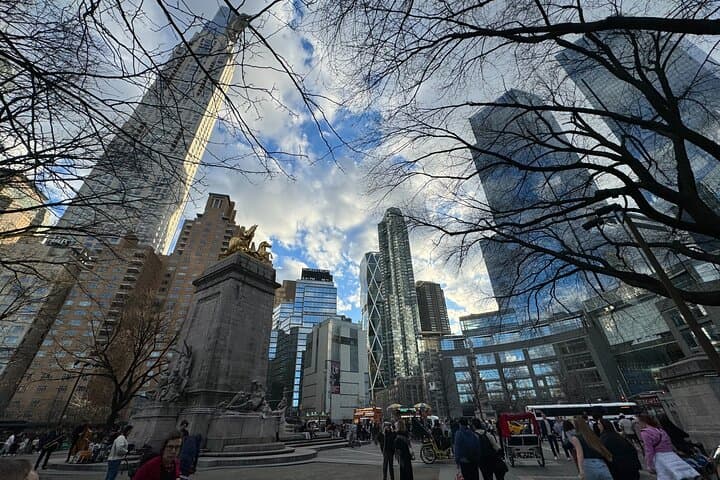
On the sidewalk where Central Park hands the city its first deep breath, the Upper West Side tour begins beneath a gilded figure and the hush of plane trees. The guide breaks a neighborhood into chapters: civic plazas, modernist glass, collegiate Gothic and daring contemporary flats. You’ll move from the civic drama of Lincoln Center to the faceted glass of Hearst Tower, feeling the block-by-block conversation between old masonry and new engineering.
On the sidewalk where Central Park hands the city its first deep breath, the Upper West Side tour begins beneath a gilded figure and the hush of plane trees. The guide breaks a neighborhood into chapters: civic plazas, modernist glass, collegiate Gothic and daring contemporary flats. You’ll move from the civic drama of Lincoln Center to the faceted glass of Hearst Tower, feeling the block-by-block conversation between old masonry and new engineering.
The area grew with 19th- and early-20th-century wealth and institutional ambition—Fordham and Columbia shaped academic life while brownstones and prewar apartment buildings defined residential taste. Geologically the neighborhood sits on glacially scoured Manhattan schist; that bedrock is why skyscrapers like Hearst and VIA 57 West can pin their loads deep and soar. Culturally, the UWS has long been a nexus for performing arts, publishing and academia; traces of immigrant workshops and progressive politics remain in storefronts and plaques.
Expect two hours of mostly flat urban walking, frequent stops for façade study and public-space discussion, and occasional traffic noise. Comfortable shoes, layered clothing for variable wind off the Hudson, and a charged phone for photos are practical musts. Morning and late-afternoon departures show the architecture in softer light; midday crowds are thicker near Lincoln Center and Columbus Circle. Guides provide headsets so you don’t miss details.
This tour suits anyone curious about how design, materials and civic aspiration shape a city block. It’s an urban hike that reads buildings like a map—practical, immediate, and visually rich.