THE ADVENTURE COLLECTIVE® · Independent discovery and booking for outdoor travel

Walk the elegant stretch of Fifth Avenue from the Frick to the Guggenheim on this focused two-hour architecture tour of Manhattan’s Upper East Side. Expect close readings of façades, small-group commentary and practical tips for visiting nearby museums.
Walk the elegant stretch of Fifth Avenue from the Frick to the Guggenheim on this focused two-hour architecture tour of Manhattan’s Upper East Side. Expect close readings of façades, small-group commentary and practical tips for visiting nearby museums.
Morning light slices across limestone facades as the group gathers outside the Frick Collection on 70th and Fifth—bronze plaques, carved cornices and stoops that remember New York’s Gilded Age. The two-hour walk follows the park edge and Fifth Avenue, moving from the intimate scale of townhouses to museum monuments where stone and concrete argue with glass.
Verified experiences and guided adventures in the surrounding area.
Morning light slices across limestone facades as the group gathers outside the Frick Collection on 70th and Fifth—bronze plaques, carved cornices and stoops that remember New York’s Gilded Age. The two-hour walk follows the park edge and Fifth Avenue, moving from the intimate scale of townhouses to museum monuments where stone and concrete argue with glass.
The route traces layers of history: late-19th-century mansions built for industrial fortunes, the Beaux-Arts scale of the Metropolitan Museum, and Frank Lloyd Wright’s spiraling Guggenheim—each a response to the city’s rapid growth and changing tastes. The former Whitney and nearby consulates add 20th-century modernism and diplomatic presence to the architectural language. Geology here is subtle—the Manhattan schist beneath your feet allowed vertical construction; the avenue’s grid frames procession and display.
Culturally the Upper East Side has been a stage for wealth, art collecting and civic institutions; the architecture reflects those civic ambitions and private legacies. Locals will point out discreet garden courts and carved lintels if you listen closely.
Practical guidance: expect roughly 1–1.5 miles on paved sidewalks with virtually no elevation gain. The tour is wheelchair-accessible and suitable for most fitness levels; professional headsets are provided so you won’t miss details. Museum admissions are not included—plan extra time if you want to enter. Morning departures avoid peak crowds along Fifth; bring water, sun protection and comfortable shoes. If weather turns, the guide will adapt the route. With small groups (up to 10) you’ll get close reading of façades and enough time for questions.
easy.
2 hours.
Suitable for people who can walk 1–2 miles on flat sidewalks; minimal stamina required
No—this is an exterior architecture walk; museum admissions (Frick, MET, Guggenheim) are not included in the tour price.
Yes—routes use sidewalks and curb cuts; the tour listing notes wheelchair accessibility and stroller access.
Outside the entrance of the Frick Collection on East 70th Street at Fifth Avenue; allow time to find the guide in busy conditions.
Guides are available in English, Spanish and Italian according to the tour inclusions; confirm language when booking.
The Upper East Side grew rapidly during the late 19th century as the wealthy moved north; many mansions were later converted into museums and institutions.
The area balances preservation of landmark architecture with urban pressures; follow Leave No Trace principles and respect private property when photographing façades.
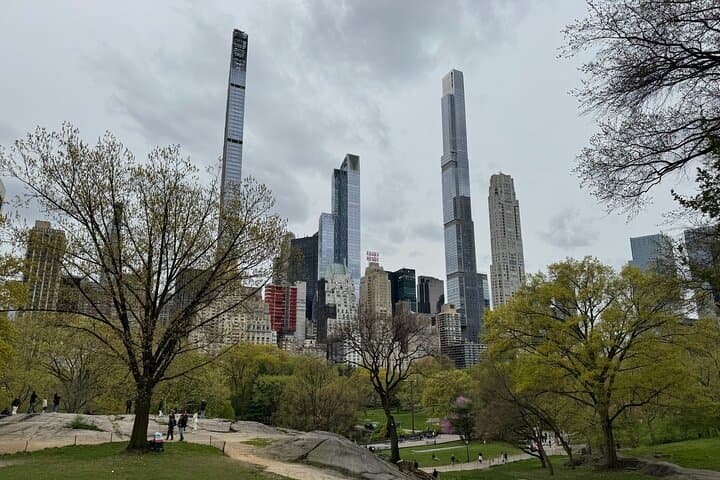
Morning light slices across limestone facades as the group gathers outside the Frick Collection on 70th and Fifth—bronze plaques, carved cornices and stoops that remember New York’s Gilded Age. The two-hour walk follows the park edge and Fifth Avenue, moving from the intimate scale of townhouses to museum monuments where stone and concrete argue with glass.
Morning light slices across limestone facades as the group gathers outside the Frick Collection on 70th and Fifth—bronze plaques, carved cornices and stoops that remember New York’s Gilded Age. The two-hour walk follows the park edge and Fifth Avenue, moving from the intimate scale of townhouses to museum monuments where stone and concrete argue with glass.
The route traces layers of history: late-19th-century mansions built for industrial fortunes, the Beaux-Arts scale of the Metropolitan Museum, and Frank Lloyd Wright’s spiraling Guggenheim—each a response to the city’s rapid growth and changing tastes. The former Whitney and nearby consulates add 20th-century modernism and diplomatic presence to the architectural language. Geology here is subtle—the Manhattan schist beneath your feet allowed vertical construction; the avenue’s grid frames procession and display.
Culturally the Upper East Side has been a stage for wealth, art collecting and civic institutions; the architecture reflects those civic ambitions and private legacies. Locals will point out discreet garden courts and carved lintels if you listen closely.
Practical guidance: expect roughly 1–1.5 miles on paved sidewalks with virtually no elevation gain. The tour is wheelchair-accessible and suitable for most fitness levels; professional headsets are provided so you won’t miss details. Museum admissions are not included—plan extra time if you want to enter. Morning departures avoid peak crowds along Fifth; bring water, sun protection and comfortable shoes. If weather turns, the guide will adapt the route. With small groups (up to 10) you’ll get close reading of façades and enough time for questions.