THE ADVENTURE COLLECTIVE® · Independent discovery and booking for outdoor travel

A long, early-day outing from Las Vegas takes you to two of the Colorado Plateau’s most photographed sites: the flowing sandstone corridors of Upper Antelope Canyon and the dramatic river loop of Horseshoe Bend. Expect tight canyons, wide panoramas, and a full day of travel and exploration.
A long, early-day outing from Las Vegas takes you to two of the Colorado Plateau’s most photographed sites: the flowing sandstone corridors of Upper Antelope Canyon and the dramatic river loop of Horseshoe Bend. Expect tight canyons, wide panoramas, and a full day of travel and exploration.
You leave Las Vegas before dawn, the highway slicing through sagebrush as the light hardens into the desert. By midmorning you step off the coach and the canyon narrows around you — light threads down vertical shafts, dust motes caught in a slow, deliberate choreography. The walls seem to move when you walk, carved into sinuous curves by ancient floods that still remind you of their power.
Verified experiences and guided adventures in the surrounding area.
Operated by TakeYourTrip · Page, Arizona
You leave Las Vegas before dawn, the highway slicing through sagebrush as the light hardens into the desert. By midmorning you step off the coach and the canyon narrows around you — light threads down vertical shafts, dust motes caught in a slow, deliberate choreography. The walls seem to move when you walk, carved into sinuous curves by ancient floods that still remind you of their power.
Antelope Canyon sits on Navajo Nation land and is primarily a slot canyon formed in Navajo Sandstone by flash floods over millennia; Horseshoe Bend is an entrenched meander of the Colorado River, cut deep into 4,200-foot mesas. The two sites are geologically young but visually mature: Antelope shows sculpted, smooth walls while Horseshoe Bend exposes broad stratified layers and a dramatic river loop.
Culturally, visits are guided under Navajo stewardship — guides share local perspectives and keep fragile areas protected. Expect short, managed walks: Antelope’s interior is photographed in tight groups; Horseshoe Bend is an open rim overlook with a half-mile approach on packed sand and gravel.
Practical tips: plan for a very long day (14–15 hours round trip from Vegas), wear sturdy closed-toe shoes for sand and short scrambles, and carry at least 1–2 liters of water. Sun protection is essential; shade is limited at the overlook and nonexistent inside the canyon. Photography is a highlight — low, soft light inside the slot, wide panoramas at the bend — but tripods may be restricted to photography-specific tours. Be mindful of cultural rules, follow your guide’s instructions, and leave no trace: these are working landscapes and sacred places.
easy.
14–15 hours.
Suitable for most fitness levels but requires stamina for a long travel day, standing and short walks; able to walk on uneven sand and rock.
The full excursion runs about 14–15 hours round trip, including travel time, guided visit to Upper Antelope, and time at Horseshoe Bend.
Yes — Antelope Canyon is on Navajo Nation land and all access is by guided tour; this tour typically includes the required admission.
Tripod policies vary; standard sightseeing tours often restrict tripods for safety and traffic flow. Photography-specific tours allow more equipment — check with your operator.
Upper Antelope Canyon and Horseshoe Bend have uneven sand, steps, and short scrambles; they are not fully wheelchair accessible and may be difficult for those with limited mobility.
The slot was carved from Navajo Sandstone by episodic flash floods; the area sits within Navajo Nation, which manages tours and access.
Tours limit group sizes and enforce rules to protect fragile sandstone and cultural sites; follow all guide instructions and pack out trash.
TakeYourTrip operates guided outdoor trips and adventures with an emphasis on safety, stewardship, and memorable experiences.
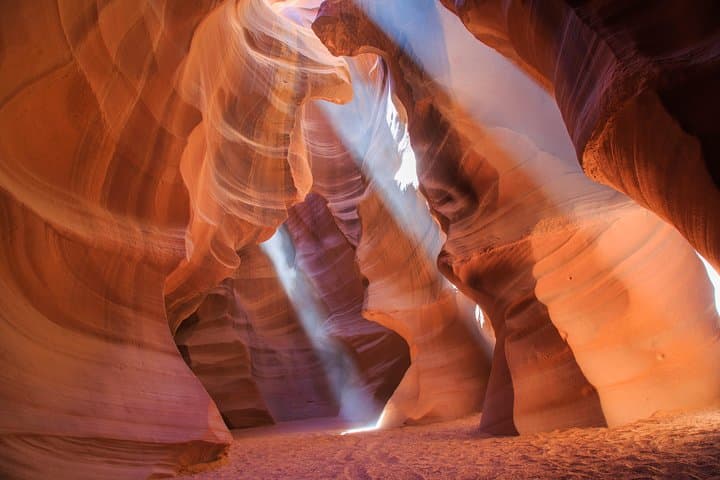
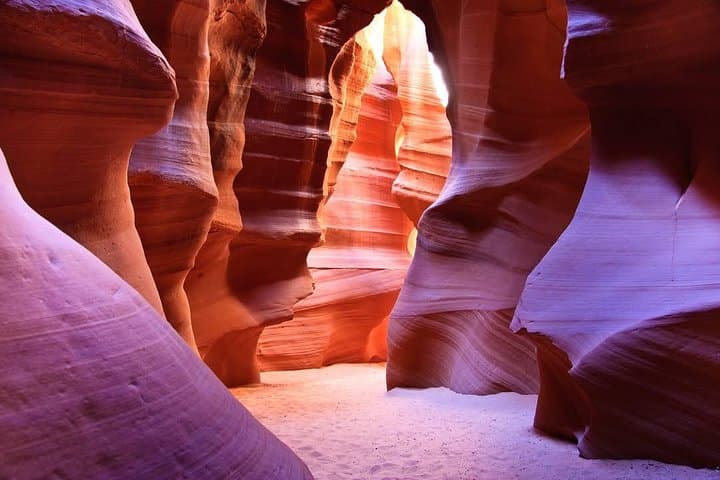
You leave Las Vegas before dawn, the highway slicing through sagebrush as the light hardens into the desert. By midmorning you step off the coach and the canyon narrows around you — light threads down vertical shafts, dust motes caught in a slow, deliberate choreography. The walls seem to move when you walk, carved into sinuous curves by ancient floods that still remind you of their power.
You leave Las Vegas before dawn, the highway slicing through sagebrush as the light hardens into the desert. By midmorning you step off the coach and the canyon narrows around you — light threads down vertical shafts, dust motes caught in a slow, deliberate choreography. The walls seem to move when you walk, carved into sinuous curves by ancient floods that still remind you of their power.
Antelope Canyon sits on Navajo Nation land and is primarily a slot canyon formed in Navajo Sandstone by flash floods over millennia; Horseshoe Bend is an entrenched meander of the Colorado River, cut deep into 4,200-foot mesas. The two sites are geologically young but visually mature: Antelope shows sculpted, smooth walls while Horseshoe Bend exposes broad stratified layers and a dramatic river loop.
Culturally, visits are guided under Navajo stewardship — guides share local perspectives and keep fragile areas protected. Expect short, managed walks: Antelope’s interior is photographed in tight groups; Horseshoe Bend is an open rim overlook with a half-mile approach on packed sand and gravel.
Practical tips: plan for a very long day (14–15 hours round trip from Vegas), wear sturdy closed-toe shoes for sand and short scrambles, and carry at least 1–2 liters of water. Sun protection is essential; shade is limited at the overlook and nonexistent inside the canyon. Photography is a highlight — low, soft light inside the slot, wide panoramas at the bend — but tripods may be restricted to photography-specific tours. Be mindful of cultural rules, follow your guide’s instructions, and leave no trace: these are working landscapes and sacred places.