THE ADVENTURE COLLECTIVE® · Independent discovery and booking for outdoor travel

Trace Georgia’s ancient spine on a full-day private tour from Tbilisi that pairs the rock-cut town of Uplistsikhe with Gori’s fortress and Mtskheta’s hilltop monasteries. This itinerary blends archaeology, early-Christian architecture and dramatic river views.
Trace Georgia’s ancient spine on a full-day private tour from Tbilisi that pairs the rock-cut town of Uplistsikhe with Gori’s fortress and Mtskheta’s hilltop monasteries. This itinerary blends archaeology, early-Christian architecture and dramatic river views.
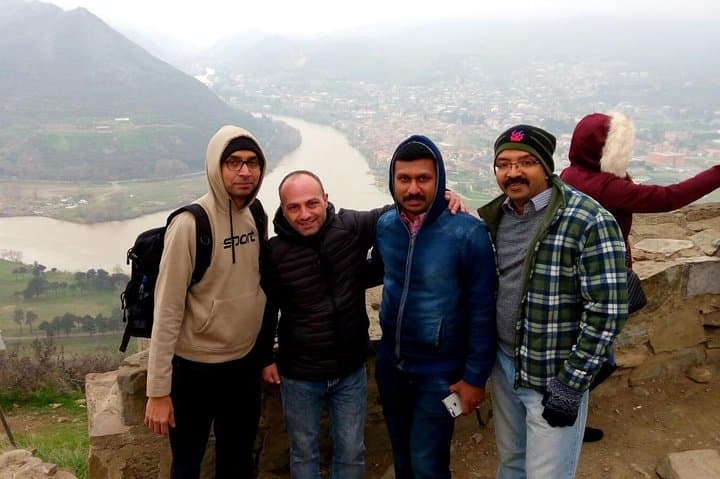
You arrive at a sun-baked ridge where rock faces have been hollowed into streets and rooms; wind slides through carved tunnels and the river below dares you to follow its silver ribbon to the valley. The Uplistsikhe complex opens like an ancient workshop — halls, bakeries and a stone basilica chiseled into lifeworn rock — and the day unspools through Gori’s fortressed hill and the cliff-top calm of Jvari overlooking Mtskheta.
Verified experiences and guided adventures in the surrounding area.
Operated by Guide of Georgia · Gori, Shida Kartli
You arrive at a sun-baked ridge where rock faces have been hollowed into streets and rooms; wind slides through carved tunnels and the river below dares you to follow its silver ribbon to the valley. The Uplistsikhe complex opens like an ancient workshop — halls, bakeries and a stone basilica chiseled into lifeworn rock — and the day unspools through Gori’s fortressed hill and the cliff-top calm of Jvari overlooking Mtskheta.
This route stitches together Georgia’s early Christian landmarks and pre-Christian urbanism. Uplistsikhe dates to the late Bronze Age and was a political and religious center into the medieval period; nearby Mtskheta served as the capital of the eastern Georgian kingdom of Iberia and houses Svetitskhoveli Cathedral, a UNESCO site founded around the 11th century. Geologically, the area is carved from volcanic tuff and riverine erosion; the confluence of the Mtkvari and Aragvi rivers gives Jvari its dramatic perch.
Expect well-marked sites, short climbs and staircases inside rock-cut halls — not technical climbing but uneven surfaces. The tour is best scheduled early or late in the day to avoid midday heat and crowded gates. Bring sturdy shoes, sun protection and a light jacket for exposed ridgelines. Hydrate on the drive between stops; restroom and café options are available in Gori and Mtskheta.
Practical: the full loop is an 8–10 hour day with mostly short, interpretive walks at each stop. Photography is excellent from Jvari’s lookout and Uplistsikhe’s high terraces; keep to the paths, respect fragile rockwork, and allow time for customs at museums.
moderate.
8–10 hours.
Light to moderate fitness: able to handle short uphill walks and stairs; no long-distance hiking required.
This private tour runs about 8–10 hours with short guided walks of 20–120 minutes at each site and driving between stops — it’s a full day but not strenuous.
Entrance fees are often not included; check booking details and bring local currency or card for museum admissions.
Children generally manage well, but some sites have uneven steps and narrow tunnels; visitors with limited mobility may find access at Uplistsikhe and some viewpoints challenging.
Private tours usually include pickup from Tbilisi hotels; confirm the exact pickup point with the operator when booking.
Uplistsikhe originated around the late Bronze Age and remained a major political and religious center until the 13th century; Mtskheta served as the capital of ancient Iberia and is central to Georgian Christian history.
Many sites are fragile volcanic tuff and suffer erosion and foot traffic; visitors are encouraged to stick to paths, avoid touching carved surfaces and follow local signage to minimize impact.
Guide of Georgia operates guided outdoor trips and adventures with an emphasis on safety, stewardship, and memorable experiences.

You arrive at a sun-baked ridge where rock faces have been hollowed into streets and rooms; wind slides through carved tunnels and the river below dares you to follow its silver ribbon to the valley. The Uplistsikhe complex opens like an ancient workshop — halls, bakeries and a stone basilica chiseled into lifeworn rock — and the day unspools through Gori’s fortressed hill and the cliff-top calm of Jvari overlooking Mtskheta.
You arrive at a sun-baked ridge where rock faces have been hollowed into streets and rooms; wind slides through carved tunnels and the river below dares you to follow its silver ribbon to the valley. The Uplistsikhe complex opens like an ancient workshop — halls, bakeries and a stone basilica chiseled into lifeworn rock — and the day unspools through Gori’s fortressed hill and the cliff-top calm of Jvari overlooking Mtskheta.
This route stitches together Georgia’s early Christian landmarks and pre-Christian urbanism. Uplistsikhe dates to the late Bronze Age and was a political and religious center into the medieval period; nearby Mtskheta served as the capital of the eastern Georgian kingdom of Iberia and houses Svetitskhoveli Cathedral, a UNESCO site founded around the 11th century. Geologically, the area is carved from volcanic tuff and riverine erosion; the confluence of the Mtkvari and Aragvi rivers gives Jvari its dramatic perch.
Expect well-marked sites, short climbs and staircases inside rock-cut halls — not technical climbing but uneven surfaces. The tour is best scheduled early or late in the day to avoid midday heat and crowded gates. Bring sturdy shoes, sun protection and a light jacket for exposed ridgelines. Hydrate on the drive between stops; restroom and café options are available in Gori and Mtskheta.
Practical: the full loop is an 8–10 hour day with mostly short, interpretive walks at each stop. Photography is excellent from Jvari’s lookout and Uplistsikhe’s high terraces; keep to the paths, respect fragile rockwork, and allow time for customs at museums.