THE ADVENTURE COLLECTIVE® · Independent discovery and booking for outdoor travel

A compact, small-group circuit from Alice Springs to Uluru and Kata Tjuta that combines guided base walks, cultural interpretation, and an outback camping night—ideal for travelers who want an immersive Red Centre experience in two days.
A compact, small-group circuit from Alice Springs to Uluru and Kata Tjuta that combines guided base walks, cultural interpretation, and an outback camping night—ideal for travelers who want an immersive Red Centre experience in two days.
The bus slides out of Alice Springs before dawn, headlights slicing through the flat ochre of the Red Centre. By mid-morning the landscape has rearranged itself into long shadows and rising heat—the road becomes a ribbon between low saltbush and distant rock. Arriving at the Uluru-Kata Tjuta National Park feels less like reaching a landmark and more like stepping into a different scale of time: Uluru’s bulk looms, patient and indifferent, while Kata Tjuta’s domes punch the horizon with blocky shoulders.
Verified experiences and guided adventures in the surrounding area.
Operated by Autopia Tours · Yulara, Northern Territory
The bus slides out of Alice Springs before dawn, headlights slicing through the flat ochre of the Red Centre. By mid-morning the landscape has rearranged itself into long shadows and rising heat—the road becomes a ribbon between low saltbush and distant rock. Arriving at the Uluru-Kata Tjuta National Park feels less like reaching a landmark and more like stepping into a different scale of time: Uluru’s bulk looms, patient and indifferent, while Kata Tjuta’s domes punch the horizon with blocky shoulders.
Over two days this small-group tour moves deliberately between these geologic giants. On day one travelers stop at Mt Connor—often mistaken for Uluru—before settling into an outback camp for lunch and then a guided base walk around Uluru. The base route covers roughly 2–3 km of uneven, rocky ground, leading to Mutitjulu waterhole and several rock-art sites where Anangu stories are read into the stone by an accredited guide. Uluru itself rises about 348 meters above the plain; its iron-rich face changes tone with the light, not out of vanity but because the desert insists on drama.
Day two is dedicated to Kata Tjuta, the ‘many heads’ whose conglomerate rock and deep gorges are a counterpoint to Uluru’s monolith. Hikes through Walpa Gorge or the Valley of the Winds range from 2–5 km and demand steady footing; wind funnels through the red-rock corridors and can sharpen the temperature quickly. The itinerary includes park entry, guided walks (total walking each day usually 2–4 hours), camp accommodations—either twin permanent safari tents or traditional swags—and meals shared around a communal table.
Beyond the geology are the human layers: the park is co-managed with the Anangu people, whose cultural law governs access to certain sites, and the National Park has held UNESCO status since 1987. Practicalities matter here. The tour requires a moderate to high fitness level, comfortable hiking shoes, and sun protection—shade is scarce and the desert demands respect. Baggage is limited to 15 kg for vehicle storage, and guests should be ready to help with mealtime prep as part of the group experience.
For travelers, this two-day escape is a compact but immersive way to move from Alice Springs’ low scrub to Uluru and Kata Tjuta’s monumental spaces. The payoff is immediate: close-up encounters with rock art and waterholes, sunrise silhouettes that transform scale and color, and evenings under a clear southern sky where the Milky Way redraws the map above the camp.
Practical tip: plan an extra night in Yulara in case of flight delays, carry a full water bottle (1.5–2 L minimum per day), and leave time to listen—guides and custodians both bring stories that change the stone into context.
challenging.
2 days (approx. 48 hours).
Expect several short to moderate hikes each day over rocky, uneven ground; a moderate-to-high level of fitness is required
Yes — the Uluru-Kata Tjuta National Park pass is included in the tour price.
Climbing Uluru is not permitted out of respect for Anangu wishes and park regulations; your guide will explain culturally sensitive areas to avoid.
Walks are short to moderate (2–5 km) but on uneven ground and in heat; a moderate to high fitness level is recommended.
One night is in outback permanent twin safari tents or traditional swags; facilities are communal with shared toilets and showers.
Yes — two lunches, one dinner and one breakfast are included; guests may be asked to assist with meal prep and cleanup.
The operator recommends booking an extra night in Yulara; they will drop off at Yulara/Ayers Rock Airport but cannot guarantee alternate transfers for late arrivals.
The park is co-managed with the Anangu people and was inscribed as a UNESCO World Heritage site in 1987 for its natural and cultural values.
Visitors are expected to follow park rules, stay on marked trails, and respect culturally restricted sites to minimize impact on fragile desert ecosystems.
Autopia Tours operates guided outdoor trips and adventures with an emphasis on safety, stewardship, and memorable experiences.

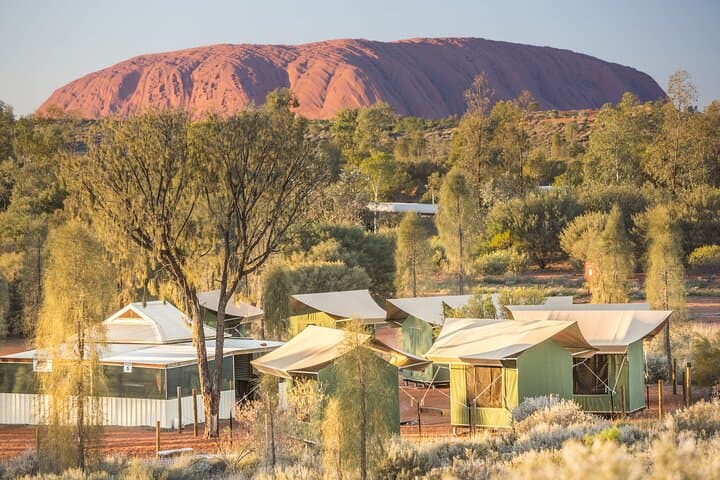


The bus slides out of Alice Springs before dawn, headlights slicing through the flat ochre of the Red Centre. By mid-morning the landscape has rearranged itself into long shadows and rising heat—the road becomes a ribbon between low saltbush and distant rock. Arriving at the Uluru-Kata Tjuta National Park feels less like reaching a landmark and more like stepping into a different scale of time: Uluru’s bulk looms, patient and indifferent, while Kata Tjuta’s domes punch the horizon with blocky shoulders.
The bus slides out of Alice Springs before dawn, headlights slicing through the flat ochre of the Red Centre. By mid-morning the landscape has rearranged itself into long shadows and rising heat—the road becomes a ribbon between low saltbush and distant rock. Arriving at the Uluru-Kata Tjuta National Park feels less like reaching a landmark and more like stepping into a different scale of time: Uluru’s bulk looms, patient and indifferent, while Kata Tjuta’s domes punch the horizon with blocky shoulders.
Over two days this small-group tour moves deliberately between these geologic giants. On day one travelers stop at Mt Connor—often mistaken for Uluru—before settling into an outback camp for lunch and then a guided base walk around Uluru. The base route covers roughly 2–3 km of uneven, rocky ground, leading to Mutitjulu waterhole and several rock-art sites where Anangu stories are read into the stone by an accredited guide. Uluru itself rises about 348 meters above the plain; its iron-rich face changes tone with the light, not out of vanity but because the desert insists on drama.
Day two is dedicated to Kata Tjuta, the ‘many heads’ whose conglomerate rock and deep gorges are a counterpoint to Uluru’s monolith. Hikes through Walpa Gorge or the Valley of the Winds range from 2–5 km and demand steady footing; wind funnels through the red-rock corridors and can sharpen the temperature quickly. The itinerary includes park entry, guided walks (total walking each day usually 2–4 hours), camp accommodations—either twin permanent safari tents or traditional swags—and meals shared around a communal table.
Beyond the geology are the human layers: the park is co-managed with the Anangu people, whose cultural law governs access to certain sites, and the National Park has held UNESCO status since 1987. Practicalities matter here. The tour requires a moderate to high fitness level, comfortable hiking shoes, and sun protection—shade is scarce and the desert demands respect. Baggage is limited to 15 kg for vehicle storage, and guests should be ready to help with mealtime prep as part of the group experience.
For travelers, this two-day escape is a compact but immersive way to move from Alice Springs’ low scrub to Uluru and Kata Tjuta’s monumental spaces. The payoff is immediate: close-up encounters with rock art and waterholes, sunrise silhouettes that transform scale and color, and evenings under a clear southern sky where the Milky Way redraws the map above the camp.
Practical tip: plan an extra night in Yulara in case of flight delays, carry a full water bottle (1.5–2 L minimum per day), and leave time to listen—guides and custodians both bring stories that change the stone into context.