THE ADVENTURE COLLECTIVE® · Independent discovery and booking for outdoor travel

Walk the slopes of Jabal Uhud with a licensed guide to visit mosques, memorials and battle sites central to early Islamic history. This four-hour guided program mixes short walks on paved paths and rocky overlooks with clear cultural context and audio narration in English and Arabic.
Walk the slopes of Jabal Uhud with a licensed guide to visit mosques, memorials and battle sites central to early Islamic history. This four-hour guided program mixes short walks on paved paths and rocky overlooks with clear cultural context and audio narration in English and Arabic.
You arrive at the base of Jabal Uhud with the city’s low hum behind you and stone rising like a page of history. The route climbs gently along paved approaches then opens to rocky outcrops where graves and memorial stones mark the Battle of Uhud. Wind moves across the slopes, pushing heat and dust over the same ridge where events of the seventh century unfolded.
Verified experiences and guided adventures in the surrounding area.
Operated by Gray Line - Kurban Tours · Madinah, Al Madinah Region
You arrive at the base of Jabal Uhud with the city’s low hum behind you and stone rising like a page of history. The route climbs gently along paved approaches then opens to rocky outcrops where graves and memorial stones mark the Battle of Uhud. Wind moves across the slopes, pushing heat and dust over the same ridge where events of the seventh century unfolded.
This four-hour guided tour threads through key sites: Uhud Mountain, Masjid Al-Mustarah where the Prophet rested, Masjid Al-Dira tied to battle preparations, and the cluster known as the Seven Mosques connected to the Battle of the Trench. Geologically the area is an exposed sandstone ridge—compact, uneven underfoot at points, with short steeper sections rather than sustained elevation gain. Culturally, the landscape is both sacred and lived-in; vendors and caretakers maintain daily rhythms around places of reverence.
Expect roughly 3–5 km of walking, mostly on paved or packed surfaces with occasional rocky patches; elevation change is modest and manageable for most visitors. Practical notes: modest dress is required, photo etiquette is strict around graves and inside mosques, and summer heat can be intense—start early or late afternoon. The tour includes hotel pickup, entrance fees, and English/Arabic audio guiding, making logistics straightforward.
Plan for hydration, respectful behavior at religious sites, and footwear that handles stone and short scrambles. The Uhud Experience is less a hike than a paced cultural walk where landscape and history press close enough to touch.
easy.
4 hours.
Suitable for most fitness levels; involves short walks and brief climbs but no sustained exertion
The tour runs about 4 hours with a gentle pace; expect 3–5 km of walking, frequent stops for interpretation, and short climbs to viewpoints.
Much of the route is accessible, but some viewpoints use uneven stone steps or short slopes—contact the operator ahead to confirm wheelchair-accessible segments.
Photography is allowed in many outdoor areas but restricted inside mosques and at some memorial spots; always follow your guide’s directions.
The tour provides licensed guides with audio narration in English and Arabic as part of the inclusions.
Jabal Uhud is the site of the 625 CE Battle of Uhud; the ridge and surrounding mosques are central to early Islamic history and pilgrimage memory.
Sites are actively maintained by local custodians and authorities—visitors are asked to stay on paths, avoid disturbing markers, and dispose of waste off-site.
Gray Line - Kurban Tours operates guided outdoor trips and adventures with an emphasis on safety, stewardship, and memorable experiences.

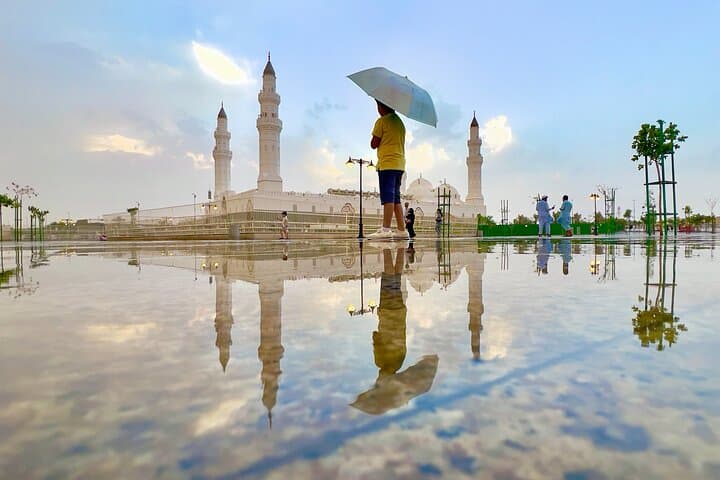


You arrive at the base of Jabal Uhud with the city’s low hum behind you and stone rising like a page of history. The route climbs gently along paved approaches then opens to rocky outcrops where graves and memorial stones mark the Battle of Uhud. Wind moves across the slopes, pushing heat and dust over the same ridge where events of the seventh century unfolded.
You arrive at the base of Jabal Uhud with the city’s low hum behind you and stone rising like a page of history. The route climbs gently along paved approaches then opens to rocky outcrops where graves and memorial stones mark the Battle of Uhud. Wind moves across the slopes, pushing heat and dust over the same ridge where events of the seventh century unfolded.
This four-hour guided tour threads through key sites: Uhud Mountain, Masjid Al-Mustarah where the Prophet rested, Masjid Al-Dira tied to battle preparations, and the cluster known as the Seven Mosques connected to the Battle of the Trench. Geologically the area is an exposed sandstone ridge—compact, uneven underfoot at points, with short steeper sections rather than sustained elevation gain. Culturally, the landscape is both sacred and lived-in; vendors and caretakers maintain daily rhythms around places of reverence.
Expect roughly 3–5 km of walking, mostly on paved or packed surfaces with occasional rocky patches; elevation change is modest and manageable for most visitors. Practical notes: modest dress is required, photo etiquette is strict around graves and inside mosques, and summer heat can be intense—start early or late afternoon. The tour includes hotel pickup, entrance fees, and English/Arabic audio guiding, making logistics straightforward.
Plan for hydration, respectful behavior at religious sites, and footwear that handles stone and short scrambles. The Uhud Experience is less a hike than a paced cultural walk where landscape and history press close enough to touch.