THE ADVENTURE COLLECTIVE® · Independent discovery and booking for outdoor travel

Launch from a bamboo platform above Ubud’s terraces on a 13‑meter jungle swing, then zipline across irrigated rice paddies before a cooling swim at Ulu Petanu Waterfall and a local coffee tasting. This compact half‑day tour pairs adrenaline with cultural context and hotel pickup.
Launch from a bamboo platform above Ubud’s terraces on a 13‑meter jungle swing, then zipline across irrigated rice paddies before a cooling swim at Ulu Petanu Waterfall and a local coffee tasting. This compact half‑day tour pairs adrenaline with cultural context and hotel pickup.
On a humid morning above Ubud, the air smells of wet earth and sweet rice shoots. Platforms built from bamboo and timber perch at the lip of terraced fields; guides check harnesses, nod, and the group steps forward. A soft breeze tugs at sarongs and camera straps as people lean into a 13‑meter jungle swing that launches them over the stepped green—then clip into a zipline that hums across paddies and gullies, carrying riders low over irrigation channels and high above the folds of the valley.
Verified experiences and guided adventures in the surrounding area.
Operated by CV MyBali Explore · Ubud, Bali
On a humid morning above Ubud, the air smells of wet earth and sweet rice shoots. Platforms built from bamboo and timber perch at the lip of terraced fields; guides check harnesses, nod, and the group steps forward. A soft breeze tugs at sarongs and camera straps as people lean into a 13‑meter jungle swing that launches them over the stepped green—then clip into a zipline that hums across paddies and gullies, carrying riders low over irrigation channels and high above the folds of the valley.
The landscape you fly over is shaped by volcanic soils and a water law called subak, a communal irrigation system that has governed Balinese rice culture for centuries. The terraces here are carved into a volcanic shoulder; their edges hold water like mirrors and channel it down by gravity to each small plot. The zipline operators have placed their platforms to maximize views of that engineered geometry—rows of rice become a kind of living map, and the guides are as likely to explain the irrigation as they are to cinch your helmet.
Culturally, rice is not just a crop in Bali; it is central to ritual life. Offerings and temples sit at fields’ edges; farmers follow seasonal cycles that have remained consistent despite tourism. Geologically, the valley owes its fertility to repeated eruptions from the central volcanoes of Bali, creating the deep, humus‑rich soils that make these terraces so vivid.
Practical nuts and bolts: the tour is a half‑day (about six hours), includes hotel pickup and drop‑off, bottled water, safety equipment, and a post‑activity coffee and tea tasting. There’s a recommended swim stop at Ulu Petanu Waterfall to rinse off and cool down; bring a towel and a change of clothes. Weight limits for the zipline run from 40 kg (88 lbs) to 100 kg (220 lbs), and children must meet minimum age/weight rules. The operator provides instruction and safety briefings; pay attention, use closed‑toe shoes for approaches, and secure loose items before launching.
Timing matters: mornings are cooler and quieter; late afternoons offer warmer light but can be busier. If the sky is heavy with rain, platforms get slippery—ask about cancellation or rescheduling. After the adrenaline, the coffee tasting is a calm denouement: local brews and herbal teas that point back to the valley’s agricultural rhythms.
For travelers, this half‑day combo delivers a compact mix—action, landscape, and cultural context—without a full day’s commitment. It’s a practical way to see Ubud’s terraces from motion instead of from a roadside viewpoint: the rice seems to move with you, the water daring you to look down, and the valley pushes you forward toward the next run and the cool pool of a waterfall.
moderate.
5–6 hours.
Light to moderate fitness: able to walk short uneven trails and climb steps to platforms.
The itinerary runs about six hours including hotel pickup, safety briefings, multiple swing/zipline runs, the waterfall stop, and a short coffee/tea tasting.
Yes—participants must weigh between 40 kg (88 lbs) and 100 kg (220 lbs); there are minimum age requirements for children, so check at booking.
Yes, most groups include a supervised swim at Ulu Petanu Waterfall; however, water levels vary—follow your guide’s advice and avoid strong currents.
Wear closed‑toe shoes for approaches, a swimsuit under your clothes if you plan to swim, and bring a change of clothes and a towel.
Yes—this tour includes AC vehicle pickup and drop‑off from most Ubud hotels; confirm your hotel name when booking.
You’ll taste local Balinese coffee and tea—focus is on sampling local roasting styles and flavors rather than premium kopi luwak presentations.
The terraces are shaped by Bali’s communal subak irrigation system, a centuries‑old practice that organizes water and ritual around rice cultivation.
Stay on marked paths and avoid stepping into rice plots; local operators emphasize low‑impact access to fields and proper waste disposal.
CV MyBali Explore operates guided outdoor trips and adventures with an emphasis on safety, stewardship, and memorable experiences.


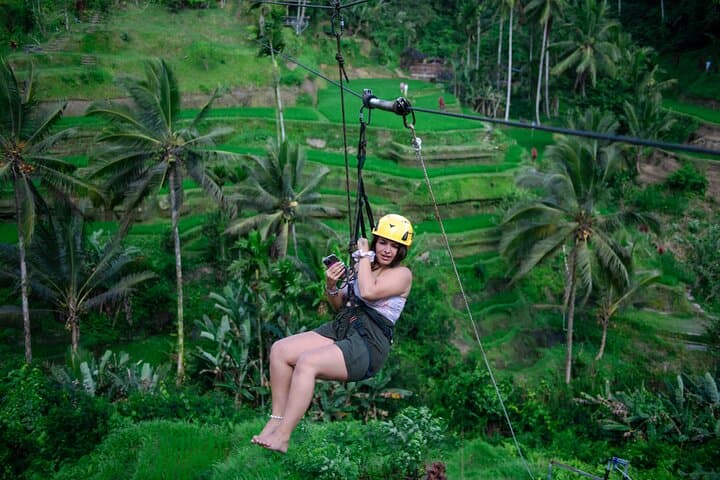

On a humid morning above Ubud, the air smells of wet earth and sweet rice shoots. Platforms built from bamboo and timber perch at the lip of terraced fields; guides check harnesses, nod, and the group steps forward. A soft breeze tugs at sarongs and camera straps as people lean into a 13‑meter jungle swing that launches them over the stepped green—then clip into a zipline that hums across paddies and gullies, carrying riders low over irrigation channels and high above the folds of the valley.
On a humid morning above Ubud, the air smells of wet earth and sweet rice shoots. Platforms built from bamboo and timber perch at the lip of terraced fields; guides check harnesses, nod, and the group steps forward. A soft breeze tugs at sarongs and camera straps as people lean into a 13‑meter jungle swing that launches them over the stepped green—then clip into a zipline that hums across paddies and gullies, carrying riders low over irrigation channels and high above the folds of the valley.
The landscape you fly over is shaped by volcanic soils and a water law called subak, a communal irrigation system that has governed Balinese rice culture for centuries. The terraces here are carved into a volcanic shoulder; their edges hold water like mirrors and channel it down by gravity to each small plot. The zipline operators have placed their platforms to maximize views of that engineered geometry—rows of rice become a kind of living map, and the guides are as likely to explain the irrigation as they are to cinch your helmet.
Culturally, rice is not just a crop in Bali; it is central to ritual life. Offerings and temples sit at fields’ edges; farmers follow seasonal cycles that have remained consistent despite tourism. Geologically, the valley owes its fertility to repeated eruptions from the central volcanoes of Bali, creating the deep, humus‑rich soils that make these terraces so vivid.
Practical nuts and bolts: the tour is a half‑day (about six hours), includes hotel pickup and drop‑off, bottled water, safety equipment, and a post‑activity coffee and tea tasting. There’s a recommended swim stop at Ulu Petanu Waterfall to rinse off and cool down; bring a towel and a change of clothes. Weight limits for the zipline run from 40 kg (88 lbs) to 100 kg (220 lbs), and children must meet minimum age/weight rules. The operator provides instruction and safety briefings; pay attention, use closed‑toe shoes for approaches, and secure loose items before launching.
Timing matters: mornings are cooler and quieter; late afternoons offer warmer light but can be busier. If the sky is heavy with rain, platforms get slippery—ask about cancellation or rescheduling. After the adrenaline, the coffee tasting is a calm denouement: local brews and herbal teas that point back to the valley’s agricultural rhythms.
For travelers, this half‑day combo delivers a compact mix—action, landscape, and cultural context—without a full day’s commitment. It’s a practical way to see Ubud’s terraces from motion instead of from a roadside viewpoint: the rice seems to move with you, the water daring you to look down, and the valley pushes you forward toward the next run and the cool pool of a waterfall.