THE ADVENTURE COLLECTIVE® · Independent discovery and booking for outdoor travel

Cover Athens’ essentials in two hours with a local guide who balances top sights and off-the-beaten-path lanes. Ideal for first-time visitors who want context, tips, and quick orientation before deeper exploration.
Cover Athens’ essentials in two hours with a local guide who balances top sights and off-the-beaten-path lanes. Ideal for first-time visitors who want context, tips, and quick orientation before deeper exploration.
You step into a narrow street where sunlight slants across pale marble and the city smells faintly of roasting coffee and lemon trees. In two hours a local guide threads history into the present: Byzantine churches crouch beside neoclassical facades, while the Acropolis watches like an old ruler on its rocky outcrop.
Verified experiences and guided adventures in the surrounding area.
You step into a narrow street where sunlight slants across pale marble and the city smells faintly of roasting coffee and lemon trees. In two hours a local guide threads history into the present: Byzantine churches crouch beside neoclassical facades, while the Acropolis watches like an old ruler on its rocky outcrop.
The route typically winds through Plaka’s stepped lanes and the micro-neighborhood of Anafiotika clinging to the Acropolis slope. Geology peeks through in the Acropolis’s limestone and Pentelic marble—materials quarried for millennia and scored by weather. Culture here is tactile: taverna chatter, scooters negotiating alleys, and shopkeepers who remember family recipes. The modern city grew around ancient foundations; every cobble and column has been repurposed across eras, from classical democracy to Ottoman trade to today’s tourism pulse.
Practical notes: expect 2 hours of steady walking on uneven stone and occasional stair sections; the pace is conversational but continuous. Mornings are best for cooler light and fewer crowds; late afternoons offer golden tones on the Parthenon. Bring low-profile, grippy shoes, a refillable water bottle, and a light layer for coastal breezes. Photography stops are frequent but timed—arrive five minutes early to the meeting point and carry a credit card or small cash for quick purchases.
This short tour is an efficient primer: it orients you to Athens’ top sights and hidden turns while arming you with local tips to extend your day on foot or by metro.
moderate.
2 hours.
Light-to-moderate fitness for walking on uneven stone and stair sections; able to stand and walk for the tour length.
Meeting points vary by operator but are commonly near Syntagma Square or the base of Plaka; confirm exact location and arrive 5–10 minutes early.
Yes for most kids and active older adults—expect stairs and uneven surfaces; contact the operator if mobility assistance is required.
This specific small-group tour is typically in English; other languages may be available on request—check booking details.
Large luggage is not advised on a short walking tour; bring a small bag only—left-luggage options are available near central stations.
Athens layers classical ruins over Byzantine and Ottoman neighborhoods; Plaka developed around the slopes of the Acropolis during the Ottoman period and later became a 19th-century cultural district.
Tour routes emphasize staying on paved paths and not climbing on monuments; support local businesses to keep neighborhoods economically viable and reduce pressure on archaeological sites.
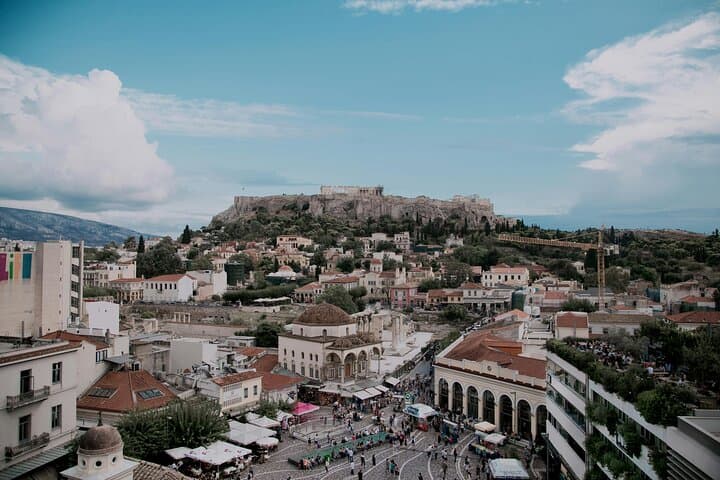
You step into a narrow street where sunlight slants across pale marble and the city smells faintly of roasting coffee and lemon trees. In two hours a local guide threads history into the present: Byzantine churches crouch beside neoclassical facades, while the Acropolis watches like an old ruler on its rocky outcrop.
You step into a narrow street where sunlight slants across pale marble and the city smells faintly of roasting coffee and lemon trees. In two hours a local guide threads history into the present: Byzantine churches crouch beside neoclassical facades, while the Acropolis watches like an old ruler on its rocky outcrop.
The route typically winds through Plaka’s stepped lanes and the micro-neighborhood of Anafiotika clinging to the Acropolis slope. Geology peeks through in the Acropolis’s limestone and Pentelic marble—materials quarried for millennia and scored by weather. Culture here is tactile: taverna chatter, scooters negotiating alleys, and shopkeepers who remember family recipes. The modern city grew around ancient foundations; every cobble and column has been repurposed across eras, from classical democracy to Ottoman trade to today’s tourism pulse.
Practical notes: expect 2 hours of steady walking on uneven stone and occasional stair sections; the pace is conversational but continuous. Mornings are best for cooler light and fewer crowds; late afternoons offer golden tones on the Parthenon. Bring low-profile, grippy shoes, a refillable water bottle, and a light layer for coastal breezes. Photography stops are frequent but timed—arrive five minutes early to the meeting point and carry a credit card or small cash for quick purchases.
This short tour is an efficient primer: it orients you to Athens’ top sights and hidden turns while arming you with local tips to extend your day on foot or by metro.