THE ADVENTURE COLLECTIVE® · Independent discovery and booking for outdoor travel

Two days of desert drama and rock-cut civilization: a private route from the Wadi Arava border through Wadi Rum’s red dunes to Petra’s carved façades. Expect rugged 4x4 tracks, a guided Petra walk and practical border logistics.
Two days of desert drama and rock-cut civilization: a private route from the Wadi Arava border through Wadi Rum’s red dunes to Petra’s carved façades. Expect rugged 4x4 tracks, a guided Petra walk and practical border logistics.
You step off the dusty Jordanian border terminal and into a different rhythm: the road hums, the air tastes faintly mineral, and the desert ahead seems to wait with a wide, patient breath. In under an hour the pavement gives way to sand and stone, and Wadi Rum’s rust-colored walls rise like pages of a weathered book. A Bedouin driver eases the 4x4 along tracks, and the desert begins to reveal itself—towering granite ribs, soft dunes shaped by wind, and faint Nabatean inscriptions that glance back at you from cliff faces.
Verified experiences and guided adventures in the surrounding area.
Operated by Petra Nights Tours · Wadi Rum, Ma'an Governorate
You step off the dusty Jordanian border terminal and into a different rhythm: the road hums, the air tastes faintly mineral, and the desert ahead seems to wait with a wide, patient breath. In under an hour the pavement gives way to sand and stone, and Wadi Rum’s rust-colored walls rise like pages of a weathered book. A Bedouin driver eases the 4x4 along tracks, and the desert begins to reveal itself—towering granite ribs, soft dunes shaped by wind, and faint Nabatean inscriptions that glance back at you from cliff faces.
Wadi Rum is the opening act—3 hours of Jeep corridors, canyons and moonscape vistas. Drivers know narrow ravines where light pours through like a spotlight; they’ll steer toward ruins and petroglyphs, and point out where Lawrence of Arabia once crossed the dunes. That evening most travelers sleep in a desert camp, the stars exact and low, the wind narrating small migrations across the sand.
Day two is a shift in scale. A 1.5-hour drive brings you to Petra, the rose-red city carved by the Nabateans into sandstone. The approach through the Siq, a tight, shadowed slot canyon, is quiet and cinematic: the altar of light appears, then the Treasury’s façade—ornamented, monumental, and unexpectedly intimate. A local guide escorts you along the Street of Facades, past the Royal Tombs and amphitheater, explaining water-engineering feats, trade routes and the city’s slow surrender to the desert.
Geology and history sit cheek by jowl here: sandstone strata yield sculpted columns and swirling bands of ochre; Nabatean ingenuity carved cisterns and channels to harvest rare rain. Culturally, both sites remain close to Bedouin life—camp hosts and local guides still keep traditional rhythms alive while catering to modern travelers.
Practicalities: expect several kilometers of walking in Petra—uneven rock, occasional steps, elevation changes of a few hundred meters if you climb to viewpoints. Wadi Rum’s 4x4s are older models without air conditioning; drives can be bumpy. Border logistics require full passport details in advance and note the Arava crossing is closed on certain holidays. Bring good walking shoes, sun protection, and a small daypack; hydrate often—the desert asks for respect.
This two-day loop compresses Jordan’s theatrical landscapes into a sharp, manageable itinerary: cinematic desert, millennia-old stonework, and enough local color to make the transition between sites feel seamless. It’s an essential primer for first-time visitors who want intensity over itinerary, and who don’t mind trading leisurely pace for concentrated wonder.
moderate.
2 days.
Moderate fitness; able to walk several kilometers over uneven terrain and tolerate vehicle transfers.
Visa rules depend on nationality—check Jordan’s embassy guidance in advance and have passport data ready for booking.
Expect several kilometers and uneven terrain; the guided portion is about 2–3 hours with additional free time to explore.
Jeep rides are common but bumpy; infant seats are available per the provider, and assess comfort for young children.
Yes—this tour drops you at your pre-booked camp on night one; confirm camp accessibility and any required 4x4 transfers.
Not usually—many Wadi Rum 4x4s are older models without A/C; plan for dust and heat.
Not recommended for travelers with heart problems or pregnant guests due to physical exertion and remote conditions.
Petra was the Nabatean capital (1st century BCE–1st century CE) and a hub on incense and spice trade routes; Wadi Rum preserves Thamudic and Nabatean rock art and Bedouin heritage.
Both sites face erosion and visitor pressure; stick to marked paths, avoid touching carved surfaces, and support locally run camps and guides.
Petra Nights Tours operates guided outdoor trips and adventures with an emphasis on safety, stewardship, and memorable experiences.


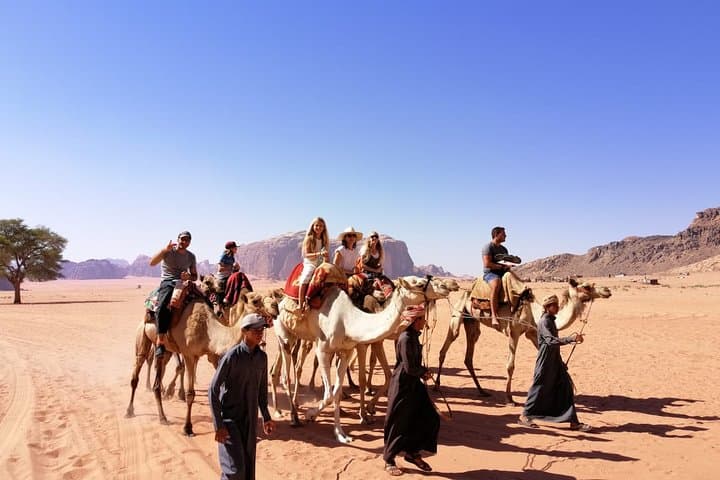
You step off the dusty Jordanian border terminal and into a different rhythm: the road hums, the air tastes faintly mineral, and the desert ahead seems to wait with a wide, patient breath. In under an hour the pavement gives way to sand and stone, and Wadi Rum’s rust-colored walls rise like pages of a weathered book. A Bedouin driver eases the 4x4 along tracks, and the desert begins to reveal itself—towering granite ribs, soft dunes shaped by wind, and faint Nabatean inscriptions that glance back at you from cliff faces.
You step off the dusty Jordanian border terminal and into a different rhythm: the road hums, the air tastes faintly mineral, and the desert ahead seems to wait with a wide, patient breath. In under an hour the pavement gives way to sand and stone, and Wadi Rum’s rust-colored walls rise like pages of a weathered book. A Bedouin driver eases the 4x4 along tracks, and the desert begins to reveal itself—towering granite ribs, soft dunes shaped by wind, and faint Nabatean inscriptions that glance back at you from cliff faces.
Wadi Rum is the opening act—3 hours of Jeep corridors, canyons and moonscape vistas. Drivers know narrow ravines where light pours through like a spotlight; they’ll steer toward ruins and petroglyphs, and point out where Lawrence of Arabia once crossed the dunes. That evening most travelers sleep in a desert camp, the stars exact and low, the wind narrating small migrations across the sand.
Day two is a shift in scale. A 1.5-hour drive brings you to Petra, the rose-red city carved by the Nabateans into sandstone. The approach through the Siq, a tight, shadowed slot canyon, is quiet and cinematic: the altar of light appears, then the Treasury’s façade—ornamented, monumental, and unexpectedly intimate. A local guide escorts you along the Street of Facades, past the Royal Tombs and amphitheater, explaining water-engineering feats, trade routes and the city’s slow surrender to the desert.
Geology and history sit cheek by jowl here: sandstone strata yield sculpted columns and swirling bands of ochre; Nabatean ingenuity carved cisterns and channels to harvest rare rain. Culturally, both sites remain close to Bedouin life—camp hosts and local guides still keep traditional rhythms alive while catering to modern travelers.
Practicalities: expect several kilometers of walking in Petra—uneven rock, occasional steps, elevation changes of a few hundred meters if you climb to viewpoints. Wadi Rum’s 4x4s are older models without air conditioning; drives can be bumpy. Border logistics require full passport details in advance and note the Arava crossing is closed on certain holidays. Bring good walking shoes, sun protection, and a small daypack; hydrate often—the desert asks for respect.
This two-day loop compresses Jordan’s theatrical landscapes into a sharp, manageable itinerary: cinematic desert, millennia-old stonework, and enough local color to make the transition between sites feel seamless. It’s an essential primer for first-time visitors who want intensity over itinerary, and who don’t mind trading leisurely pace for concentrated wonder.