THE ADVENTURE COLLECTIVE® · Independent discovery and booking for outdoor travel

Two days of fast-moving scenery from Tbilisi to Borjomi, Vardzia and the Kazbegi foothills—historic caves, mountain viewpoints, and mineral springs combine into a compact, accessible eastern Georgia circuit. Expect long drives, short hikes, and high-altitude photo stops.
Two days of fast-moving scenery from Tbilisi to Borjomi, Vardzia and the Kazbegi foothills—historic caves, mountain viewpoints, and mineral springs combine into a compact, accessible eastern Georgia circuit. Expect long drives, short hikes, and high-altitude photo stops.
A low sun slides over Tbilisi as a coach eases onto the highway and the city gives way to river gorges and slopes lined with birch and oak. Within hours the road climbs; water—dark, abrupt, and cold—cuts through rock, and viewpoints open on the Zhinvali reservoir where the Caucasus begins to assert itself.
Verified experiences and guided adventures in the surrounding area.
Operated by Budget Georgia · Tbilisi, Tbilisi
A low sun slides over Tbilisi as a coach eases onto the highway and the city gives way to river gorges and slopes lined with birch and oak. Within hours the road climbs; water—dark, abrupt, and cold—cuts through rock, and viewpoints open on the Zhinvali reservoir where the Caucasus begins to assert itself.
The route threads through layered history: Borjomi’s mineral springs, tapped since the Russian imperial era, still bubble into public fountains; Rabati Castle in Akhaltsikhe reworks medieval masonry with Ottoman and Georgian layers; then Vardzia’s cliff-cut dwellings reveal masonry carved into volcanic tuff in the 12th century. Geologically the region is young—folded by the collision of the Arabian and Eurasian plates—and that uplift creates the raw ridgelines you’ll photograph from Gudauri and the Kazbegi approaches.
Culturally the trip offers quick, concentrated lessons in Georgian hospitality: shared bread, local cheese, and the cadence of a supra explained by a guide. Travelers will cross elevations from roughly 700–2,170 m (Gergeti Trinity Church) and trade long corridor drives for short walks and viewpoint stops.
Practical notes: expect 2 long travel days with multiple short hikes and steps at historic sites; road surfaces can be smooth asphalt or rough mountain sections—motion-sick travelers should plan accordingly. Dress in layers for alpine wind and sun, bring sturdy footwear for uneven stone and cave passages, and carry water—mountain air and dry valleys dehydrate faster than you think. Photography windows favor morning and late afternoon light; mid-day can be busy at popular sites.
easy.
2 days (approx. 8–10 hours per day including travel).
Suitable for travelers in average physical condition who can manage short walks, stairs, and brief alpine climbs.
Expect multiple driving segments of about 2–4 hours between stops; the itinerary prioritizes scenic viewpoints and short on-foot exploration.
This tour’s itinerary notes admission not included for many sites; check with the operator ahead of time for exact inclusion details.
The tour is listed as physically easy and suitable for all fitness levels, but some sites have stairs and uneven terrain—consider mobility limitations.
No permits are normally required; standard day-hike gear and clothing for variable mountain weather are sufficient.
The region bears layered rule—medieval Georgian kingdoms, Mongol raids, Ottoman influence, and 19th-century Russian imperial development—which shaped castles, churches, and fortress towns.
Visitor impact is concentrated at caves and castles—stay on marked paths, avoid touching frescoes, and support local guides who practice low-impact touring.
Budget Georgia operates guided outdoor trips and adventures with an emphasis on safety, stewardship, and memorable experiences.
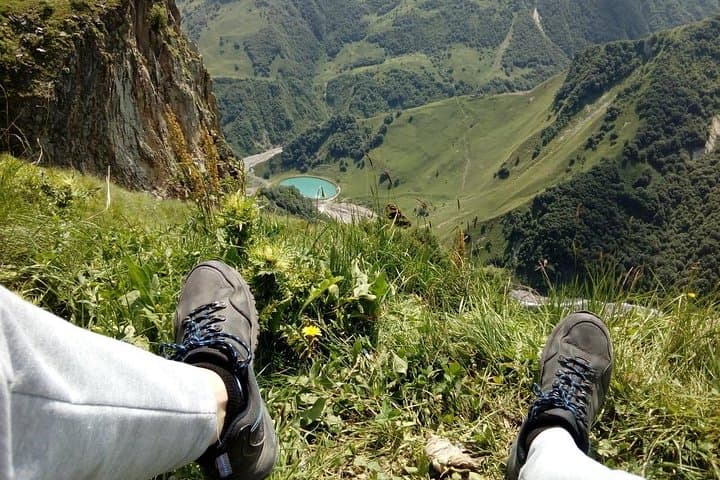


A low sun slides over Tbilisi as a coach eases onto the highway and the city gives way to river gorges and slopes lined with birch and oak. Within hours the road climbs; water—dark, abrupt, and cold—cuts through rock, and viewpoints open on the Zhinvali reservoir where the Caucasus begins to assert itself.
A low sun slides over Tbilisi as a coach eases onto the highway and the city gives way to river gorges and slopes lined with birch and oak. Within hours the road climbs; water—dark, abrupt, and cold—cuts through rock, and viewpoints open on the Zhinvali reservoir where the Caucasus begins to assert itself.
The route threads through layered history: Borjomi’s mineral springs, tapped since the Russian imperial era, still bubble into public fountains; Rabati Castle in Akhaltsikhe reworks medieval masonry with Ottoman and Georgian layers; then Vardzia’s cliff-cut dwellings reveal masonry carved into volcanic tuff in the 12th century. Geologically the region is young—folded by the collision of the Arabian and Eurasian plates—and that uplift creates the raw ridgelines you’ll photograph from Gudauri and the Kazbegi approaches.
Culturally the trip offers quick, concentrated lessons in Georgian hospitality: shared bread, local cheese, and the cadence of a supra explained by a guide. Travelers will cross elevations from roughly 700–2,170 m (Gergeti Trinity Church) and trade long corridor drives for short walks and viewpoint stops.
Practical notes: expect 2 long travel days with multiple short hikes and steps at historic sites; road surfaces can be smooth asphalt or rough mountain sections—motion-sick travelers should plan accordingly. Dress in layers for alpine wind and sun, bring sturdy footwear for uneven stone and cave passages, and carry water—mountain air and dry valleys dehydrate faster than you think. Photography windows favor morning and late afternoon light; mid-day can be busy at popular sites.