THE ADVENTURE COLLECTIVE® · Independent discovery and booking for outdoor travel

Two days in Egypt condense millennia: Giza’s pyramids, Saqqara’s Step Pyramid and Dahshur’s early experiments, then a coastal sweep through Alexandria’s Roman and Hellenistic sites. This private tour pairs airport transfers with a local Egyptology guide to make the most of a short stay.
Two days in Egypt condense millennia: Giza’s pyramids, Saqqara’s Step Pyramid and Dahshur’s early experiments, then a coastal sweep through Alexandria’s Roman and Hellenistic sites. This private tour pairs airport transfers with a local Egyptology guide to make the most of a short stay.
You step out of the airport into Cairo’s dry, bright air and the city presses in: honking cars, call to prayer, and the jagged silhouette of ancient stone on the horizon. Day one sends you west across the Nile to the Giza Plateau where the Great Pyramid and Sphinx loom not as relics but as physical challenges of scale — stone faces that have weathered four and a half millennia.
Verified experiences and guided adventures in the surrounding area.
Operated by Egypt Lifetime Tours · Cairo, Cairo Governorate
You step out of the airport into Cairo’s dry, bright air and the city presses in: honking cars, call to prayer, and the jagged silhouette of ancient stone on the horizon. Day one sends you west across the Nile to the Giza Plateau where the Great Pyramid and Sphinx loom not as relics but as physical challenges of scale — stone faces that have weathered four and a half millennia.
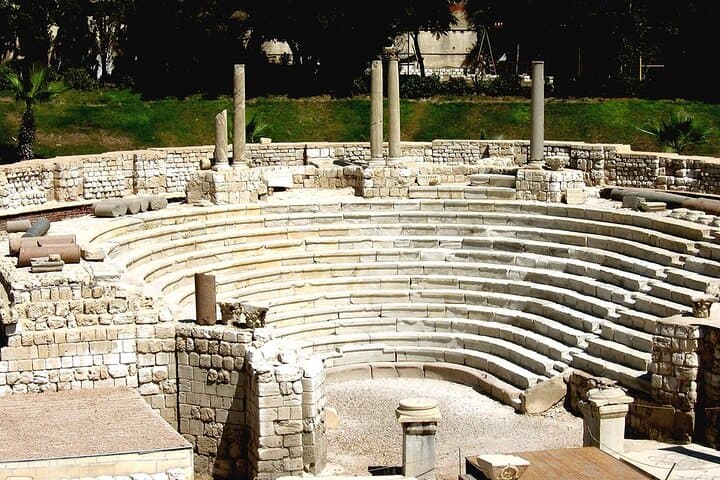
The route threads history: Saqqara’s Step Pyramid (c. 4,800 years old) shows the evolution from mastaba to pyramid, while Dahshur’s Bent and Red Pyramids reveal experiments in angle and technique. Geology is obvious underfoot — compacted desert limestone and wind-polished blocks that demand steady footing. On day two a 220 km drive north delivers the cool salt air of Alexandria, founded by Alexander the Great in 331 BCE; here Roman theaters, catacombs and the modern Bibliotheca Alexandrina recall the city’s layered past and its lost Pharos lighthouse.
Expect long walks on uneven stone, stairs down into catacombs, and open, sunny plateaus that push temperatures up quickly. Practicalities matter: airport pickup and two lunches are included, but entrance fees are paid separately; carry a card and some local cash. Wear supportive closed shoes, sun protection, and bring at least 1–2 liters of water per person for daytime touring. Pace yourself — mornings are cooler and best for the plateau; late afternoon light makes for the best photos. The itinerary balances fast-moving highlights with meaningful context from a licensed Egyptology guide, so you see both the architecture and the stories that built it.
moderate.
2 days (approx. 10–12 hours per day).
Able to walk several kilometers on uneven stone and climb stairs in hot conditions; comfortable with long days in open sun.
No, entrance fees are not included and should be paid on-site (the operator notes fees can be paid by card).
Yes, two lunches are included—one each day—though beverages are not included unless specified by the local provider.
Alexandria is about 220 km from Cairo; expect roughly 2.5–3.5 hours each way depending on traffic and stops.
The operator lists wheelchair accessibility, but many archaeological sites include uneven ground and stairs—check specific access needs with the provider before booking.
The Great Pyramid at Giza dates to around 2560 BC and represented the pinnacle of Old Kingdom engineering; Alexandria was founded in 331 BC and became the Hellenistic world’s intellectual hub, once home to the Pharos lighthouse.
These sites suffer wear from heavy visitation and environmental exposure; stick to marked paths, avoid touching reliefs and support licensed guides to ensure tourism benefits local conservation.
Egypt Lifetime Tours operates guided outdoor trips and adventures with an emphasis on safety, stewardship, and memorable experiences.
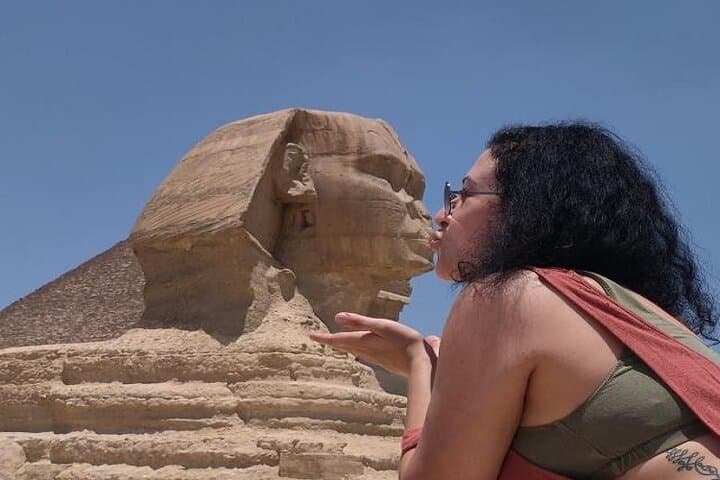


You step out of the airport into Cairo’s dry, bright air and the city presses in: honking cars, call to prayer, and the jagged silhouette of ancient stone on the horizon. Day one sends you west across the Nile to the Giza Plateau where the Great Pyramid and Sphinx loom not as relics but as physical challenges of scale — stone faces that have weathered four and a half millennia.
You step out of the airport into Cairo’s dry, bright air and the city presses in: honking cars, call to prayer, and the jagged silhouette of ancient stone on the horizon. Day one sends you west across the Nile to the Giza Plateau where the Great Pyramid and Sphinx loom not as relics but as physical challenges of scale — stone faces that have weathered four and a half millennia.
The route threads history: Saqqara’s Step Pyramid (c. 4,800 years old) shows the evolution from mastaba to pyramid, while Dahshur’s Bent and Red Pyramids reveal experiments in angle and technique. Geology is obvious underfoot — compacted desert limestone and wind-polished blocks that demand steady footing. On day two a 220 km drive north delivers the cool salt air of Alexandria, founded by Alexander the Great in 331 BCE; here Roman theaters, catacombs and the modern Bibliotheca Alexandrina recall the city’s layered past and its lost Pharos lighthouse.
Expect long walks on uneven stone, stairs down into catacombs, and open, sunny plateaus that push temperatures up quickly. Practicalities matter: airport pickup and two lunches are included, but entrance fees are paid separately; carry a card and some local cash. Wear supportive closed shoes, sun protection, and bring at least 1–2 liters of water per person for daytime touring. Pace yourself — mornings are cooler and best for the plateau; late afternoon light makes for the best photos. The itinerary balances fast-moving highlights with meaningful context from a licensed Egyptology guide, so you see both the architecture and the stories that built it.